Showing posts with label brazil. Show all posts

Saturday, March 2, 2013

Pterosaur Week: Anhanguera.

 One of the things I keep stressing in pterosaur entries is how darn weird they are. Seriously, there are a lot of relatively-untapped monsters in pterosaurs, even without making them into dragons. Plenty of them would make one release one's bowels in an untimely manner on sight.

Source.


This is one of those. Anhanguera is a Late Cretaceous pterosaur straight out of somebody's nightmare. Its name means "ancient devil," and rightfully so. It looks freaky. The species was found in Brazil, and thus got a Portuguese name. By pure coincidence, it also shares that name with a Brazilian highway and a few individuals.

Anhanguera, along with all other ornithocheirids, has one of the freakier faces seen in pterosaurs. The group is characterized by a slender bill with a wider tip. In Anhanguera's case, this tip had teeth splaying out in all directions. These were excellent for trapping flailing fish. The tip was also weighted with a crest on each piece. This makes it the rough equivalent of a spoonbill mixed with a fish-eating, flying death machine. Oh, and it wasn't the only one with a strange bill - just the only one called a devil.


Surprisingly, we have been able to glean quite a lot of information about how Anhanguera worked. Through presumably a lot of simulations, we have found that Anhanguera likely took off from the ground. It had a running start, then flapped to get into the air. The skeleton also has a keel for flight muscles, making powered flight like that even more likely.

Anhanguera is too weird to not make it into popular culture. Like most things this week, it has a Fossil Fighters counterpart in Guera. As a bizarre, more subtle reference, Birdramon's toothy beak also bears an uncanny resemblance to Anhanguera's jaws (or that of its relative, Ornithocheirus). Subtle? Perhaps, but tell me there isn't some pterosaur, here:

Tell me there ISN'T ornithocheirid in this thing.


"Bird dragon monster" indeed. Anhanguera or one of its relatives made for one nightmarish phoenix.

Thursday, February 7, 2013

Creature Feature: Irritator.

You are not misreading that header. It is not Pokemon Week again. There really is something with the simple name of "Irritator." Let us show you.

I'll show YOU irritating - try being DEAD for a couple million years! - from Wiki.


This is a dinosaur named Irritator challengeri. It was found in Brazil in 1996. Like other spinosaurids, it was either carnivorous or piscivorous - there's still a fair amount of debate on that regarding spinosaurids in general. It lived in the early Cretaceous, which means it did not quite coincide with Tyrannosaurus and a great amount of the most popular dinosaurs.

Before you mention that this sounds like Latin done by a moron who was trying to sound smart, no, it was made by scientists after racking their brains trying to figure out what exactly this thing was. It was first classified as a raptor for some very questionable reasons, including that the snout had been lengthened just to make the specimen more impressive. It might even be the same thing as Angaturama, another spinosaurid found in the same time and place. Irritating indeed.


Despite being named by scientists, Irritator was not discovered by scientists. They named it, but they were not the ones to dig the skull up. The skull - the only part we have - was found through the illegal fossil trade. As mentioned above, it was doctored to look more impressive, making scientists ball up paper in frustration. The good news? It's still the most complete spinosaurid skull today.


Now for what you really came to see: Irritator in the flesh. Contrary to its mildly-annoying name, Irritator was a beast. Imagine a crocodile walking on two legs. Now imagine that it weighs 2-3 tons and is 8 meters long from head to tip of the tail. Imagine that it had a neat-looking fin and could all but breathe underwater with its nostrils located towards the top and back of the jaw. That was Irritator, AKA "Jaws meets Jurassic Park."

Irritator has not had much love in popular culture. To its credit, however, the "Dinosaurs Alive!" attraction at King's Island starts with Irritator. It's hard to imagine a Vivosaur more trollicious than Dimorph in Fossil Fighters, but if Irritator ever made the cut, I'm sure he would live up to his name. Don't expect to see him as a Jurassic Park threat, though...at least, not with a name like that.

Tuesday, January 22, 2013

Creature Feature: Golden Lion Tamarin.

A rather interesting question came to me in the form of a fortune cookie: Which would you rather have as a pet: a pig or a monkey? Both are notably intelligent, messy, and carry diseases that can cross over into humans. It's a fair question; answer it below if you like.

Now, as anyone who follows this blog is aware, I am not the biggest fan of monkeys. My answer to that question would probably be the pig, hands-down, if one particular type of monkey did not exist:


It's called a golden lion tamarin (Leontopithecus rosalia) (or "golden marmoset" for those of you without any imagination). It can be found in the Brazilian forests along the east coast. This monkey has a diverse diet of fruit, leaves, insects and eggs. Basics done - you may d'aww now.

The golden lion tamarin really looks like a little lion. Although not predatory like a lion, this monkey does have a "mane" of elongated hair along the sides of its face. This color supposedly comes from the carotenoids in their diet, much like flamingo coloration being the result of eating crustaceans. The tamarin also has claws - a rarity in primates, with the notable exception of all other New World monkeys.


Golden lion tamarins are also monogamous. Like wolves, they have a social structure in which the top male and top female mate. They mate for life while everybody else doesn't get any. Aww, just in time for- wait, it's not Valentine's Day, yet. Never mind. 

Alas, the golden lion tamarin is highly endangered, and not because it's darn adorable. A good chunk of its habitat has been chipped away by deforestation. The lion tamarin is considered one of the more popular endangered species - enough so that one of the characters in Tokyo Mew Mew has a tamarin as her animal splice. That said, any attempts to get one as a pet would probably be illegal. Guess I'd pick the pig after all.

Saturday, July 21, 2012

Creature Feature: Pygmy Marmoset.

Monkeys are another group of animals that gets very little press on this blog. With a few rare exceptions, they were never really a favorite animal of mine. It's really about time we had another on this blog; even if I don't like them, I know that a lot of people find monkeys adorable.


...and this is one adorable monkey! It's a pygmy marmoset (Cebuella pygmaea), one of the smallest primates in existence! It is native to the rainforests of Brazil, Ecuador, and Peru, presumably existing to make the scientists there turn into piles of mush. It also has nicknames like "little lion" or "pocket monkey" in Portuguese. Yes, it's that cute.

Pygmy marmosets are the smallest monkeys in the world. They are only 14-16 centimeters long, excluding the tail (20cm). In American terms, this monkey does not even reach the six inch mark if you don't count the tail. Despite this, they are capable of jumping around 16 feet (5 meters) - quite a lot for a little monkey! The babies, umm...just look below. Really.

This pic says it all.


The pygmy marmoset feeds exclusively on tree gum. It gnaws holes in trees with its specialized teeth, then laps the resulting syrup out of the tree. It shares a habitat (and tree juice) with monkeys called Brown-mantled tamarins, who are far less cute. If the trees there run out of delicious sugar, the marmosets will move to sate their sugar cravings. Nature combined the cuteness of a monkey with a diet of nothing but sugar and shrunk it, just to make people squeal at the adorable furball; it's safe to say she hit a weak point.

Pygmy marmosets are very social creatures. They're born as twins, meaning that they've always got a sibling to keep them company. They communicate using every means possible, including scents and a variety of vocalizations.  They may even have the beginnings of language; certain calls are only used in certain situations, such as a particular trill used to communicate over long distances and a chitter if danger approaches. If confronted with a predator, they can and will mob it in an attempt to scare it away. Cute just got serious.

Hi! :D


Pet pygmy marmosets are a thing. This does not mean they are a good idea. The babies require feeding every two hours, you cannot keep just one marmoset, and they, like many monkeys, may throw feces at you. Most importantly, you need a permit to even own one legally. Just get a plushie  instead - it's much easier to take care of and will not get you arrested.

Saturday, June 9, 2012

Creature Feature: Neon Tetras.

At the Lit Fair today, one author who wrote a book about shapeshifters and other superpowers got into a convo with me about GloFish. She herself was a bio major at Northwestern, so she got a huge kick out of us now being able to make zebra danios in every color of the rainbow. She thought her son would get a kick out of them, too. Well, whatever it takes to possibly make glowing rats (or snakes!) into pets works, I suppose.


For those of us who aren't so keen on Frankenfish, there are neon tetras. Neon tetras are among the most popular and manageable aquarium fish around, along with being beautiful to boot. Most specimens in the U.S. are imported from Thailand or Hong Kong, but the fish is actually native to South America. This entry is just about the neon tetra Paracheirodon innesi - any other 'neon tetras' don't count, here.

Now, to be fair, neon tetras do not glow like GloFish. They instead have a bright blue, iridescent stripe running along their bodies. This evolved so that other neon tetras can recognize them in the darkwater rivers of Brazil, Peru, and Colombia.  The stripe and red marking actually become duller when the fish rests - a neat color-changing trick rarely seen on land. Still, this is probably as close as you're going to get to a 'natural' GloFish, especially if you're on a budget.  Buy a school of them; they'll be happier and more colorful that way.


Neon tetras are omnivorous. While they will do fine on flake food in captivity, some meatier things like brine shrimp are also recommended.  Some special pellet foods even contain supplements to enhance the tetras' natural coloration. Bear in mind that they'll still dull a little when stressed or tired. They may not be what most people think of when they hear "Omnivorous fish," but they won't be happy on fish flakes. They also get along well with other tetras and guppies. (Do your research, as usual.)

Although generally seen as a 'starter fish' for tropical fishkeeping, neon tetras have one nasty disease. It's simply called "Neon Tetra Disease" and is characterized by restlessness, loss of color, cysts, and difficulty swimming. Despite tetras being a very popular fish, there is no cure for the disease.  Since tetras are hard to breed (again, despite their popularity), you will likely have to dispose of all the tetras and buy more from Thailand if they get hit with NTD. Tetras are beautiful fish, but beauty is far from permanent.


Wednesday, June 6, 2012

"They Actually Eat That:" Arugula.

"Arugula?" Well, the name certainly sounds exotic enough. It's also called "rocket," which can cause some befuddlement on English-language menus. These look an awful lot like dandelions to Americans, but they definitely are not. Dandelions are an all-American plant and are totally different. :)


Arugula (eruca, rocket, or roqette elsewhere; Eruca sativa) is a plant native to the Mediterranean, ranging from Morocco to Turkey. It has been used in Mediterranean salads for ages. The taste of arugula spread as far as India in the East and has also been very popular in Brazil. Only recently, however, has it become common enough in the U.S. to make it onto grocery store shelves.

Arugula is particularly popular in Italy. The Romans have been using it as a garnish, salad, and aphrodisiac since the days of the empire. Down in the Gulf of Naples, they even make digestive liquor out of arugula. Oh, and since Italian pizzas are totally in right now, you'll be seeing a lot more of it. (Before you say that's redundant: Italy has several unique pizzas that the U.S. is in the process of butchering.)


Arugula has a strong flavor for a leafy veggie. Spinach has a flavor, too, but arugula's stronger.  It has been described as "peppery," or "like cress," which I suppose suffices for those who have never tried it, but in the end, arugula is arugula. Trust me, if your salad has arugula and you've tasted it once before, you'll know it's in there. It's distinct from every other green out there.

Arugula is rich in potassium and Vitamin D. It also has a lot if dietary fiber and protein, so if you've been trying to stay away from meat, look into it. Just bear in mind that this particular green veggie does have a flavor all its own. Try it on a freshly-baked pizza; you might like it. :)

Sunday, February 5, 2012

Creature Feature: Proboscis Bat.

Today is Super Bowl Sunday. Joy; this blog would have absolutely nothing to do with such a 'holiday' except maybe putting up a few interesting, rarely-seen swine. So, without further ado, here is something completely unrelated to football: A bat.


The proboscis bat (Rhynchonycteris naso) is native to Central and South America. It eats insects like most microbats. It is, however, eaten by the spider Argiope savignyi, so pick who you would root for in a fight wisely. They are usually seen near water in large groups.


Proboscis bats are so named for their long noses. Strange faces are not unknown in the bat world, but these mostly involve huge ears for better sonar reception. It's rare to have a bat with a face that looks like a tapir. I have not seen any information on why (the better to smell you with, my dear mosquito?) but if any bat-lovers can provide, I will gladly update this entry.

As if the nose was not enough, proboscis bats also have strange, wavy stripes down their backs. These stripes serve no known purpose other than to make too-curious bat enthusiasts scratch their heads. They could be for mating, but those stripes might not show up on sonar. Camouflage is the most likely possibility, seeing as they would make the little bat look a tiny bit more like a scrap of bark. Weirdly, these bats can be seen clinging to rocks in perfect single file- your mileage may vary on whether or not this disrupts their camouflage.


When night falls, the colony of proboscis bats flies up from that strange position and over a body of water. They feed at the same spot every night; it is always around water and Rainforest travelers should thank these bats; they're helping to keep the mosquitoes at bay. 

Saturday, October 1, 2011

Creature Feature: Land Planarians.

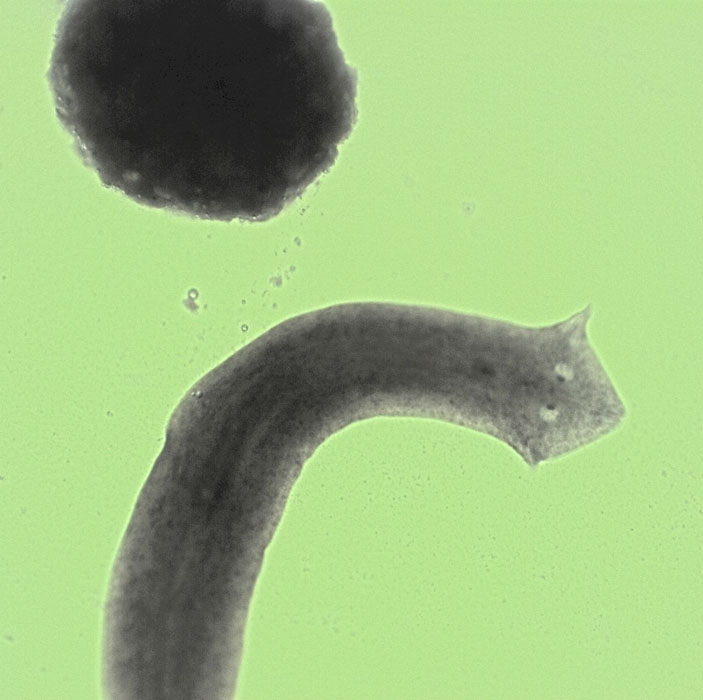
As you all (hopefully) well know, the authoress of this blog finds planaria to be among the cutest creatures in existence. Some people are freaked out by simple earthworms, but what's there not to like about cross-eyed flatworm? Heck, they even look like they're smiling if you catch them on a good day. Even without that luck, they are eternally cross-eyed, which is pretty amusing itself.

ETERNAL DERP.


Then there are land planarians. Yes, flatworms can go on land. Did you think you were safe just by avoiding the water?

Land planarians (family Geoplanidae) are a lot less cute than their water-bound counterparts. They look a lot more like nudibranchs that made it onto land. These worms come in trippy colors and are definitely predatory, eating any invertebrates smaller than themselves. They cannot live outside of rainforest regions. When they do have the right environ, they do well enough to cause problems to native invertebrate fauna.

TRIPPY! Credit is on the pic. :3
 

The way these land-bound planarians hunt is quite ingenious: Many invertebrates leave a slimy trail in their wakes as they squish along. As soon as night falls, the planaria come out and follow the chemical trails to find slugs, snails, and their favorite foods, earthworms. They are also cannibalistic, showing that even flatworms can be quite vicious!

Land planarians are so successful in the right environment that they have been used to curb invasive snail species in Hawaii and the Pacific Isles. On the flipside, they also threaten any native snails. Somehow, land planarians have caused issues in the British Isles - how they survive there, we do not know.

From Whatsthatbug.com. Go there.


Unfortunately, not many people are looking into these exotic worms. Despite their flashy colors and ecological significance, land planarians remain one of the least studied invertebrate groups in existence. This must be fixed.