Showing posts with label pterosaur. Show all posts

Sunday, March 3, 2013

Pterosaur Week: Why Pteranodon?

So, at the start of this theme week, we covered the rather casually tossed-around term, "pterodactyl." While it is technically a correct term for all pterosaurs, what bugs me about it is that the image that comes with the word "pterodactyl" is usually not a Pterodactylus. It is usually either some messy chimera of a pterosaur or, umm, this:

From this wonderful site here.


There is a 90% chance that this is exactly what came to mind after hearing the word "pterodactyl." While all pterosaurs are by definition pterodactylids, the pterosaur that comes to mind nine times out of ten is Pteranodon. That's the beaky, crested fellow. It was around during the Late Cretaceous (when all the cool dinosaurs except Stegosaurus lived) and has been found in much of North America. They were piscivores, likely behaving much like albatrosses. They were a lot bigger than albatrosses, but still not as big as Quetzalcoatlus.

There are two things that are really distinct about Pteranodon: the beak and the crest. Pteranodon's name means "toothless wing;"indeed, just like in a modern bird, there weren't any teeth in that beak. This does not stop artists from adding them in because rawr, dinosaur. That has to be their logic.

The crest is the most varied aspect in Pteranodon as a genus. Although other pterosaurs had crests, Pteranodon had amazingly prominent ones that curved back like the crest of a cockatoo- only immobile. Along with varying in size, the crests also varied with sex. Males had more prominent crests than females. That said, this pretty much cements Pteranodon's role as a visual creature - again, just like a modern bird.


But that's just the basic info. This entry will go one step further from the norm and try to answer the hidden question posed at the start of this week: why are all pterosaurs mentally lumped into the term "pterodactyl," anyways? Isn't that a lot like calling T-rex "tyrannosaurid" or Triceratops a "ceratopsid?" It's a weird, generic term (actually going back farther than the genus, but I digress) that applies uniquely to pterosaurs.

For starters, Pteranodon was a Pterodactylus before it was its own genus. There are a ton of complicated things involving naming dinosaurs. We could just say "the name stuck," but that still doesn't quite explain the popularity of Pteranodon versus, well...other pterodactyls. It may have been the biggest of its time, but if we Chicagoans can get used to calling the Sears Tower the Willis Tower, surely biology classes can update themselves accordingly.

Along with the name "pterodactyl" sticking, Pteranodon's popularity may well lie in how relateable it is. When marketing dinosaurs, one usually won't go for "OMG this thing is weird!" They want "just weird enough." It is easy for our minds to think things like lion = big carnivore, T-rex = bigger, meanier, scalier carnivore, rhino = big herbivore with horns, Triceratops = big herbivore with horns, and so on. Pteranodon is like a big, weird seabird of some sort - see how easy it is to make that parallel?   Tyrannosaurus rex and Triceratops are "just weird enough." So is Pteranodon; it's pretty tame as far as pterosaurs are concerned. (And yet, "Pteranodon" is a lot easier to say than "pterodactyl." Go figure.)

It also helps that there are many complete, in-tact specimens of Pteranodon. We more or less know what a Pteranodon looked like. T-Rex's image has undergone more revisions through the ages than Pteranodon has or will. Until Jurassic Park becomes real, we probably know all that we're going to know about Pteranodon aside from the odd new species to the genus. We know that they had sexual dimorphism, with males being larger than females and sporting larger crests. Yes, we literally know Pteranodon intimately.

I'm not even going to try to list every single pop culture reference Pteranodon has had. If a dinosaur thing has a pterosaur in it, there's a good chance it's Pteranodon or some creature modeled after it.  Instead, have a picture of Rodan, one of the most famous Pteranodon cosplayers ever:


As for the chimeric "pterodactyl" still running rampant? Just treat it as a dragon/wyvern. That's what it looks like, after all.

Saturday, March 2, 2013

Pterosaur Week: Anhanguera.

 One of the things I keep stressing in pterosaur entries is how darn weird they are. Seriously, there are a lot of relatively-untapped monsters in pterosaurs, even without making them into dragons. Plenty of them would make one release one's bowels in an untimely manner on sight.

Source.


This is one of those. Anhanguera is a Late Cretaceous pterosaur straight out of somebody's nightmare. Its name means "ancient devil," and rightfully so. It looks freaky. The species was found in Brazil, and thus got a Portuguese name. By pure coincidence, it also shares that name with a Brazilian highway and a few individuals.

Anhanguera, along with all other ornithocheirids, has one of the freakier faces seen in pterosaurs. The group is characterized by a slender bill with a wider tip. In Anhanguera's case, this tip had teeth splaying out in all directions. These were excellent for trapping flailing fish. The tip was also weighted with a crest on each piece. This makes it the rough equivalent of a spoonbill mixed with a fish-eating, flying death machine. Oh, and it wasn't the only one with a strange bill - just the only one called a devil.


Surprisingly, we have been able to glean quite a lot of information about how Anhanguera worked. Through presumably a lot of simulations, we have found that Anhanguera likely took off from the ground. It had a running start, then flapped to get into the air. The skeleton also has a keel for flight muscles, making powered flight like that even more likely.

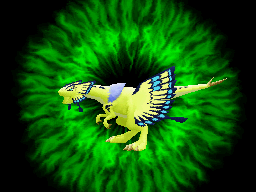
Anhanguera is too weird to not make it into popular culture. Like most things this week, it has a Fossil Fighters counterpart in Guera. As a bizarre, more subtle reference, Birdramon's toothy beak also bears an uncanny resemblance to Anhanguera's jaws (or that of its relative, Ornithocheirus). Subtle? Perhaps, but tell me there isn't some pterosaur, here:

Tell me there ISN'T ornithocheirid in this thing.


"Bird dragon monster" indeed. Anhanguera or one of its relatives made for one nightmarish phoenix.

Friday, March 1, 2013

Pterosaur Week: Quetzalcoatlus.

Sometimes, one wonders why certain dinosaurs get popular and others remain obscure. Tyrannosaurus rex was not the largest carnivorous dinosaur, for example. Pterosaurs also have an excellent example of this in Pteranodon, which was not the largest and not even the most dragonlike of the pterosaurs. It's a fairly simple bat-lizard-bird creature; just about the only outstanding thing outside from the very weird identity of "pterosaur" is the crest, which we will get to in Pteranodon's entry.

To make up for the gross misjudgement of popular culture...this:


That monster of a pterosaur is Quetzalcoatlus. Yes, that name does come from the Aztec serpent god, Quetzalcoatl. This massive flyer was around during the Late Cretaceous, sharing the land and skies with Pteranodon, T-Rex, and Triceratops. Nobody is really sure what it ate, but the current theory is that it behaved much like a stork.

Quetzalcoatlus has one trait that sets it apart from most "standard" pterosaurs - a long, stiff neck made of perfectly circular vertebrae. Attached to this long neck is a head with a long, pointed beak like the head of a spear. This is normal for the group of pterosaurs called azdharchids - literally, pterosaurs named after a Persian dragon. All of them have long, slender necks that make one wonder how they could fly at all. A fair amount of them are also crested. Impressive creatures, in any case.

So a guy, a giraffe, and a stork-lizard walk into a bar.


Azhdarchid pterosaurs, including Quetzalcoatlus, were the largest pterosaurs in existence. Quetzalcoatlus had a wingspan some 13 meters (~39 feet) across. The beak alone was 8 feet from tip to base. Although Quetzalcoatlus cannot truly claim the title of "biggest," it was pretty impressive. Instead of being compared to other flying birds in size, Quetzy is usually compared to giraffes owing to the long neck and possibly common quadrupedal posture. That's what we're looking at: a giant, flying giraffe that may well have killed things.

We do not know everything about Quetzalcoatlus, however.  We have height and width (including wingspan), but not weight. Most proportions were based off of either extant flying animals (birds, bats) or other pterosaurs (in Quetzy's case, other azhdarchids). This missing data is actually a problem for most pterosaurs, simply because they're so different from any other flying animal, past or present. There are also a few odd azhdarchid pterosaur fossils that may or may not be Quetzalcoatlus, leaving the status of "largest" slightly up for debate. For now, all we can say is "that was one big, alien-looking pterosaur." The largest pterosaur that we can say for sure, in fact.

Source.


Although Pteranodon and the not-pterodactyl remain the most common presentations of pterosaurs in popular media, Quetzalcoatlus has not gone unnoticed. As in the screenshot above, Quetzy remains popular on shows that involve a large variety of prehistoric life. One series gave it ultraviolet vision for a reason that didn't quite make sense. There's a lot of creative potential to be had!

If Pteranodon is popular solely because it's the closest thing we have to a flying dragon, take a look at scale size comparisons of Quetzalcoatlus and a human.If that isn't a wyvern waiting to happen, I don't know what is.

Tuesday, January 10, 2012

Creature Feature: Nyctosaurids.

Pterosaurs are my favorite prehistoric creatures ever, in part because they are so goshdarn strange. They could fly, a feature that has only evolved in vertebrates three separate times. They had fur. Many of them had crazy head. (The generic pterosaur with a crest, a long neck, and a long tail did not exist, by the way.) Pterosaurs were also the origin of wyverns, the basis for the ever-so-popular British dragon.


The pterosaur genus Nyctosaurus probably takes the cake for weirdness, even for pterosaurs.  They were relatively large pterosaurs with two-meter wingspans. All Nyctosaur specimens come from exactly one deposit (the Niobrara Formation) in Kansas, U.S.A. It lived in the Cretaceous like its relative Pteranodon, but it did not live nearly as long.

First off, what's in a name? "Nyctosaur" means "night lizard" or "bat lizard." By default, it and Stygimoloch should be mascots for a death metal band, or at least a brand of alcohol. Why Fossil Fighters made this particular pterosaur bright green instead of giving it a darker palette and a black wyvern super form is beyond me. That's right, I know you know Greek. Don't be scared to flaunt it!

 Part of the reason they got their goth-friendly name was because, unlike all other pterosaurs, Nyctosaurus had only one digit on each wing. This made its wing structure more like a bat's than like the wings of other pterosaurs. Most pterosaurs had four digits total on each wing: three claws and a long, thick wing digit. Nyctosaurus was all wing and no hand. We are not even sure how it landed.

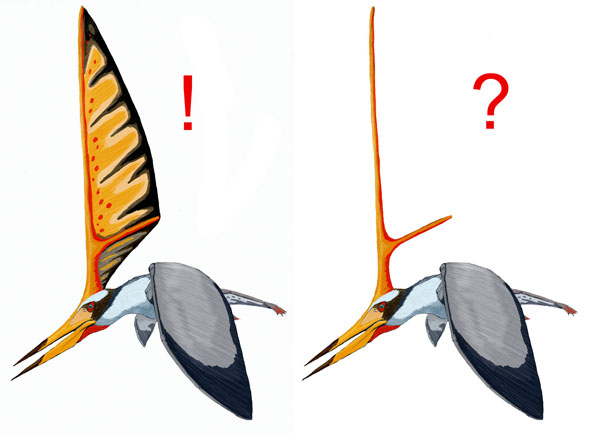
Pterosaurs in general have some pretty weird headgear, but Nyctosaurus puts them all to shame with its antler. Although not present in all nyctosaurid specimens, many skulls sport a crest about a foot high with a horizontal prong that's almost as long. The crest is roughly three times as big as the pterosaur's actual head. If this projection had a flap of skin between the two, it may have been used like a sail to steer the creature. There is also the possibility that, sail or no, it was used in courtship...which may explain why the nyctosaurids did not live very long.

This just LOOKS awkward.


Alas, Nyctosaurus lived for maybe a million years, and only in one location. Compared to other paleo-beasts, its life was short and sweet. Is anybody reading this really surprised? It's trippy to know that something like this existed, but there are a few aspects of Nyctosaurus that are impractical, to say the least. Darwinism: It works.

Monday, January 9, 2012

Bio-Art: Fossil Fighters.


Is that the most badass way to start a week of entries or what?

For the past week or so, I've been hooked on the sequel to the above game: Fossil Fighters Champions. I was a total addict for the first Fossil Fighters, too. In a nutshell, the whole premise of the game is digging up fossils, reviving superpowered dinosaurs, and then pitting them against each other in death matches. It's cracktastic.

If you are familiar with Japanese 'mon' series, two should immediately come to mind: Pokemon and Dinosaur King. Yes, this is another one of those infamous monster fighting games from Japan. If one fused the basic idea of Dinosaur King with the bright colors of Pokemon, one would get something like Fossil Fighters...but not quite.

If Tefflaceras is indeed a thing, I'm sure it didn't have wings like that. Also, Ancient Fairy Dragon just got competition.


Fossil Fighters blows both Pokemon and Dinosaur King out of the water. The stories for both games, although a bit predictable in places, are amazingly dark for kids' games (one involves David Icke's reptoids; another, necromancy)  and have nice little twists that I never saw coming. The element system is simple, the battle mechanics strategic (beware of rotating moves!), and the attacks, while a mite unrealistic (although dinosaurs just snapping at each other WOULD get old after a while) are pretty darn cool. The game was popular enough to spawn a sequel, Super Fossil Fighters/Fossil Fighters Champions, which featured a few new mechanics and online play.

The Vivosaur (we have to be fair: plesiosaurs, pterosaurs, and ancient mammals aren't dinosaurs) designs were among the best little Easter eggs of the game for me. The designs often have to do with the meaning of the dinosaur's name, which, as a linguist, is a real treat. For example, "Krona," a giant mosasaur, has Roman numerals on its body like a clock (think "chronological," "chronic," etc.). Coatlus, based off of Quetzalcoatlus and my favorite Vivosaur in the first game, is modeled after its namesake feathered serpent deity. Krypto, who only appears in FFC/Super, is modeled after Anubis, the Egyptian god of mummification (i.e. crypts). I could go on with this. There are a lot of in-jokes being ignored.

Crysosaurus has ice on it in this game? Noooo...really?


I cannot think of a better way for kids (and anyone else) to learn about ancient fauna. Aside from dinosaurs, the original Fossil Fighters also had prehistoric mammals like Andarch (Andrewsarchus) and the rather bizarre Jara (a tapejarid pterosaur). Fossil Fighters Champions has ventured into invertebrates, fish, and synapsids. There are several times I have gone "that's a thing?" at something in Fossil Fighters, only to go online and find out that, yes, things like slingshot deer actually existed. The series overall contains 90% real paleos and 10% "fun" creatures, such as chickens and aliens. Hardcore paleontologists will be impressed with you after playing this game - just don't ask if T.rex ever had a Harley-ish paintjob. The answer is no.

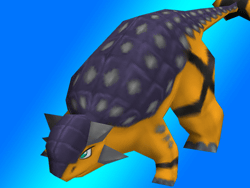
So, is it worth giving a try? If you've ever enjoyed Pokemon and/or loved dinosaurs, you betcha. The storylines are more carefully thought-out than anything Pokemon has ever concocted. Some of the dinosaurs are really creative; you'll laugh when you see the ankh on the Ankylosaurus. Effort and heart went into these games, and if they improve your hand-eye coordination and paleo knowledge, so much the better. The graphics are much better in FFC/Super, especially in the cut scenes, but there are some elements of the first game that I still love. If Pokemon falls to the ancient behemoths of Fossil Fighters, all I'll have to say is "it's about damn time." This is a must-see for any fan of video games with a love of prehistoric creatures.