If you live on the internet, the above phrase should be strikingly familiar to you. It comes from the extremely odd Flash movie called Charlie the Unicorn. The first of the series features a Liopleurodon sprawled across a giant rock. So, what is a Liopleurodon, anyways?
Liopleurodon is a genus of extinct, short-necked pleisiosaur (pliosaur) containing two species. These marine reptiles lived during the Jurassic Period, joining Stegosaurus as one of the few well-known archosaurs from that time frame. They have been found mostly in England and France, which you'd think would merit a more uppity-sounding name.
Liopleurodon was one of the big ones. The biggest specimen of L.ferox was roughly 21 feet long. People trying to cash in on Liopleurodon will tell you otherwise, sometimes replacing "feet" with "meters" to create a sea monster of gargantuan proportions. There were bigger pliosaurs. For some reason, the misconception of a giant Liopleurodon has stuck.
Pliosaurs, including Liopleurodon, had very powerful bites. Look at that huge jaw on a stocky neck - it's like a crocodile mixed with a pit bull. The exact opposite applies to plesiosaurs normally; Nessie, for example, has a tiny head on a long neck. One pliosaur was thought to be capable of biting through granite, but unfortunately, we have no means of testing. Liopleurodon is one of paleontology's sweethearts. It's a giant carnivore, and has been treated like one in series such as Walking With Dinosaurs (which got its size grossly wrong). There's also a neat bit with a Lio versus a Megalodon- a giant, extinct shark. Oh, and when Liopleurodon is not being a killer, it shows magical unicorns the way to candy mountain. Y'know, even though it didn't say anything.
You are not misreading that header. It is not Pokemon Week again. There really is something with the simple name of "Irritator." Let us show you.
I'll show YOU irritating - try being DEAD for a couple million years! - from Wiki.
This is a dinosaur named Irritator challengeri. It was found in Brazil in 1996. Like other spinosaurids, it was either carnivorous or piscivorous - there's still a fair amount of debate on that regarding spinosaurids in general. It lived in the early Cretaceous, which means it did not quite coincide with Tyrannosaurus and a great amount of the most popular dinosaurs.
Before you mention that this sounds like Latin done by a moron who was trying to sound smart, no, it was made by scientists after racking their brains trying to figure out what exactly this thing was. It was first classified as a raptor for some very questionable reasons, including that the snout had been lengthened just to make the specimen more impressive. It might even be the same thing as Angaturama, another spinosaurid found in the same time and place. Irritating indeed.
Despite being named by scientists, Irritator was not discovered by scientists. They named it, but they were not the ones to dig the skull up. The skull - the only part we have - was found through the illegal fossil trade. As mentioned above, it was doctored to look more impressive, making scientists ball up paper in frustration. The good news? It's still the most complete spinosaurid skull today.
Now for what you really came to see: Irritator in the flesh. Contrary to its mildly-annoying name, Irritator was a beast. Imagine a crocodile walking on two legs. Now imagine that it weighs 2-3 tons and is 8 meters long from head to tip of the tail. Imagine that it had a neat-looking fin and could all but breathe underwater with its nostrils located towards the top and back of the jaw. That was Irritator, AKA "Jaws meets Jurassic Park."
Irritator has not had much love in popular culture. To its credit, however, the "Dinosaurs Alive!" attraction at King's Island starts with Irritator. It's hard to imagine a Vivosaur more trollicious than Dimorph in Fossil Fighters, but if Irritator ever made the cut, I'm sure he would live up to his name. Don't expect to see him as a Jurassic Park threat, though...at least, not with a name like that.
Now this blog finally gets to live up to its once-relevant URL: tracking mythological monsters and seeing how they could be possible in real life. Luckily for this week, a lot of cryptoids are quite possible. That is what makes them cryptoids as opposed to acid nightmares. Cryptoids are simply animals whose existence has not yet been proven. Plausible animals, mind.
We're starting this week off with one of the best-known cryptids in existence: A lake monster. There are lake-dwelling leviathans found all over the world. It all probably loops back to our instinctive fear of the unknown and things dwelling in the icy cold depths in which the human eye cannot see. For those of us interested in sea monsters of more questionable existence than the dwellers of the lightless sea trenches, we have the Loch Ness Monster:
The Surgeon's Photograph: a confirmed fake, yet people still say it's real.
Nessie, for those of you living beneath rocks, is a lake monster native to Loch Ness, Scotland. The main evidence for its existence comes from numerous photographs and video footage. It is generally agreed that Nessie is a very long, semi-amphibious creature that spends most of its time in the lake. It is always described with a very long, slender neck and a body with anywhere from 1-3 humps.
Nessie as we know it was first spotted in the 1930's, although reports of water monsters in the River Ness date back to the 6th century. The first semi-reliable account of Nessie comes from the Spicers in 1933. The husband and wife were driving along the loch one night when they saw a creature with a neck as long as a Burmese Python and a body a little over a meter in height crossing in front of their vehicle.
Aside from photographs, eyewitness reports, and odd ripples, sonar hunts have been done in search of Nessie. One search in the December of 1954 yielded results 146 meters beneath the surface, keeping up with the boat. The other, a more formal study done by the Loch Ness Phenomena Investigation Bureau in 1968, picked up large creatures moving at approximately 12 mph. Another study done a year later came back with huge echoes. These are not fish, whatever they are.
The most obvious candidate for Nessie's true identity is some form of plesiosaur. Although plesiosaurs were not true dinosaurs, they did live around the same time, and describing them as "brontosaurus with flippers and sharp teeth" tends to simplify things. That said, they ate fish and other animals, not kelp, so if you do encounter a prehistoric beast in Loch Ness, approach with caution. They also had live babies, thus the lack of Nessie eggs.
To this day, we are not certain if there is anything in Loch Ness. There are even some people theorizing that Nessie died a while back. Before you get on my case about how the government likes to cover things up, bear in mind that lakes are enclosed bodies of water. It is generally easier to find things that live in such a small range. Granted, Loch Ness is fairly deep and there are a bunch of unexplored areas, including underwater caverns. If Nessie does exist, it is doing a decent job at hiding.
Whether it exists or not, Nessie remains very popular in media. The Simpsons and South Park both had episodes mentioning Nessie. The Pokemon Lapras supposedly had the name "Ness" before the dubbers went with "Lapras." Then, of course, there is the CGI-fest called Water Horse - Legend of the Deep - a story which combines the legend of Nessie with that of the kelpie, a magical Celtic creature. (J.K. Rowling suggested that, too.). Even if it isn't real, Nessie has made its mark.
Is that the most badass way to start a week of entries or what?
For the past week or so, I've been hooked on the sequel to the above game: Fossil Fighters Champions. I was a total addict for the first Fossil Fighters, too. In a nutshell, the whole premise of the game is digging up fossils, reviving superpowered dinosaurs, and then pitting them against each other in death matches. It's cracktastic.
If you are familiar with Japanese 'mon' series, two should immediately come to mind: Pokemon and Dinosaur King. Yes, this is another one of those infamous monster fighting games from Japan. If one fused the basic idea of Dinosaur King with the bright colors of Pokemon, one would get something like Fossil Fighters...but not quite.
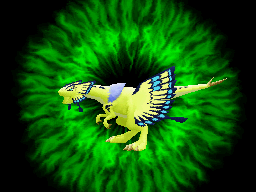
If Tefflaceras is indeed a thing, I'm sure it didn't have wings like that. Also, Ancient Fairy Dragon just got competition.
Fossil Fighters blows both Pokemon and Dinosaur King out of the water. The stories for both games, although a bit predictable in places, are amazingly dark for kids' games (one involves David Icke's reptoids; another, necromancy) and have nice little twists that I never saw coming. The element system is simple, the battle mechanics strategic (beware of rotating moves!), and the attacks, while a mite unrealistic (although dinosaurs just snapping at each other WOULD get old after a while) are pretty darn cool. The game was popular enough to spawn a sequel, Super Fossil Fighters/Fossil Fighters Champions, which featured a few new mechanics and online play.
The Vivosaur (we have to be fair: plesiosaurs, pterosaurs, and ancient mammals aren't dinosaurs) designs were among the best little Easter eggs of the game for me. The designs often have to do with the meaning of the dinosaur's name, which, as a linguist, is a real treat. For example, "Krona," a giant mosasaur, has Roman numerals on its body like a clock (think "chronological," "chronic," etc.). Coatlus, based off of Quetzalcoatlus and my favorite Vivosaur in the first game, is modeled after its namesake feathered serpent deity. Krypto, who only appears in FFC/Super, is modeled after Anubis, the Egyptian god of mummification (i.e. crypts). I could go on with this. There are a lot of in-jokes being ignored.
Crysosaurus has ice on it in this game? Noooo...really?
I cannot think of a better way for kids (and anyone else) to learn about ancient fauna. Aside from dinosaurs, the original Fossil Fighters also had prehistoric mammals likeAndarch (Andrewsarchus) and the rather bizarre Jara (a tapejarid pterosaur). Fossil Fighters Champions has ventured into invertebrates, fish, and synapsids. There are several times I have gone "that's a thing?" at something in Fossil Fighters, only to go online and find out that, yes, things like slingshot deer actually existed. The series overall contains 90% real paleos and 10% "fun" creatures, such as chickens and aliens. Hardcore paleontologists will be impressed with you after playing this game - just don't ask if T.rex ever had a Harley-ish paintjob. The answer is no.
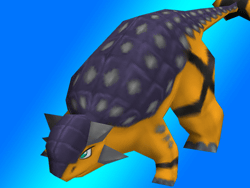
So, is it worth giving a try? If you've ever enjoyed Pokemon and/or loved dinosaurs, you betcha. The storylines are more carefully thought-out than anything Pokemon has ever concocted. Some of the dinosaurs are really creative; you'll laugh when you see the ankh on the Ankylosaurus. Effort and heart went into these games, and if they improve your hand-eye coordination and paleo knowledge, so much the better. The graphics are much better in FFC/Super, especially in the cut scenes, but there are some elements of the first game that I still love. If Pokemon falls to the ancient behemoths of Fossil Fighters, all I'll have to say is "it's about damn time." This is a must-see for any fan of video games with a love of prehistoric creatures.
Your resident lover of weird creatures, foods, etc. Likes going outside and looking for faeries in whatever form they choose to take. Is fascinated by parasites, worms, snakes, and anything with wings.