Showing posts with label salamanders. Show all posts

Sunday, March 16, 2014

NARBC Spring 2014!

Confession time: The reason I've not been updating as much is simply because I've been using my other Gmail account more. Having both switchable at the ready is nice. Never fear; more entries are coming, and they'll be juicier and meatier than ever before!

This entry focuses on North American Reptile Breeders' Convention (NARBC) Spring 2014 (Mar 15-6). I love these - there's so much cool stuff to take photos of! These went on my Twitter (@kurokarasu), so some people got a live feed of this entry as it was being made. ;) Most things are way out of my price range, but there are also some really great bargains that remind one how expensive pet stores can be. You'll also see a lot of species that one would not ordinarily see, like...


...yes, that's a hognose (H. nasicus). They're really cool, little rear-fanged snakes that are only mildly venomous. Nobody has ever died from a hognose bite; the worst that's happened is an allergic reaction. I've complained about how hard they are to get in IL before, but all one really needs is a permit.


So, how can these people even touch poison dart frogs? Captive-bred poison dart frogs aren't poisonous. The poison needs a few things before it can activate: bacteria on the frog, UV light, and a certain species of insect. We can take that last one away, at least, meaning that these frogs are OK to handle. Still, wash your hands after handling. These are mostly display frogs, anyways.


Someone on my Twitter commented that these ball pythons (P. regius) were on the pricey side. Um...no, not for ball python morphs, they are not. Here are a few non-slashed (or very slightly discounted) ball python morphs for your gawking pleasure:


Yes, I deliberately took photos of acid trips for you. Bear in mind that your regular ball pythons (usually "loser males") can be purchased for 30-50 bucks from a reptile specialty store.


A leucistic rainbow boa! A shame it looks almost like every other white snake on the market. If there was any of the species' namesake iridescence in these guys, the light was not showing it well.


This is a legless lizard. It was hard to get a good look at its eyes, but several other features made me believe it anyways. I'd like to think someone at a reptile convention would correct the owner if he was BS'ing us.


Hypo Burms! One of them was sold as I was walking around. People acted like they were having trouble getting rid of them. Given the abundance of laws surrounding giant snakes, I understand why.


I absolutely love dwarf reticulated pythons! This picture also happens to be for science; I'm working on a paper concerning what makes for a good domesticated animal, and dwarf retics are actually a really good candidate for a domesticated snake. I asked if they retained their legendary intelligence (by snake standards) even when dwarfs; the seller said yes. Regardless, it was amazing to hold one of these beauties.


Finally, my own acquisition: A GFP axolotl! This little guy (or girl, we don't know) glows green under black light, just like a GloFish. His/her working name is "Fran," short for both "Frankenstein" and "Francesca/Francisco"- we aren't sure, yet. Once the little salamander grows a bit, the males get bulges near the base of the tail. We shall see! 

Sunday, September 16, 2012

Creature Feature: Alpine Salamander.

Life has away of situating itself where we least expect it. There are bacteria in literally every environment.  Tiger mosquitoes came to us in tire shipments. Crested geckos went extinct for a few years, then suddenly reappeared. Frogs are surprisingly abundant in the Himalayas. The list goes on.


So why should we be surprised that there is a unique sort of salamander in the Alps? The alpine salamander (Salamandra atra) also happens to be completely black.  It is found at altitudes above 700 meters - pretty darn high up - in the Central, Eastern, and Dinaric Alps. For those of you bad with geography, that's Switzerland, Austria, Italy, France, and more obscure places like Bosnia and Croatia.

Let's put this in perspective. Salamanders, and amphibians in general, are usually associated with hotter climates. The Alps? The Alps are where the Sound of Music took place. There is a lot of snow in mountains in general. Personal experience has also taught me that altitude alone makes things cold. Discovering a neat salamander in such a place is, well, something to write about.

These salamanders are among the few wholly terrestrial amphibians. As if in rebellion against the name "amphibian," alpine salamanders spend their whole lives on land. Most salamanders mate, lay eggs, and spend part of their lives in the water. These do not, leading to a phrase you will never see anywhere else: pregnant salamander. Yep, these guys have live babies.

Belongs to Wikipedia. Still a cute salamander.


Baby alpine salamanders are born much like baby sharks or boas: they have an egg at one point, but it hatches inside the mother. The eggs eventually melt into a nutrient (vitelline) mass that all the embryos share. Like all babies, the salamanders also have gills in the 'womb' as they develop; in the case of these salamanders, however, the gills link them to the mother's blood supply. They've evolved a womb without really evolving a womb. Neat.

The freaky part: Alpine salamanders have a long gestation period, even by mammalian standards. It takes them 2-3 years to give birth, depending on subspecies. That makes the longest gestation period of any known animal. This is probably the reason that some subspecies of alpine salamander are critically endangered - that, and being amphibians. Not-endangered varieties aside, these salamanders are decently abundant and simply very good at not being seen.

Tuesday, June 12, 2012

Creature Feature: Chinese Giant Salamander.

All too often, endangered animals are glamorized. I've ranted about how the less-impressive endangered species get so little press before. Sometimes, however, this favoritism is wholly unjustified.


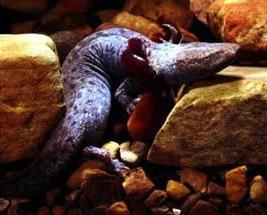
Hello, Chinese giant salamander (Andrias davidianus)! Hello, amphibian that's on the critical list! Hello, highly endangered animal that never seems to get any press outside of Year of the Frog!

There's a lot that you probably gathered from this thing's name already. It's a salamander, it's giant, and it's from the rocky streams and lakes in China. Its only living relatives are the Japanese giant salamander and the hellbender. It's so big that frogs and fish are on the menu as well as insects.


How big is big? A little over a meter. A yard and eight inches. You get the idea: this salamander is about the same length and weight as a medium-sized dog, if not a little longer. There are even reports of them once achieving lengths of 6 feet - roughly 2 meters. That's a lot of salamander. Hell, that's a record for amphibians.

Size is not the only thing unique about this river monster. Chinese giant salamanders are also among the few salamanders that make noise. They can whine, hiss, and bark; they may even sound like human babies to some Chinese people. They also have special sensory nodes that run from head to tail in compensation for awful eyesight. Neat.

The Chinese giant salamander is among the most underrated endangered species in the world. This particular point relates to something called the EDGE (Evolutionarily Distinct and Globally Endangered)  list. To get on this list, a species has to be more or less unique in every way - particularly from an evolutionary viewpoint, meaning that there are very few extant relatives to the species in question. It also has to be critically endangered to make it into the top ten.  This salamander is literally right beneath the Yangtze river dolphin (which recently went extinct as we know it) in that regard, holding the #2 position on the entire "world's most evolutionarily distinct and endangered animals" list. Read: Not the panda or any other cute mammal, but a giant salamander is among the most threatened, unique animals in the entire world. The panda is way farther down the list.

Aside from being an amphibian and therefore more susceptible to environmental changes by default, the Chinese giant salamander has a few other things making it go from just plain "endangered" to "critically endangered." China isn't just polluted - it's the most polluted nation in the world and, as evidenced by the extinction of the Yangtze river dolphin, has the most toxic waters as well. Oh, and this salamander's from China, meaning that it's also on the menu.  (When cobras and tigers aren't prominent threats, nothing is spared.) The Chinese giant salamander is one of those awesomely unique animals that has so many strikes against it that we're amazed it isn't extinct already.


Honestly? I'm sure someone, somewhere, could find a way to market the giant salamander. Salamanders tend to have natural, dopey "derp" looks on their faces that could be shilled for cute points. Last time we tried using a mammal to  encourage conservation of these waterways - a dolphin, no less - it failed. Time to milk the amphibian - so long as doing so doesn't cause more damage, of course.

Tuesday, July 19, 2011

Creature Feature: Hellbender.

Ohsnap. This blog has run out of weird creatures, so we now have to show you Satan. (Actually, I was about to repeat myself today. Good thing I caught that.) Break out your rosaries and holy water for the demonic beast called the hellbender:

AAAAAAAH- wait, what?
 

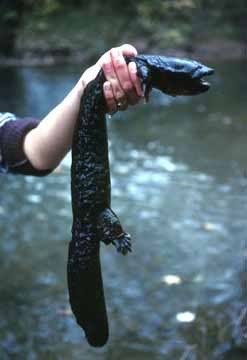
Or, if you prefer, the giant, salamander-ish turd called a hellbender (Cryptobranchus alleganiensis). Its native range is from New York to Arkansas and Kentucky. It lives only in swiftly-running water and chows down primarily on small fish and crayfish (which are considerably more hellish than this salamander). It is the biggest salamander in North America and third biggest in the entire world, growing up to two feet from head to tail.

The name 'hellbender' comes from being seen by religious nutjobs (which ALL colonists were, really). They didn't like how weird the thing looked in general. The folds on its side may also have reminded them of the tortures of the afterlife. Basically, it just looked too darn strange not to come from Hell. It has also been called "devil dog" and "mud-devil" because it looked THAT evil.

Hail derpy Satan!

The hellbender breathes through both gill slits and the rippling frill along the sides of its body. This frill is part of why the hellbender needs oxygenated, fast-running water to survive. This weird way of breathing limits its habitat options a lot. Hellbenders are very niche creatures.

The good news: Nobody has tried to steal that niche for over 65 million years. They have been living in running water since before we had a relative called Necrolemur (which should totally be a rock band). There were hellbenders in the Jurassic Period. A hellbender flipped the dinosaurs the bird after that giant meteor hit. A hellbender saw humans and went "Meh, as long as they don't touch my river." Since the hellbender has gone virtually unchanged for eons, it has been deemed a living fossil.

Put me down, whippersnapper!
 

Hellbenders are, unfortunately, disappearing. All amphibians are super-sensitive to environmental changes. Hellbenders take double the hit because they require a specific environment in which to live. Dams, pollution, and collection to see exactly WTF is going on with these guys all contribute to irreversible population loss. There's no need to make the hellbender's life Hell on Earth, too.

Thursday, September 16, 2010

Who's That Pokemon? - #258 MUDKIP


You will be assimilated. Seriously, though, this thing is cute enough to take over the internet.


Mudkip was one of the three Starter Pokemon from Ruby, Sapphire and Emerald (Gen III). It eventually evolves into the powerful Swampert, but as if that was not enough to warrant a massive Mudkip uprising, 4chan turned the cute little bugger into a meme.


Mudkip is classified as a "Mud Fish" Pokemon, leading one's mind to immediately think "mudskipper." Mudskippers (family Oxudercinae) are fish that walk through mud on their pectoral fins, meaning that they are among the few fish capable of living on land. They live in the tropics of Africa and India, although some species range all the way to southern Japan.


i herd u liek me?

Mudkip itself looks a lot more like a mudpuppy (family Proteidae), a four-legged salamander with frilly gills. Not only are they as cute as puppies, but they were once thought to make puppy-like sounds. Like axolotls, mudpuppies never lose their baby gills and are entirely aquatic. They live in the shallow waters of anywhere from Canada to the southern United States.

So...if u liek Mudkipz, go ahead and find a real one. You have quite a few options.


Including this.

Wednesday, September 1, 2010

Creature Feature: Sirens.

If you read that title and went "WTF, mermaids?!", there are a few things wrong with your way of thinking. The original sirens were avian and later became mermaid-like creatures. The mermaid idea has snuck into several scientific terms including a usually fatal syndrome that merges a human baby's legs together (Sirenomelia). Also, manatees and dugongs are in the order Sirenia; supposedly, some extremely drunk sailors thought that they resembled human women with piscine tails.


EXTREMELY drunk. I want what they had. Alas, this is NOT the most perverted manatee joke I could make.

Great though manatees may be, this is not about them. There are far lesser-known amphibians that are also called sirens (family Sirenidae). Unfortunately, they sing about as well as Britney Spears and are nowhere near as sexy.


On second thought, that tail doesn't look half bad...

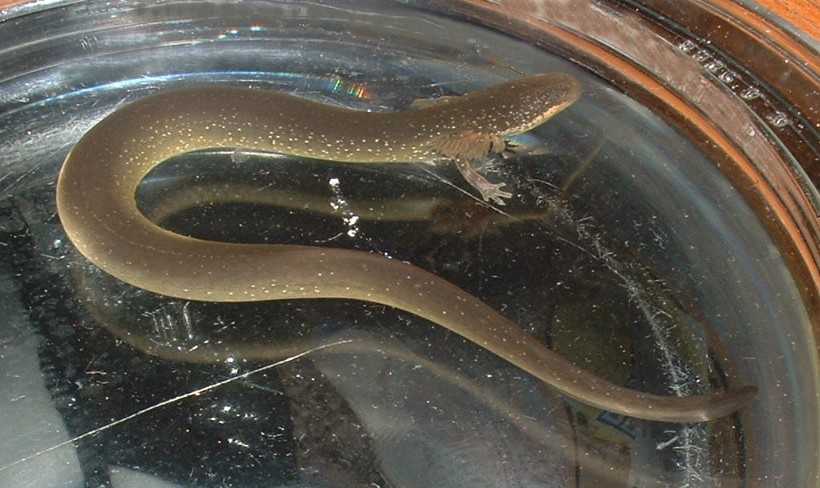
When was the last time you saw a tetrapod with two forelimbs that were definitely not fins and no hind limbs to speak of? If you said "naga porn," good for you; you have a VERY DIRTY MIND to which I can relate.

Sirens are native to the Southeastern U.S. and Mexico. Even though those limbs look stubby, like other salamanders, sirens can leave the water if the ground is wet enough. Similar to the axolotl, sirens retain their feathery juvenile gills. (Their juvenile gills are comparatively useless.)

Sirens can breathe through both gills and lungs. They are one of the most ancient groups of salamanders and boy does it show. They share the burrowing habits of lungfish. When they hunt, they inhale their prey. It's like a lamprey did it with a lizard.


More on sirens here. They're cool creatures!

...I should really do lampreys sometime.