Showing posts with label france. Show all posts

Wednesday, March 23, 2011

"They Actually Eat That:" Frogs.


"Frogs and snails and puppy dog tails..." That's what little boys are made of. We've done dog. We've done snails. Real-life Hypnotoad up there is not happy that frogs are, unfortunately, also fairly common food items around the world. No, we are not talking about a stupid dare in college to eat the frog on the bio dissection table. Frogs are haut cuisine in many, many places.

Frogs are often described as "tasting like chicken" (just like everything else) simply because they are closer to chickens than mammals on the evolutionary playing field. The meat of cold-blooded animals is also such that frog legs sometimes death-twitch while in the pan (or just with a little salt).


Eating frogs, particularly frog legs, has a link with French culture. If the French have touched a place, it has frog legs on the menu. Vietnam? Yep. Louisiana? Sure. France? Mais oui!


Several other places have frogs as food without French influence. China (surprised?) and Indonesia are also large consumers of frog meat. In China, frog legs are stir-fried; in Indonesia, frog legs are used in a soup called Swikee. Hell, most of the frogs eaten in France today were farmed in Indonesia.

Eating frogs has also been recorded in India, Spain, Greece, and a few places in California. In short, frogs are eaten just about everywhere in some way, shape or form. Maybe Kermit was right: It's not easy being a green frog.


Only Gaga wears them as clothing. We're pretty sure about that.


Next week: Just to prove that NOTHING is off the menu...dragons. And fortune-telling.

Wednesday, December 29, 2010

"They Actually Eat That:" Ortolan.

The French have some really weird cuisine. Most of it tastes good (y'know, unlike 'cuisine' in America, which is a death sentence if one can taste trans fats), but really, some of the things that France considers cuisine -as well as how said things are prepared- are enough to keep people off of meat and/or join PETA.

Ortolan's name does not immediately clue one in on what it is. That is, of course, unless one is French; the word "ortolan," deriving from the Latin word for "garden" ("hortus," see "horticulture") can refer to many species of bunting, a type of songbird similar to (but distinct from) finches.  The particular species used for Ortolan is Emberiza hortulana, simply called the "Ortolan" or "Ortolan Bunting."


They Actually Eat That?!

Take off an Ortolan's feathers and you get this:


Or, rather, catch the wild bird in a net, fatten it up overnight, then drown it in brandy and bake it for 5 minutes. Add a potato. Then you get that. The taste is often described as being a little gamey, like quail, but with bones and blood to go along with it. Ortolan is so good that the bird that is killed for it is protected by law due to overhunting and cannot be legally sold anywhere in Europe.


What? You think I'm just an American raging at Ortolan because it's different? Even the BBC - the British Broadcasting Company - had a complaint with this one. Argue all you like that it's just because they're British, too; part of the ritual of eating Ortolan involves covering one's face with a napkin to hide one's disgrace from God (among other explanations, including "nobody wants to see you eat a songbird"). You can't say that a dish is sane when God disapproves.


I can't see what you're doing beneath that napkin! 

This is the first time that one of my reviewed dishes has been considered unholy.  Illegal, sure; cruel, yes (factory farming is a LOT worse than Ortolan, as are lobster and ikizukuri); possibly an invention of Satan? That's a first. You don't have to be religious to agree with this one.

Wednesday, December 15, 2010

"They Actually Eat That:" Escargot.

Humans really are omnivores. Pica (i.e. eating random stuff) aside, there is almost nothing that our stomachs cannot handle. Numerous zoo exhibits have pointed out that, despite the fact that we should be eating leaves with all the other Great Apes, we have evolved systems to work with meat as part of our diets. Screw pigs and goats; humans should be used as the classic "eats anything" animal.


If you watch the video of a goat eating a textbook on YT, the goat only takes a few pages before realizing that law texts do not even taste good.

This has been stated a million times and will never grow old: People eat what's around them. If there is a not-so-appetizing something around, chances are that we will try to eat it, no matter how poisonous it may be. (No doubt the toxicity of poison dart frogs was discovered the hard way.) We can do that; we're omnivores.

That means that we will even eat things that regularly feed on things that are already dead. Things like snails:


They Actually Eat That?!

And it's classy. Really, really classy. You probably know snail meat by the French name of "escargot," but many places eat land snails, from the U.S. to France to Laos and Vietnam. They rank up there with frogs in the category of "notorious French foods," despite their universal appeal.

The snails themselves are usually some species of the genus Helix (which in turn led to snail farming being called "heliciculture"). Eating snails goes back to the prehistoric days (hey, shells preserve well), proving that even ancient humans ate more different things than goats.


Helix pomatia, the Roman snail. Yes, the Romans loved snails, too.

Snails eat carrion, rotten plants, and leaves.  If just listening to some of those made you want to throw up, worry not; farmed escargot are fed grain and have all the toxins 'purged' out of them. Purging can consist of either feeding them grain like other livestock or, umm, starving them.


Escargot, like all molluscs, is low in fat and high in protein. This is, of course, barring any additions; usually, the sauce adds a couple hundred calories by itself. To get REALLY nutritious snails, one would probably have to boil and eat the poor snails oneself. (Also, avoid the canned snails at any cost; they supposedly taste TERRIBLE.) They provide a good "beginner's step" into 'weird' food regardless of their nutritional value.

(I will be giving these snails a try sometime in December-early January. Expect a video! Wish me luck on my THREE finals tomorrow, guys!)

Wednesday, September 29, 2010

"They Actually Eat That:" Foie Gras.

Ah, France. Home of Notre Dame, l'Arc de Triomphe, the Eiffel Tower and fine cuisine. Fine, disgusting cuisine.

The chocolate and such is all right. It's when you get into what they consider cuisine that you have to wonder what the hell went wrong. The whole frog-eating thing is 100% true, as is eating snails (classily called escargot). Frogs and snails...aren't those two of the ingredients that go into making little boys?


Then they have this. Oh, gosh, there is NO way to make this one look good without turning it into a fine paste, France.


They Actually Eat That?!

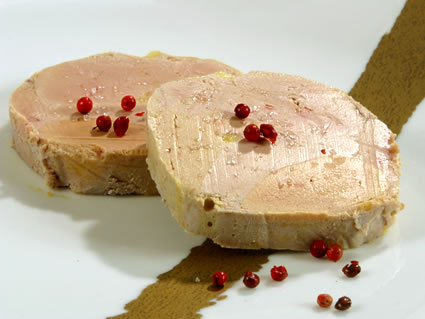
Well, it doesn't look like that when it gets to your table. It looks more like this:


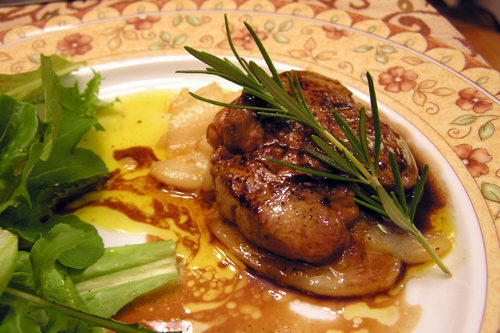
Sometimes, there's even more garnish or sauce.

Foie gras (lit. ''fatty liver") is made from the fattened liver of a goose or duck. It can be sold as mousse, parfait or pate, which all sound pretty classy given that it is still an animal's liver. There is a VERY good chance that you will never want to order it off of a French restaurant's menu again after reading this entry.

If liver was not gross enough already, the French have found a million ways to make the geese suffer in the process. Sure, they're free to frolic about as little goslings...but as soon as possible, they are stuffed into little box-like cages for phase two of foie gras preparation:


Is it just me or are these particular geese possessed, too?

Europe is more humane than people in the U.S. to many of their animals. These geese are not among them. After being crammed into tiny cages, they are force-fed corn ("gavaged") until their livers turn yellow with fat. Then the organ is made into whatever classier form you like.


This doesn't look half bad. I avoid most meat and I'm salivating a little.

France not only considers this a perfectly legitimate part of their culture, but did not invent that method of force-feeding. It goes all the way back to ancient Egypt. Yes, the Egyptians gavaged their geese; it was fairly well-known throughout the ancient world. It will not being going away any time soon, unlike the perfectly preventable (and equally sick) factory farming.

Bon appetit.