Showing posts with label pigeon. Show all posts

Monday, April 2, 2012

Bio-Art: Hooved Shoes et al.

A little personal entry, this time: Ever since last semester, I have been interested in making wearable shoes out of real cow hooves. I still need to get some heels, some red fur, and a good way to cut solid, thick keratin, but the hooves I spray-painted gold are at my current apartment. Yes, I will make them into shoes that hopefully look fabulous; my last attempt at this was a spectacular failure. The only reason I ever go shoe shopping of my own volition is to make crazy art.

That said, I'm not the one who did shoes using real animal hooves first. The unofficial queen of hoof shoes is German taxidermist Iris Schieferstein. She loves mixing taxidermy and fashion...like this:

Source.


Schieferstein's first pair of hoof shoes were made of horse hooves. Although not as impressive as her pair of cow shoes, these are still pretty neat.  They cost around 5,500 USD, though, and can only be worn for a couple of hours.

Moo.


The "Vegas Showgirl" hoof shoes use cow hooves, fur, and toy pistols. They look snazzy, but I doubt they're actually wearable.  Apparently the horse ones are, however, so I would totally give these a shot. Someone with 12 years of creative taxidermy experience has to know how long they last, too.

If hooves are not your thing, how about doves?

Link.


Schieferstein has also done full-body snake mounts on shoes. Just sayin'.

He come to town (credit).


The idea of hoof-like shoes has since caught on in the fashion world. There have been shoes that I can only describe as "camel toe" showing up. Designers like Alexander McQueen made 'hoof shoes' that really look more like platforms with a narrow toe than actual hooves. One German company, Kronier, at least has the ankle length required for hooves about right. When designers start using actual animal parts in their works, then I might listen. Until then, I am avoiding all heels not made with real hooves.

Sunday, November 20, 2011

Creature Feature: Bleeding Heart Pigeon.

We've said it before and will say it again: Pigeons are underrated. They go far beyond the feathered rodents that can now be found around the world. Hell, doves and pigeons are the same thing, only one is white and the other is shiny. That is how little people really seem to know about pigeons: to most people, a pigeon is a feathered disease-bag, but, if it's white, it's suddenly the embodiment of Jesus.

This is saying nothing about wild pigeons. The amount of stunningly beautiful wild pigeons is staggering. The last of these we covered was the Gaga-cuno pigeon, AKA the Victoria Crowned Pigeon. In the interest of breaking up the mammalian monotony, here's another:


Wait! Who shot an innocent pigeon like that? Can we find a picture of this bird where it didn't get shot in the chest? No? Huh.

The bird in that picture is an aptly-named Luzon Bleeding-heart (Gallicolumba luzonica). It is native only to the Philippenes. In contrast to most bird species with fancy markings, both sexes have the namesake red patch on their chests. They are slightly iridescent on top as well.


Unlike city pigeons, Bleeding-hearts prefer to walk on the ground. There they pick up seeds and insects. They look very much like chickens until one realizes that, yes, that bird is in fact a pigeon.  They do not have "chicken-dove" in their generic name for nothing; they occupy roughly the same ecological niche as Galliformes.


(FromNarellerobinson.com)

As one can probably imagine, the Bleeding-heart pigeon is present in the pet trade. A fair amount of them are trapped and either sold as pets or eaten. There are a fair amount of captive birds available, so please be sure to buy yours from a reputable breeder should you so desire one. They require special aviaries (NO wire floors!) and are definitely long-term commitments. Some of these birds have lived almost thirty years!


Tuesday, August 9, 2011

Creature Feature: Victoria Crowned Pigeon.

Pigeons have a really bad reputation. To most of the world, they are chattering, flying disease bags hell-bent on destroying our architecture with their corrosive waste. Although white pigeons get to be called the embodiment of Christ, piebald pigeons are still seen as rats with wings. Man, that lady who said, "feed the birds, tuppence a bag" in Mary Poppins must be some kind of diabolical mastermind.

"Every two pence goes to Big Brother!"
 

Remarkably, all the pigeons we have come to recognize as city pests belong to one species (also called "rock doves"). There are plenty of other pigeons out there, including some that look like an artist was on drugs while looking at a regular pigeon.


Yes, that is a pigeon. That blue crested head with the striking red iris belongs to the Victoria Crowned Pigeon, a wild pigeon native to New Guinea and some of the surrounding islands. Sexes look alike- no special treatment for the male, which is a rarity among fancy birds like this. It eats fruit, seeds, and small invertebrates - not like the no-class pigeons who eat anything thrown their way.

Victoria Crowned Pigeons are probably the largest pigeons in the world. They can get almost 30 inches long and weigh up to five pounds. As rather large birds, they have been hunted for meat, and have been slated as "Vulnerable" by CITES.

The only species in which EVERY family member looks like Articuno mixed with Lady Gaga.
 

People also keep Victorias as pets. These are not birds that one can just stick in a cage, however. Like all pigeons, VCPs feed on the ground. They also need plenty of space in which to exercise and play. One has to be ready to prepare a whole bedroom for these birds, and they are not cheap. At least they tame down readily! If you must get a fancy pigeon, but don't quite have the space for a VCP, might I recommend a Jacobin rock dove?


...never mind.

Friday, July 30, 2010

Creature Feature: Freak Week - Barb Pigeons.


Pigeons have some of the freakiest breeds in the avian world. If you thought the Polish Chicken was freaky, think back to my pigeon article. There was a picture of a Jacobin there - a pigeon breed that looks like its head exploded into a mess of feathers.


KA-POW!

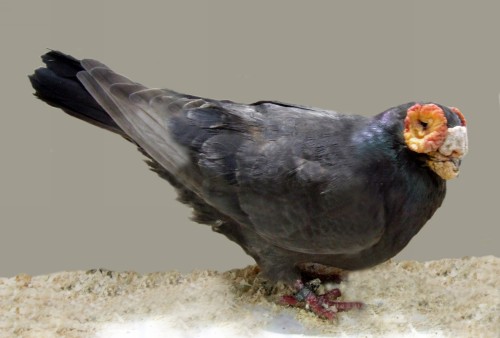
The Jacobin is not the weirdest pigeon in the coop. An even more bizarre breed, the barb, exists. It can only be described as a pigeon who was trying to be a vulture for Halloween and failed. Miserably.


The video does not do those wattles justice.

This...bizarre breed been around for 400 years in Europe. The barb has been featured in the works of Shakespeare and Darwin's Origin of Species. Darwin himself was a pigeon breeder. No doubt that experience impacted one of the most important works of literature ever.

A lot of scientific discoveries are not made by men in sterile white labs. Darwin not only bred pigeons as a hobby, but also went to the Galapagos himself. Gregor Mendel, the father of modern genetics, worked in a monastery growing peas as a hobby. It is one thing to read about evolution, and another to steer it yourself...even if the results seem more odd than beautiful.

Friday, June 11, 2010

Creature Feature: Rock Dove.


...yeah, that's just a more awesome way of saying 'common city pigeon' (Columba livia domestica). I know, I know, there are a MILLION other pretty pigeons out there, but, as with the Japanese beetle, it never hurts to try and see the beauty in the invasive and mundane.

Pigeons are surprisingly interesting birds. If you do not immediately shoo them away, take a look at them sometime. Not only are the wild-type (!) pigeons iridescent, but they come in a variety of colors and patterns. Like many species, they can inherit piebaldism, which leaves some patches of black iridescence in a sea of white. Other times, they just remind one of cheesecake or cookies n' cream ice cream.

Unlike Japanese beetles and lionfish, rock doves have been bred in captivity for thousands of years (going all the way back to cuneiform tablets) and have a few exotic looks to show for it.


As cool as exploding feathery heads are, I cannot fathom what prompted THIS breed.

Like many doves, city pigeons have an innate sense of direction. One theory says that magnetic particles in their brains allow pigeons to remember exactly where their nests and mates are, even if they are moved thousands of miles away from the site. Other theories say that pigeons can return home via solar patterns, visual cues, or familiar smells, but those are not nearly as awesome as honing in on the Earth's magnetic pull. However they do it, the pigeon's knack for navigation has been observed and manipulated since ancient times; pigeons were often used to deliver messages. In World Wars I and II, the ability to carry notes back and forth earned a few lucky pigeons medals. By "lucky," I mean "got injured and still delivered the notes."


Lest we forget.

Pigeons are also one of the few groups of birds that feed their young with milk. No, they do not have breasts (do I even need to mention DuckTits?), but instead regurgitate a high-fat and -protein semi-liquid from their crops. It is produced by both male and female pigeons. Replacing this special feed is one of the main obstacles of pigeon breeders (such as, say...Darwin).

Despite the pigeon's talents and service to mankind, we still do not want them in our cities. Their waste slowly decays bridges and statues, after all. The easiest way to curb the pigeon population is to stop people from feeding them, or, alternatively, let the peregrine falcons do their thing.

Falcons are badasses like that.