Showing posts with label week of the triffids. Show all posts

Sunday, October 10, 2010

Week of the Triffids: Doll's Eyes

If that title alone did not send shivers up your spine, you have never seen Chuckie. Or Rozen Maiden. Or...anything involving killer dolls, really. The plant is much creepier than either of those regardless:


Chuckie has nothing on this.

Doll's Eyes (Actaea pachypoda) are native to the Eastern United States and Canada. One can only assume that the settlers immediately thought that they were manifestations of Satan and proceeded to hover crosses over these plants. They are related to wolfsbane and monkshood.


(I have seen these IRL; they ARE kinda creepy, even if they're not in full color. This is the freakiest thing you will EVER see in IL.)

True to the red-yellow/white-black trinity, Doll's Eyes are highly poisonous to mammals, including humans and rabbits. Specifically, they contain cardiotoxins - toxins that attack the heart. Eating these berries is like getting hit by the Death Note.


Yeah, those berries look more like shinigami food to me.

Despite its toxicity, it has been used by native Canadians to calm menstrual periods (if you do not know what that is, good for you) and as a medicine after childbirth. Yes, it sucks that much to be a chick sometimes.

The creepiest thing about it, in this author's opinion, is that those berries DO look a lot like eyes. Although poisonous to humans, the berries are not toxic to the birds that help disperse the plant's seeds. If the berries look like eyes, and birds know to look for those berries...what is keeping them from eating human eyes on a regular basis?

Friday, October 8, 2010

Week of the Triffids: Pitcher Plants.

Tomorrow will be a plant that is awesome without eating bugs, I swear. For now, pitchers are pretty cool plants in and of themselves.


I would call these "champagne glass plants," but your name's good, too.

Although certainly not as active as sundews or flytraps, pitcher plants are still awesome. They can be found on almost every continent with a corresponding genus: Old World pitchers are Nepenthes, New World pitchers (like the ones above) are Sarraceniaceae and one bizarre pitcher from Australia, the Cephalotus, is its own genus.


Oh, Australia, you so cra-zy.

Pitcher plants, as their collective name implies, resemble the pitchers that humans use to pour lemonade during the summer heat or other such water vessels. These pitchers are filled with something far less delicious: Water and digestive fluids.


Unsuspecting insects are lured into the pitcher plant's gullet using a number of tricks. Sometimes, the pitcher is colored a vibrant red, which tells flower-loving insects (but not ants) that they should land. Other pitchers bait their traps with delicious nectar. Some just take advantage of an obvious hiding place, only to slide down into the watery depths. It's kinda like going to the only Mickey D's on a highway when you really need a rest stop, and you don't know (or care) that it's run by an axe-murderer.


Fast-food can be hell.

Not all pitchers feed on bugs. Some have evolved into vegetarians (which is...almost cannibalism, except that they're feeding on fallen leaves etc.). Others have gone beyond insects and are big enough to trap and digest birds and rats. A few millennia down the road, who knows what they might try to eat...


The obvious conclusion.

Thursday, October 7, 2010

Week of the Triffids: Venus' Flytrap.

After two quizzes and one big binary test (pray to whatever deity you worship that my soul survives after that one), Triffid Week brings a really, really easy plant to cover: The Venus flytrap (Dionea muscipula).


In case you were wondering about the name, yes, it refers to the Roman goddess of love and (in the scientific name) her ad-libbed mother. There are a number of suggestions for its nomenclature, but the real story behind it is the plant's resemblance to a vulva. It has two roundish, sensitive lobes surrounded by hairs. Scientists are all perverts; get used to it.


I'm looking at breast...cancer. Right.

The Venus flytrap is the most famous carnivorous plant in the world, bearing more pop culture references than you can shake a stick at. It has an almost cute little mouth that looks like it could belong to an animal, complete with 'teeth' around the edges. Although sundews and pitcher plants are all well and good, flytraps are easily the most sensationalized plants in the media.


i herd u lieked muscips?

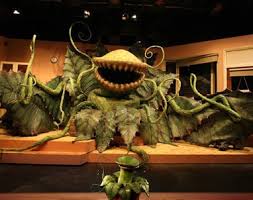
Of course, who could forget Audrey II, the plant that almost took over the world in Little Shop of Horrors?


In the original ending, Audrey II succeeded.

Despite its amazing media coverage and captive cultivation (including a red strain), the Venus flytrap is native only to the bogs of the U.S. Carolinas and is listed as 'vulnerable.' Preventing forest fires is decreasing their numbers; they rely on fires to help them reproduce.


...can stop the upcoming flytrap invasion. Don't play with matches, kids!

Tuesday, October 5, 2010

Week of the Triffids: Amorphophallus titanum.


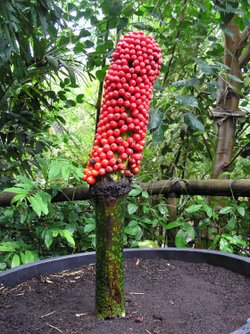
The monstrous stench-blossom above is called Amorphophallus titanum. Yes, that name means exactly what you think it means: "Giant misshapen cock." More family-friendly names include "titan arum" and "corpse flower." Those might not be pleasant, but they are PG-13.


Mommy, I wanna see the giant deformed wang!

The titan arum is found only along the edges of the Sumatran rain forest. It is actually made up of several flowers surrounding a spadix and is the largest single inflorescence in the world. As a whole structure, it can reach over 10 feet in height. It gets even taller as it matures, yielding brightly colored fruit and resembling a small tree by the end of its life cycle.


It also reeks. Oh, how it reeks; these plants only bloom for a short time (1-2 days). They need to attract as many bugs as possible to pollinate them in that short time and do so by smelling like dead meat. The plant also produces heat approximately the same temperature as the human body to further the illusion.


So is this old lady a flesh-eating zombie, dead in bed, or JUST taking a picture of a plant that will CLEARLY not be entirely visible at the angle she's shooting at? (Come to think of it, does she even have a camera?)

If any of this sounds an awful lot like Vileplume the rafflesia, you have a good memory and are a keen observer. Both of these plants are pollinated by carrion-eating beetles, and both are from the Sumatran rain forest. Great vines stink alike. *SHOT. No, seriously, that was bad of me.* (Technically, the rafflesia is a giant disembodied flower and the arum is a genuine, vineless plant, but c'mon...allow me to have SOME fun with this.)

Can this plant get any weirder? Well, its relatives can...

Week of the Triffids: Cobra Lily.

Nature is full of false advertising. There are quite a few animals that mimic poisonous species so that they themselves will not get eaten. Cats imitate venomous snakes when they hiss; hey, it's effective. Convergent evolution has produced some pretty darn similar adaptations between species (down to the 'lethal trinity' of red, yellow and black common to many venomous animals).


Not venomous, I swear.

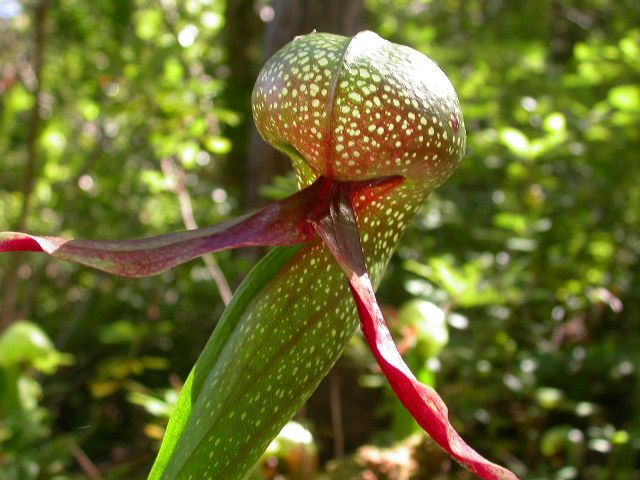
Then we have the cobra lily (Darlingtonia californica). It's not a cobra or a lily, but damn if it doesn't look like it could strike at any second. It even has a forked tongue!


D'awwwww!

This instance of mimicry was purely accidental. The cobra lily is not cobra-lethal unless you happen to be a small insect. That 'tongue' is covered with a sweet nectar trail leading directly to the cobra's 'hood' that gives the plant its name. After being lured into the hood, insects find themselves slipping down into the plant's watery bottom. The pool below is spiked with at least one digestive enzyme and the walls surrounding it absorb nutrients just like the plant's roots.


At this point, a few flies have remembered that they possess wings. This gets them out of traps 1 and 2, but trap #3 is, well...invisible.


The cobra lily's walls are translucent. A flying insect will see these fake exits and try each and every one of them, not realizing that the real way out is down. Eventually, it tires, making its attempts to fly utterly pointless. This method is extremely successful - a cobra lily's pool is, more often than not, loaded with dead insects.

That's right. It knows when its prey sleeps.

Monday, October 4, 2010

Week of the Triffids: Sundews.


Oh, wow. What is that? Vector art? An alien plant species? Whatever it is, it's pretty.


That creepy-yet-beautiful plant is a member of the genus Drosera, also known as sundews. Sundews can be found every continent except Antarctica. I know what you're thinking: That name sounds like it could belong to the bastard child of Sunkist and Mountain Dew.


To be fair, both use shiny liquids and bright colors to get one's attention.

Instead of being a soda pop, the sundew is a carnivorous plant with possibly the most beautiful weapon in the plant world: It uses sparkling drops of liquid to attract and trap its insect prey (just like soda companies). The species of sundew is usually named after how their gem-studded leaves are shaped; thus far we have looked at D. rotundifolia, D. spathulata and D. cuneifolia. Try and guess what their names mean!


Insects are apparently just as drawn shiny things as people and magpies. The drops on a sundew's tentacles are not very sweet, but insects still go "OMG SHINY!" and fly over. They are soon caught by the extremely sticky droplets on the sundew's leaves. Unable to escape, the leaf folds over them, slowly digesting the helpless bug. The rest is history.


Butbut...so...beautiful...

Regardless of how gory their feeding habits are, one really cannot blame the insects for being interested. Just look at how much colorless, hardened carbon goes for...


Diamonds: They're carbon, just like you, me and pencil lead.

Sunday, October 3, 2010

Week of the Triffids: Celosia (Brain Flower)

You thought I was going to start with the Venus's flytrap, didn't you? I will get to those (after all, I've handled them), but let's talk flowers first.

Flowers are a plant's way of reproducing. They attract insects and small birds to pollinate them. Once the male pollen reaches a female ovum, the plant starts producing seeds. The cycle begins again when the seeds fall into the ground and take root. Hooray for basic biology.

Go figure, some flowers look really weird.

Celosias, although not carnivorous plants by any means, look pretty trippy without getting into specifics. They come in a lot of really bright colors and have forms to match, making them resemble something out of a drug trip. They are often called 'cockscomb' flowers for their frilly, sometimes feathery edges.


Umm...'cockscomb?' Really? That does not look much like a rooster's head to me. There are about a million things wrong with that sentence according to my perverted mind, but I think Celosia cristata resembles something far more unsettling:


Just admit it: Florists are trying to make one of the creepiest, trippiest-looking flowers sound tame. "Brain flower" is far more marketable, especially around this time of the year. Coming in gold, hot pink, blood red and other fiery colors, they would make great decorations for Halloween. (They are usually in season until late November and produce a TON of seeds.)


People actually eat some varieties of celosia. I am unsure if these brain flowers are on the list, but they are non-toxic; you can make jokes about eating brains until the cows come home (and eat your flowers). They are closely related to amaranths and are used similarly in cooking, especially in Nigeria, India and Indonesia. If you do not like the taste of spinach, you will probably not like celosia.


The brain flower is also fairly popular in Chinese horticulture. Small wonder that one wound up in a Japanese music video. Other celosias also look pretty cool - this one looks like it could have been in The Little Mermaid - but few of them are this weird.

Saturday, October 2, 2010

Week of the Triffids.

What would October be without at least one week of weird-looking lifeforms? Of course, we look at weird animals all the time; why not take a leaf out of the (dying) horror industry's book and have a whole week of triffids?

...Triffids?

Triffids are a species of vicious, weird, deadly plant from Day of the Triffids and its sequel Night of the Triffids. Both stories involve weird-ass carnivorous plants that, due to Russian communist gene splicing, can walk and sting. Many people have gone blind and are therefore helpless against this botanical menace. Remember that humans are visual creatures, so the remaining few that could still see had a huge advantage against triffids.


In Soviet Russia, salad eat you.

The term has since been used to describe any weird plant. It is also still popular as a name for any monster plant, whether or not it resembles the original triffids.


Yeah, you don't see these popping up too often.

So, basically, this week features plants that will at least make you cock your head a little, if not send you screaming. None of them are named Audrey II.