Showing posts with label worm. Show all posts

Friday, November 12, 2010

The Human Freak: Elephantiasis.

Warning: The following entry contains a link to some manparts. Shut up. You can see them on Wikipedia, too. 

Up until now, we have covered diseases and disorders that, for the most part, you cannot get. You either have them or you don't from the day that you are born. If you don't already have increased aging or fused legs, good for you. You can induce hypertrichosis if you like, but that's your call, not mine.

This is unlike everything else that I have covered so far in that it can happen to anyone. It is not genetic. It is not induced by drugs. All you have to do is get bitten by the wrong mosquito to end up like this:



The Taiwanese woman above is currently dealing with elephantiasis. It is so named because, yes, the end result resembles an elephant's foot.

If you're a guy, this disease will also swell your scrotum in a way that a sketchy drug you ordered online might. Yeah, your junk is going to be ENORMOUS, but it will also be filled with worms. NOT IN THAT WAY, I mean actual worms.

Picture linked here is NSFW. If you don't like male genitals, don't look.

The scientific community is honestly more interested in what this disease does to a man's junk than what it does to anybody's leg. That's sad.

Most forms of elephantiasis are caused by roundworms of various species (Wuchereria bancrofti, Brugia malayi, and B. timori), to name a few. These live in pretty much every tropical-subtropical region in the known world (i.e. you are bound to find ONE of them in the area if you ever want a tropical getaway). The larvae travel by mosquito. Their destination is the human lymphatic system.

It is not entirely certain whether the swelling in the legs and genitals is caused by the worms themselves or by the human immune system's response to the worms. Whatever the case, the bulging is like a beacon to mosquitos that says "bite me." They take a few larvae out of one host and stick them in another while sucking some blood in the process. (If you think this sounds like the botfly, it sort of is, but the botfly is at least motile on its own in one stage of life.)


There is no cure, but damn if people are not trying with this one. They have put out antibiotics, an anti-worm drug called albendazole (which looks like something from Taco Bell, but is a potent vermicide), and started mapping the genome of one of the worms in an attempt to cure this. You hear a lot of talk about cancer, arthritis, etc., but although a million scientists are working on those, I have not seen such a fervent movement towards completely wiping out a pathogen since smallpox. These people not just trying to treat the symptoms - they want the worms dead, dead, dead.
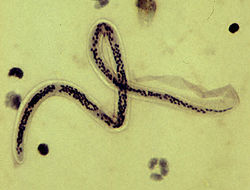

Kill on - oh, wait, we can only see these things under a microscope.

Or you could, y'know, eradicate the people harboring the worms in those parts. They are a vital part of the creature's life cycle. The mosquitoes FAR outnumber the humans and will keep reproducing even if humans are not around, but the worm needs humans to work. You want to stop elephantiasis? Stop humans. (Yes, I realize how callous that sounds.)

Tuesday, June 22, 2010

Creature Feature: Tapeworms.


Behold the tapeworm, a MARVEL of nature! YT would not let me link this, so you will have to click the text. (For the lulz, note the Shakira interview and "America's Got Talent" alongside flesh-eating parasites.)

Yes, I went from the elegant quetzal to a creature that most people would in horror from. You know how I get with worms; they fascinate me!

Tapeworms (Class Cestoda) are no exception to my love of worms. Remember, parasites have to thrive inside another organism; they have to live through acids and our own immune systems in order to survive. If anything, living in such harsh conditions should be seen with more admiration than mere predation.


All hail the tapeworm. These can grow anywhere from 40-100 feet in length. Long worm is loooong.

The first things that most people notice about tapeworms are the flat segments that make up its 'body' called "proglottids." These, almost like those little sea salps in a chain, can reproduce independently, making some biologists believe that a single tapeworm should be treated as a colony of proglottids rather than a single organism. They can reach chains of up to 100 feet long.

Gravid proglottids usually come out in a host's feces, and lay eggs intended for a different host. Beef, fish, and pork can all contain juvenile tapeworms (cysts) just waiting to get in your gut and start the process all over again.

The head of the worm, called the scolex, is rarely seen. It has suckers and a hooklike 'mouth' that latch it onto the intestinal wall. It also looks like something straight out of an Alien movie:


Just as an example of how specialized parasites like this can be, let us look at the beef tapeworm (Taenia saginata). As the name implies, the beef tapeworm spends much of its life in a cow's body, but falls onto pastures via human feces. Once the resistant eggs from a proglottid are ingested by a cow, the larvae spread all around the cow's body from there. The cycle repeats itself unless the meat is either frozen or heated to temperatures that the cysts cannot handle.


Creepy? Perhaps, but also admirable in its own right. Few species accommodate so well to the introduction of domesticated animals. There is even one for puppies, animals hailed as man's best friend. These little guys have found a way to not only infect said animals, but also to make humans part of their wormy complete breakfasts. Hosts usually show no outward symptoms, but some cases result in severe weight loss, decreased appetite, nausea, and dizziness. You may also wind up with bad case of diarrhea, making this Japanese video essential:


Since at least the Victorian era, tapeworms in particular were advertised as a weight loss supplement. Given that many parasitic infections result in a change in appetite and weight loss, it may have worked.


There are, however, several better parasites for your health; hookworms in particular have been known to reduce allergy symptoms. That's a worm for another day.


This, however, has no excuse. It looks even more like a tapeworm with wings in the video games.

Wednesday, May 19, 2010

Creature Feature: Christmas Tree Worms.


Now for a creature that looks like it came straight off of Pandora: The Christmas Tree worm. I'm sure you can see exactly why it is called that. When was the last time you saw a worm with psychedelic evergreens on its back?

Yes, I know, it's another worm. This one is more closely related to earthworms and leeches (common 'eww' worms), but is completely harmless. Hell, you probably will not even see one unless you take a dive into the ocean or know somebody with a very good reef aquarium setup. Some hobbyists select wild coral with these worms on them just because they display so well.

Avatar's Pandora had sensitive plants (which are also a real thing) based on the breathing structures of these magical little worms. If touched, the plants would quickly retract into the ground...


...just like the worms' "gills." They can be used for feeding as well as breathing, so we're using the term loosely.


They also have some of the trippiest spawns ever caught on camera. It's even more apparent in this video that the stalks themselves also look like something out of a movie. Tim Burton, jump on these guys befo- oh, wait, Cameron already put them on Pandora. Never mind.

(I'll do a vertebrate tomorrow, I swear...)