Monday, November 7, 2011

Bio-Art: One Tree(s) Project.

Plants are often overlooked when it comes to crazy artistic projects. Our minds are so entangled with freakish animals when it comes to science projects that weird plants get hardly any notice. Fact is, many 'taboo' procedures done on animals have been done on plants for ages. That includes splicing, super-inbreeding, and, of course, cloning.
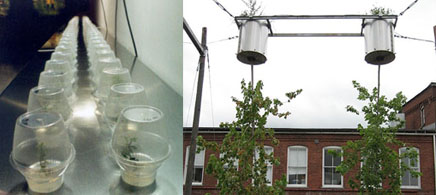


Natalie Jeremijenko had a unique idea: Since plants are cloned arbitrarily, she would plant clones of the same tree in various places. The only difference, then, would be the environment they had been planted in. There are over one thousand cloned trees scattered around the Bay City area, and a few saplings in an art gallery as well.

This project brings the question of nature VS nurture to the fore. Now that we can essentially photocopy life, what effect will the environment have on genetically-identical trees? Since trees grow slowly, the results are not quite certain. The project is ongoing, so if you live in New York, do check those trees out. You can even get one for your desktop!


Now, the big question: Is it art? It sounds more like a science experiment gone wild, but there is also a strange beauty to the idea of having the same tree in many places. Post below. :)

Sunday, November 6, 2011

Week of the Abyss: Giant Tube Worms.

If fish and eels were not freaky enough, nature really gets crazy with worms in the sea. Even without diving into the abyss, while we're more or less stuck with earthworms and leeches on land, annelids have Christmas Tree Worms and the rather unflattering pig-butt worm among their more interesting members in the ocean.

Things get even weirder in the abyss, where the harmless earthworm becomes a species whose sole purpose in life is bad hentai potential:


Permanently stuck around the geothermal vents ("black smokers") of the deep sea, these giant tube worms (Riftia pachyptila) are some of the largest annelids in existence. They can get 2.4 meters (7 feet ten inches) in length. Those tentacles can be pulled into the worms' white sheaths when danger approaches, not that they have many predators.

The tentacles on these worms are red for a reason: like our blood, they contain hemoglobin. The red tentacles have complex hemoglobins circulating in them, which allows them to circulate oxygen in a highly sulfuric environment. They are not poisoned by the hydrogen sulfide in their environment- instead, they benefit from taking in a substance that would kill any other animal.

Hell's lipstick.


If the tentacles coming out of their tubes were not creepy enough, imagine a 7-foot-long creature that lives solely on symbiotic bacteria. The bacteria in these worms is designed to convert hydrogen sulfide and carbon dioxide - basically, the stuff that Hell is made of - into usable material for the worm. These giant worms do not eat and have no gut. The millions of bacteria inside them do all the work. They're almost more like fungi than animals.

Hope you enjoyed the absolute nightmare fuel found in the deep, deep sea! Since weeks have been stunted, expect a bonus abyssal critter or two next week as well. :)

Saturday, November 5, 2011

Week of the Abyss: Umbrella Mouth Gulper Eel.

Raise your hand if, after the "They Actually Eat That" entry on eel pie, you went to a sushi store and got some non-jellied eels. No? Nobody? Then we agree that regular eels are already somewhat creepy. In the abyss, however, nature takes everything up to eleven...


...including eels. Technically, the Umbrella-mouth gulper eel/pelican eel (Eurypharynx pelecanoides) is not even a real eel, but what else would you call it? This eel-like fish is native to all tropical and subtropical areas of the sea. Like all things this week, it can only be found at depths where the sun doesn't shine. Even for eels, it is creepy in its simplicity: No scales, limited fins, and very low swimming capability.

The most noticable trait about this eel is, of course, its jaw. The pelican eel's lower jaw can theoretically stretch large enough to swallow food that is bigger than the whole fish. Despite this awesome jaw, however, the eel's diet consists of tiny prey such as small crustaceans and plankton. Unlike anglerfish, it has tiny teeth. What a relief!

Like many things in the deep, the pelican eel glows in the dark. At the end of the eel's whiplike tail is a lure made of glowing, red tentacles. It's just enough to distract little things from that giant mouth waiting to swallow them up from behind...

Is that a hungry eel, or is it just happy to see us?


The pelican eel has received enough publicity to get its own Pokemon in Huntail. Like the pipefish-chimaera Gorebyss, Huntail evolves from Clamperl and is based off of deep sea life. The sprite even glows in the dark in some games. Know this beast well; as of Gen V, it will become more and more competitive with the addition of Shell Smash, and if they do rerelease Gen III games for the 3DS, wellll....pray to whatever god you believe in that they don't.

Huntail is the thing that ISN'T an anglerfish.


Thursday, November 3, 2011

Week of the Abyss: Wolf-Trap Anglerfish

Say the words "deep-sea life" and the anglerfish is probably the one that will pop to most people's minds. Rightfully so; with head-lures, creepy jaws, and an almost nonexistent male that turns females into self-impregnating hermaphrodites, it makes sense that they would be the abyssal fish.

If you know nature, however, you know that she loves kicking things up to eleven. The phrase "There's always a bigger fish" mutates into "there's always a weirder fish" in regards to the deep-sea abyss. In this case, imagine if someone took an anglerfish and fused it with the Xenomorph from Alien. You would get something like this:


Yes, that is a real thing, not some monster somebody drew out of their nightmares. It's a wolftrap anglerfish, also called a "wonderfish" from the family name Thaumathichthyidae.  We're not sure in exactly what way this fish is wonderful aside from the mere fact that something that creepy exists. The "wolf trap" name comes from the jaws. Like other anglers, it lives in depths at which the sun does not reach.

Just...look at that thing. Its jaws are just plain nuts; if what we've seen is any indication, some wolftraps have the upper lip flipped up, exposing those nasty teeth to whatever happens to be above them. People say those jaws look like a wolf trap. Looking at them, we have to agree that any animal unfortunate enough to get caught by those teeth will be whimpering.


Wolftraps also have better hooks than the average anglerfish. Instead of simply being a light lure above nasty jaws, these things have sophisticated fishing rods above even nastier jaws. Species can be classified based on how complex their fishing rods are, complete with glowing baits. Some rods even have little hooks on them, just like ours.

Oh, and all weirdness that applies to anglerfishes applies to these girls, obviously. The only wolftraps ever caught have been hermaphroditic/parasitized females. It's safe to assume that all the nightmare fuel that comes with 'normal' anglerfishes applies to wolftraps as well. Sleep tight.

Wednesday, November 2, 2011

"They Actually Eat That:" Century Egg.

Is it just me, or has a lot of the "trick" gone out of trick or treating? Even if refused candy, one rarely sees kids TP'ing trees or egging people's houses. The threat just doesn't linger anymore. It almost makes me wonder if there was a ban on dishing out tricks, especially with the fancy types of eggs some richer kids might have...


Yes, that was once an egg. Yes, it's still edible. Yes, according to many people, it tastes like it was cooked in the bowels of Hell itself. Oh wait, no, it's usually found in China, the mosh pit of almost every strange food to Western tastes. Like many other highly-preserved foods (that means you, lutefisk), the century egg probably originated as a way for preserving food in China's poorer days.

Century eggs are duck, chicken, or quail eggs that have been preserved for several weeks, days, or months. They are soaked in an alkaline solution (pH of 9, 12, or more) for a certain period of time (your restaurant may vary). Most of the packaged ones are soaked for about ten days in plastic. Other, more traditional eggs look quite pretty, sporting botanical "pine tree" patterns on their surfaces.


The treatment that these eggs receive unleashes certain proteins into the egg that would otherwise be bound. It has been compared to sulfur in regards to smell. The flavor makes some recoil and others add a little bit of ginger. Different tastes show really easily when it comes to century eggs.

The Chinese love century eggs to death. When a CNN reporter said that the eggs tasted like they had been cooked by the devil, the Chinese were outraged. People even complained that China had grosser things - which is, admittedly, true. They cited pickled tofu and the Chinese version of balut. Checkmate.


Even just looking at YouTube videos shows the controversy surrounding these eggs. Responses range from "GROSS!" to "it's actually quite good" to "you're doing it wrong, Westerners!"Any food that requires gloves to prevent one's skin from corroding in the process of making it sounds dangerous in my book.  I have never personally tried them, but if you want a truly exotic Halloween treat next year, try to find these in Chinatown. They're sure to break the ice.

Tuesday, November 1, 2011

Creature Feature: Dumbo Octopus.

The deepsea abyss is full of things that you thought only existed in nightmares. There are things with diminished eyes, huge jaws, tentacles, and other traits that make one wonder if R'lyeh was really Atlantis at some point. Maybe H.P. Lovecraft was right about evil gods living at the bottom of the ocean.


For example, this is baby Cthulhu. Or, if you prefer, the Dumbo octopus (genus Grimpoteuthis). Dumbo octopuses live in the abyssal depths of 3-4,000 meters, feeding on worms, bivalves, copepods, and, presumably, human souls. The largest of the Dumbo octopuses are 1.8 meters in length (almost 6 feet) but most of these cephalopods are smaller.

The Dumbo octopus gets its name from the cute earlike flaps on its head. They make it look somewhat like Disney's classic flying elephant as it swims through the water. It also has another method of crawling along the bottom in which it flattens itself into a pancake, which is just as adorable. This other style gives it the name "flapjack octopus."


As creatures of the abyss, they do not need the sophisticated camouflage seen in other octopus species. Instead, they employ light tricks similar to those of the vampire squid. They can do anything from making their skin glow to making it completely clear. When you live in a place with so little light, color does not matter nearly as much. They also have no suckers, simply because they do not need them.

Alas, Dumbo octopuses are rare. Some researchers have even called them the rarest of all cephalopods. As abyssal sea creatures and octopuses, they also fare poorly in captivity. They would probably make adorable pets if only we could keep them! Good thing this mini-Cthulhu is one of the least terrifying creatures this week.

Theme Week: Week of the Abyss.

After Halloween, it was time for another terrifying theme week. Frankenstein and They Actually Eat that will naturally break the mold of this week's theme: THE UNHOLY ABYSS, WHERE LIGHT DOES NOT REACH!

Seriously, though? There's some weird stuff once you cut off all light from the ocean floor. Go down deep enough and there are things that glow in the dark and live entirely without plants, sunlight, or fresh water. It's the sort of stuff you find in your nightmares. Or H.P. Lovecraft, take your pick.


Happy Halloween 2.0!