Showing posts with label echinoderms. Show all posts

Wednesday, June 20, 2012

"They Actually Eat That" - Starfish + A Mission.

Some foods on this column are cool. Some of them look gross, but I've actually tried them and they're quite good.  Some things are ordinary stuff you didn't know was gross. Then, there are weird foods that we don't have in the States or consider bizarre on other counts...which is most things, really.

Among this last group, usually, are the things that make me go "why?" Maybe I'm just culturally-unaware of something, but there are just some things people eat that make me question their motivation for doing so. This is one of them.

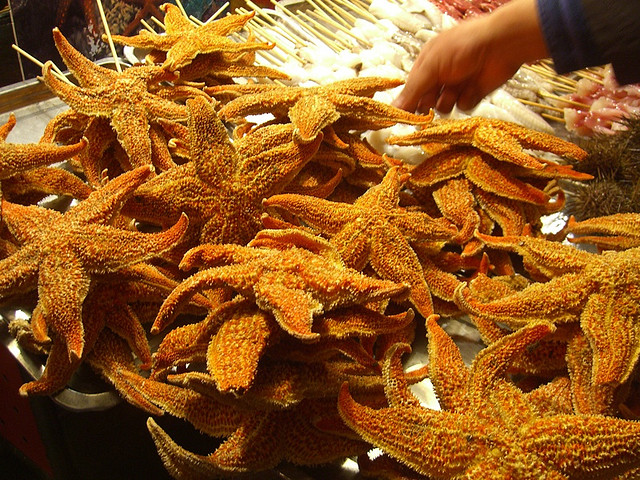
From www.uncorneredmarket.com


Starfish is one of those things that makes me go "why?" Who would look at a starfish and go, "hey, that might be good?" They're probably more appealing while alive, and it's convenient that they have a fairly simple body plan, but there's nothing about them that screams "eat me." As with sea urchins, they just look unappealing. It's an excellent survival tactic.

The upside is that starfish are not as bad for you as, say, regular fish (which have their own horror stories). After pawing through a few videos, it does look like the starfish have some meat on them. One could almost call sea urchin logic on this one (after all, they're related). That tough skin is usually protecting something. Plus, sea otters crack echinoderms all the time, right? They must be eating something in that shell...while looking adorable.


Then again, China. Just...China. I've said so much about China putting everything on a stick that there is not much more to say. They cook the starfish, at least. The most popular methods include sun-drying and just plain frying. I have yet to see starfish sold raw, but it probably exists. Probably.

That said, do not go hunting for starfish yourself and put them on sticks. Some starfish are poisonous. Eating starfish already shows that you have daring taste buds. No need to add venom into that mix. If you're really that eager to get poisoned...fugu. That is all.

Actually, that's NOT all. I have a mission for you, the readers. Starting next week, YOU get to pick the entries for a whole theme week of local specialties. It'll be a whole week of weird, unique foods. Deep-dish pizza will be the only entry I will forcefully add in there. 

Your mission, should you choose to accept it: Find a local specialty near you and post a description of it here. Get crackin'...and eatin'!

Wednesday, February 22, 2012

"They Actually Eat That:" Sea Urchin.


Sea urchins usually do a pretty good job of making themselves look unappetizing. Look at a sea urchin head-on and you will find a ball of spikes, spikes, spikes. There is a squishy little flesh ball somewhere within that mass of pointy spines, but it is hard to get to. Point is, who thought that eating these was a good idea?

Enter Japan. If it is from the sea, they have found a way to eat it. Urchin sushi, commonly called uni, is probably one of the few ways one can get sea urchin in the non-coastal areas of the world. Despite living right near the sea, Japan imports most of its sea urchins from Korea or the U.S. Surprise, surprise, sea urchins are in sushi - just like almost everything else in the entire ocean.


With sea urchins, however, things go from bad to worse. The sexual organs (gonads) of sea urchins are a delicacy in many parts of the world. It is said to have "the flavor of caviar, the trembly texture of panna cotta and the briny but bracing strangeness that comes with eating live oysters." (link)  They can cost up to 450 USD a kilo. The genitalia are so precious that eating sea urchin corals/roe has raised concerns about preserving coral reefs. Korean women called "haenyo" are sometimes reared from birth just to harvest sea urchins.

Japan, for once, is not the only place enjoying castrating small echinoderms.  Other countries also eat sea urchins. A popular dish in the Mediterranean involves raw sea urchin with lemon. Chile eats sea urchin as well. If a place is around the sea, it has probably found away to eat urchin. An appreciation for urchin can be seen as a sign of a true foodie, so if you happen to be in on any given coast, give it a try.

GOLD! Spiny, orange gold!


Should we be surprised that sea urchin has found its way into sushi and other seaside culinary styles? Of course not. Sea urchin is just one of those things that make one wonder who first thought it was appetizing. We can make an exception for sea otters. Otters eat sea urchins on a regular basis and are impossible to stay mad at.

Look into its eyes and tell it not to eat sea urchins.


Of course, China has done worse with echinoderms...but let's save that for next week.

Sunday, September 11, 2011

Creature Feature: Brittle Star.

Echinoderms are darn strange compared to what we usually think of as animals. They have pentaradial  symmetry (that is, the creature is split into 5 even sides instead of two), mouths on the bottom of their bodies, no real cephalization to speak of, and have "tentacle rape" written all over them. Or "Facehugger," take your pick.

In conclusion: This blog needs more starfish, dammit!


(Yes, they can be legally kept as pets.)

That's a rather strange starfish, no? Brittle stars (Ophiuroidea) do not look like Patrick or any other friendly starfish you can name. With their spindly legs, quick movements, and bands, they almost look more like five snakes joined at the cloaca (those stars above have "serpent" in their name, for example). They are found everywhere in the ocean, from reefs to the deepsea abyss. A few even live in brackish water. Some of the abyssal ones glow in the dark!

No two are exactly alike!
 

Brittle stars are so named because their arms are, well...brittle. Unlike more fleshy starfish, the arms of brittle stars are covered in segmented armor. These arms have no tube feet, and can break off easily to allow the star to escape.

These starfish are the unholy eldritch lords of regeneration. Starfish, as a general rule, can regenerate their limbs. Brittle stars are the masters of this, being able to regenerate segment-by-segment unless all arms are lost. A certain group of brittle stars called Amphiuridae can regenerate sexual organs and innards. Some can even perform binary fission with little harm. In other words, brittle stars make themselves very hard to kill.
MWAHAHA, they're gonna take over the world!


Fun fact: Although brittle stars are not toxic, they are among the few animals that humans have not yet found a way to eat. Trust us, the list is very small.

Tuesday, March 22, 2011

Creature Feature: Sea Pig.


At one point, it was thought that everything on land had a direct counterpart under the sea. That is why certain creatures have names like seahorse, sea cow, sea lion, and so forth, even if they do not really look anything like horses, cows, or lions. Ancient naturalists thought, "eh, close enough." Hell, the same could be said of sea cucumbers, even though they are not even plants. They just look like it.


Sea cucumbers in general are pretty weird creatures. (Wow, echindoderms really do not get enough love on this blog, do they?) They resemble, umm, cucumbers that have already been partially digested, sometimes with acid paint jobs for good measure, and just stay on the ocean floor, chillin' and eating whatever floats down. If a predator comes along, they pull the ultimate nasty prank and let out some of their internal organs into the ocean. Don't worry; they grow back. 

One of the members of the sea cucumber family ups the weirdness ante by a few more dollars. Ladies and gents, meet the sea pig (genus Scotoplanes):

Oink.


 Part Babe and part eldritch horror, the sea pig is the cutest of the sea cucumber bunch. It lives in large herds with 300-600 members, scrounging the deepsea abyss for anything tasty that floats down from the surface. They prefer rich, organic tissue such as fresh whale meat.

Sea pigs are the only holothurians with tube feet large enough to be called legs. The sea pig uses special water cavities inside its body to inflate and deflate sections around its 'limbs,' allowing it to walk like a little piggy in the darkness of the abyss.


Sea pigs (as well as sea cucumbers in general) have another fascinating defense mechanism: They can liquefy their inner parts to slip into the tiniest crack. Again, they come out perfectly fine afterward; sea cucumbers have barely any skeletons to speak of. We should all be ashamed for having such rigid spinal cords.


Looks like one of those splatter-pig toys...

The sea pig is currently under threat from deep-ocean trawling. Whole herds have been pulled up in fishing nets, which is unfortunately one of the few reasons we know sea pigs even exist. They are, like land pigs, a valuable source of food for deepsea predators. Better stop, guys; Cthulhu might get mad if we eat all of his ham.


Sea Pig by =TheEclecticEccentric on deviantART
(Plus, they're kinda adorable.)


Tomorrow: Speaking of weird echinoderms, this next one's a real basketcase!

Sunday, February 6, 2011

Creature Feature: Purple and Orange Starfish.


Y'know what? This entry does not need a fancy intro. There have been so many people asking what the hell this starfish is, or if it is even real, that mere confirmation of its status as a real animal merits a blog entry. After all, who would believe that an animal could naturally be orange and purple?

Well, this one is. The purple and orange starfish's scientific name is Astropecten articulatus- no reference to its bizarre coloration at all. It is also called the royal starfish, which is likely a reference to purple being a regal color. It is fairly common along the southeastern U.S. coast and, like all starfish, is predatory.

That is really all that is special about this particular starfish. Oh, wait...starfish are pretty darn weird anyways. No, we are not talking about Patrick's desire to taste the rainbow.

There's nothing REMOTELY suspect about this image. Nope.


On an embryonic level, starfish are much closer to us than most other invertebrates. They are deuterosomes; that is, the first opening of a baby starfish and a baby vertebrate becomes the anus, whereas in most others it becomes the mouth. We both start life wanting to crap before eating; lovely.

Starfish, like all echindoderms, exhibit pentaradial symmetry- that is, their body is divided into five fairly-even chunks instead of two. There are a few starfish species that break this rule, but otherwise, it's solid. It is safe to say that everything one arm has, the others usually do as well. Yes, this includes starfish junk and eyes.


The appendages are lined with tube feet on the bottom, allowing the starfish to move about and pry open bivalves. They are also part of the starfish's hydraulic circulatory system; basically, starfish use a dot in the center of themselves called a madreporite to gather the water that they use for moving, respiration and digestion.


The mouth is in the center of those arms. Starfish wrap themselves around potential prey and work from there, usually extending their own stomachs outwards towards their food. One of the few notable things about the royal starfish besides it wacky colors is that it, unlike other starfish, swallows its food whole; the food is already slightly digested by the time that it gets to the starfish's stomach. Oh, and it's purple, but haven't we covered that enough already?

                                                                          
No. No, we have not.
For a starfish, this colorful specimen is hardly weird. That is not saying much; starfish are pretty weird themselves.

Tomorrow: An animal so intense that it merits its own energy drink...or at least a Powerthirst reference. For some reason, the most fearless animal in nature has neither.

Also, lots of pics came from this awesome page. Thanks SO much for being an informative source as opposed to "OMG A PURPLE AND ORANGE STARFISH!"

Wednesday, August 25, 2010

Creature Feature: Crown-of-Thorns Starfish.


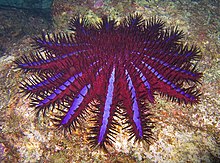
OK, what the hell is that? Whatever it is, it fell off of Lady Gaga's head, didn't it?

That is a crown-of-thorns starfish (Acanthaster planci). Though treated as a single species, there are many varieties that are not as psychedelic as the one above; these might be considered subspecies by location (Red Sea, Pacific or Indian Ocean). They are all many-armed, carnivorous echinoderms with nasty spines. Those spines are venomous, not just intimidating.

These starfish, unlike many other weird-looking animals, actually are a threat. Their population has been blossoming recently, most noticeably in Australia's Great Barrier Reef. A single crown-of-thorns can eat up to 6 square meters of reef per year. Whenever they feed, they call their friends to come join them at the buffet. These starfish mean business.


Om nom nom.

If their population is left unchecked -yes, this nasty sea star does have some predators, especially as little larvae - the whole reef could be gone before we know it. Then it's only a matter of time before they move onto land...

On second thought, the reef disappearing is bad enough.

(Lady Gaga, please make a hat out of this. Do us all a favor and kill the overpopulated, reef-eating starfish. Even Greenpeace won't bitch.)