
This is it. This is the big one. No, really, I've ended this week with one of the biggest mammals of all time. Anyone who knows their paleos probably saw the grand finale coming from a mile away. For those of you who have no idea what Baluchitherium is, however, feast your eyes:

The behemoth above is a titan among titans. It is one of perhaps a few different indricotheres, or "holy CARP that is a big mammal." Just like with the Elasmotherium, indricotheres were related to rhinoceroses. We're pretty sure this one was a browser, making this gigantic beast the unofficial bastard child of a rhinoceros and a giraffe. Its name comes from the first specimen being discovered in Baluchistan, Pakistan. It lived during the Oligocene epoch- 34-23 million years ago. It probably inspired a great deal of monsters if any survived alongside humans.
The first thing that one will notice when researching indricotheres is that the classification is very, very hazy. The species are distinguished by subtle skeletal differences. Paleontologists debate whether this is sexual dimorphism, maturity, or indeed different species from the same genus. Thus the same creature (more or less) has different names, including Baluchitherium, Paraceratherium, and Indricotherium. It's hard to identify distinct species when they can't make babies anymore. We think they're all the same genus.
Baluchitherium was the largest land mammal known. It averaged 5 meters (16 feet) at the shoulder and 8 meters (~26 feet) from nose to rear. The image above showed exactly how small a human was relative to this beast. No matter how many measurements I give, it will not do this creature justice. Just...look at this thing:
As the largest land mammal ever, Baluchitherium has made quite a dent in popular culture. It has been featured on prehistoric nature shows, sure, but the influence extends beyond that. This behemoth was the inspiration for the AT-AT Walkers in Star Wars, and it shows. The Digimon "SkullBaluchimon" is unfortunately a misnomer; it just barely looks like Baluchitherium, although its backstory as being made of counterfeit fossils justifies the dissimilarity. Does this mean we would be any less scared to encounter a Baluchitherium, much less a digital skeleton of one, in a dark alley? Of course we'd still be scared shitless! This is the biggest mammal in Earth's history, dead or alive.

The behemoth above is a titan among titans. It is one of perhaps a few different indricotheres, or "holy CARP that is a big mammal." Just like with the Elasmotherium, indricotheres were related to rhinoceroses. We're pretty sure this one was a browser, making this gigantic beast the unofficial bastard child of a rhinoceros and a giraffe. Its name comes from the first specimen being discovered in Baluchistan, Pakistan. It lived during the Oligocene epoch- 34-23 million years ago. It probably inspired a great deal of monsters if any survived alongside humans.
The first thing that one will notice when researching indricotheres is that the classification is very, very hazy. The species are distinguished by subtle skeletal differences. Paleontologists debate whether this is sexual dimorphism, maturity, or indeed different species from the same genus. Thus the same creature (more or less) has different names, including Baluchitherium, Paraceratherium, and Indricotherium. It's hard to identify distinct species when they can't make babies anymore. We think they're all the same genus.
Baluchitherium was the largest land mammal known. It averaged 5 meters (16 feet) at the shoulder and 8 meters (~26 feet) from nose to rear. The image above showed exactly how small a human was relative to this beast. No matter how many measurements I give, it will not do this creature justice. Just...look at this thing:
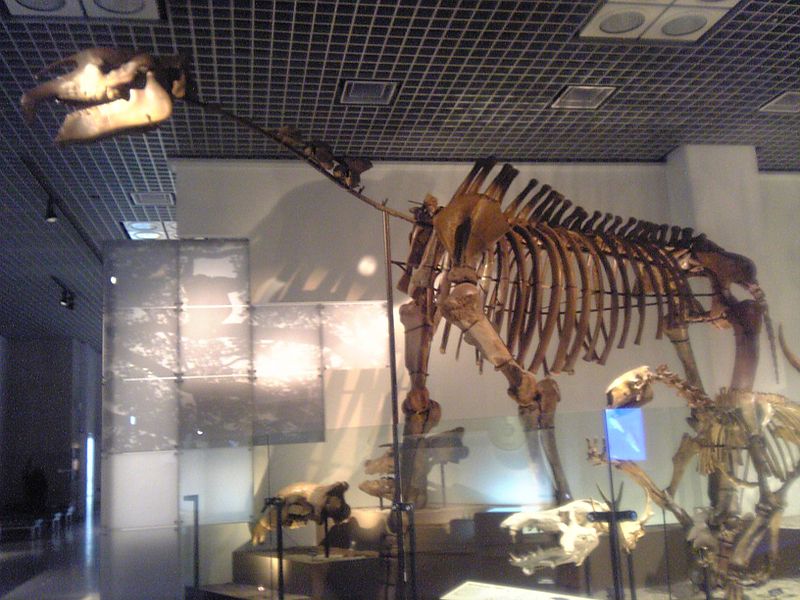 |
| From Wiki, and apparently taken at the Tokyo Natural History Museum. Japan really does have giant monsters. |
As the largest land mammal ever, Baluchitherium has made quite a dent in popular culture. It has been featured on prehistoric nature shows, sure, but the influence extends beyond that. This behemoth was the inspiration for the AT-AT Walkers in Star Wars, and it shows. The Digimon "SkullBaluchimon" is unfortunately a misnomer; it just barely looks like Baluchitherium, although its backstory as being made of counterfeit fossils justifies the dissimilarity. Does this mean we would be any less scared to encounter a Baluchitherium, much less a digital skeleton of one, in a dark alley? Of course we'd still be scared shitless! This is the biggest mammal in Earth's history, dead or alive.
 |
| It'll haunt you in your nightmares, too. |


