Showing posts with label Megafauna Week. Show all posts

Sunday, February 3, 2013

Megafauna Week: Baluchitherium.

This is it. This is the big one. No, really, I've ended this week with one of the biggest mammals of all time. Anyone who knows their paleos probably saw the grand finale coming from a mile away. For those of you who have no idea what Baluchitherium is, however, feast your eyes:


The behemoth above is a titan among titans. It is one of perhaps a few different indricotheres, or "holy CARP that is a big mammal." Just like with the Elasmotherium, indricotheres were related to rhinoceroses. We're pretty sure this one was a browser, making this gigantic beast the unofficial bastard child of a rhinoceros and a giraffe. Its name comes from the first specimen being discovered in Baluchistan, Pakistan. It lived during the Oligocene epoch- 34-23 million years ago. It probably inspired a great deal of monsters if any survived alongside humans.

The first thing that one will notice when researching indricotheres is that the classification is very, very hazy. The species are distinguished by subtle skeletal differences. Paleontologists debate whether this is sexual dimorphism, maturity, or indeed different species from the same genus. Thus the same creature (more or less) has different names, including Baluchitherium, Paraceratherium, and Indricotherium. It's hard to identify distinct species when they can't make babies anymore. We think they're all the same genus.

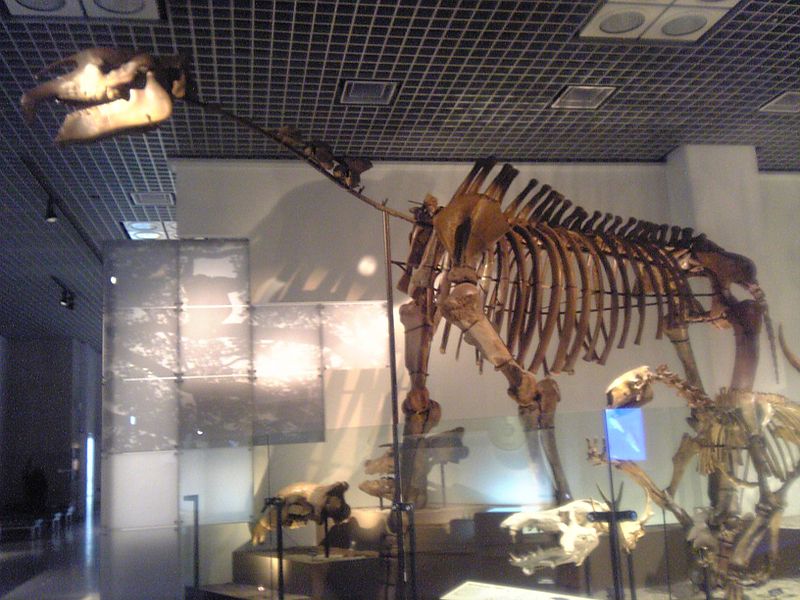
Baluchitherium was the largest land mammal known. It averaged 5 meters (16 feet) at the shoulder and 8 meters (~26 feet) from nose to rear. The image above showed exactly how small a human was relative to this beast. No matter how many measurements I give, it will not do this creature justice. Just...look at this thing:

From Wiki, and apparently taken at the Tokyo Natural History Museum. Japan really does have giant monsters.


As the largest land mammal ever, Baluchitherium has made quite a dent in popular culture. It has been featured on prehistoric nature shows, sure, but the influence extends beyond that. This behemoth was the inspiration for the AT-AT Walkers in Star Wars, and it shows. The Digimon "SkullBaluchimon" is unfortunately a misnomer; it just barely looks like Baluchitherium, although its backstory as being made of counterfeit fossils justifies the dissimilarity. Does this mean we would be any less scared to encounter a Baluchitherium, much less a digital skeleton of one, in a dark alley? Of course we'd still be scared shitless! This is the biggest mammal in Earth's history, dead or alive.

It'll haunt you in your nightmares, too.


Friday, February 1, 2013

Megafauna Week: Elasmotherium.

Ah, unicorns.  What would be cooler than meeting a unicorn? Wouldn't it be awesome if unicorns were, y'know, real? Then that unicorns VS zombies book would actually have some merit, and bronies would not be up in our faces anymore.

The good news: Macro Polo saw one. Here's what he wrote:

They have wild elephants and plenty of unicorns, which are scarcely smaller than elephants. They have the hair of a buffalo and feet like an elephant’s. They have a single large black horn in the middle of the forehead . . . They are very ugly brutes to look at. They are not at all such as we describe them when we relate that they let themselves be captured by virgins, but clean contrary to our notions.

It has long since been decided that Marco Polo was describing a rhinoceros, not a pretty white unicorn found on some chick's binder. Still, fossil evidence suggests that the traveler may have been onto something:

Chaaarrrlliiiiieee!


If the narwhal and oryx were not inspiration for the unicorn, one might suggest fossil evidence of the Elasmotherium, a relative of the rhinoceros. It lived from the Pliocene to the Pleistocene, and may have been around as recently as 50,000 years ago - old enough for a few people to have seen it and drawn it in caves. They spanned much of Asia and into Europe.

The most outstanding trait of this giant herbivore was the single horn on its face. Although "unicorn" or "monoceros" may refer to almost anything with one horn, only Elasmotherium has the horn placed right where the modern notion of "unicorn" has it - on the forehead. It was characterized as being capable of galloping based on having longer legs than most rhinoceros-like animals. We think it ate grass like a horse, too. Even with narwhals and oryx around, the Elasmotherium strikes one as a very likely basis for unicorns indeed.

Cave drawing from France.


So just how big was the real unicorn? Think 15-16 feet from head to tail. A basketball player could barely reach the top of its shoulder. It weighed 3-4 tons. Although far from the petite, slender creature depicted everywhere nowadays, Elasmotherium was still pretty amazing as far as unicorns go. Sorry, Twilight Sparkle was completely made up.

Cheer up, fantasy fans. Unicorns were once real. Sure, they weren't the prancing ponies we know today, but they were still around. The best part is, you'll never see a Christian arguing that unicorns never existed; they're in the Bible.

Wednesday, January 30, 2013

"They Actually Eat That:" Rhinoceros.

Remember when I said that humans will eat megafauna like no tomorrow? I wasn't kidding. Humans have been eating giant animals since Homo sapiens were a thing, still eat giant animals today, and will continue to eat giant animals in the future.Nothing is safe unless it is explicitly poisonous. Even then, fast food is worse for you than rhino meat:

Image by National Geographic. Look at how red it is compared to domestic meat...


Today is no exception. Everything is fair game, including the powerful rhinoceros. As long as rhinos exist, people will hunt them, just like we did to most other megafauna. We will also be eating them to the end of time. Habitat destruction is almost a new one, but this is about the edible side of things, so let's stick to that.

China, of course, is in on rhino meat. Rhinoceros horn has been touted for various medicinal properties, just like almost any other part of almost any other animal. Its main use is as a painkiller, with rhino horns fetching up to $30,000 per kilogram. There is also a concoction involving a rhino skull and coconut oil. All of this has no potency whatsoever.

A lot of people already know about the rhino horn trade. A lot fewer people realize that there is a lot of meat there. The meat itself supposedly has properties as well. It has been touted as a cure for leprosy, diarrhea, and tuberculosis. There is absolutely no basis for this.

Eating rhino is not at all common. Rhinoceroses are big, fierce animals. They're hard to kill, even with rifles and other modern weaponry. Rhino meat is still quite valuable as exotic meat. There are roughly 275 Sumatran rhinos left; we'd like to keep some around, so please don't eat rhino meat or buy...anything rhino-based, really. It may be delaying the inevitable, but let's try to keep megafauna around for as long as we can.

Tuesday, January 29, 2013

Megafauna Week: Intro + Titanoboa.

 Pinch, punch, last week of the month! You know what that means: It's a Theme Week! This month's theme is MEGAFAUNA. Let me say it in bigger letters:

MEGAFAUNA!!!!

Megafauna, in general, means "any animal larger than a human that has not been domesticated." The term can apply to both extant and extinct species. The term is usually reserved for giant, extinct animals that were much larger than their modern day counterparts. Giraffes, elephants, and many other famous African animals are also properly megafauna.  Believe it or not, the aurochs, the ancestor to the modern cow, was megafauna. We have bred cattle down a lot, and they're still pretty darn big. 

That said, there will be a lot of extinct creatures this week, too. Megafauna tends to vary inversely with human population - that is, the more humans there are in an area, the less megafauna there will be. There are a number of reasons for this.The most obvious is that humans are a lot like wolves in that anything big against us falls to coordinated effort. Less obvious things include competition for resources and habitat destruction (which kinda falls under "resources," in retrospect). Basically, humans and megafauna do not mix well.

So, without further ado, onto the first member of the heavyweight class:


Surprise, surprise: this week is starting with a giant snake. For those of you who have not seen this monster, its name was Titanoboa and it died out long before humans walked the Earth (so your hands are clean). The only known species, Titanoboa cerrejonensis, was found in the coal mines of Columbia.

Titanoboa was a giant, even among modern giant snakes. It was 48 feet long and weighed over 2,500 pounds. To put things in perspective, the longest snake, the reticulated python, is at least 10 feet shy of that. It was about as wide as a garbage can, if not slightly bigger. As for how dangerous it was, I believe the following demotivator makes the point best:


(Disclaimer: I love giant snakes.)

The discovery of a snake this big tells us a few very important things about its environment. For starters, there had to be prey big enough to accommodate such a large snake; large snakes need large food, after all. Huge reptiles also tend to live in tropical climates, meaning that Columbia was still hot millennia ago.

Before you ask, no, this snake did not eat dinosaurs. Titanoboa appeared in the Paleocene, around 60-58 million years ago. That is the time directly after the period when dinosaurs went extinct. If there were dinosaurs for it to eat, they would have been the stragglers from the KT event that refused to evolve into birds. The Paleocene had plenty of large mammals, birds, and reptiles for Titanoboa to feed on regardless.

Pop culture loves picking on giant snakes, and Titanoboa is no exception. The Smithsonian has a rather extensive page on Titanoboa, including what it would take to support one in a zoo. Primeval: New World also featured a Titanoboa, overlapping it with a Native American legend. Giant snakes are pretty common in folklore; who's to say that someone didn't discover Titanoboa before modern science?