Showing posts with label serpentes. Show all posts

Tuesday, February 11, 2014

Creature Feature: Thread Snakes.

This picture is MINE...but was done with Field Museum equipment, and is for their use.  

Now for something I actually did: This is the head of a silver snake (Leptotyphlops albifrons), a type of thread snake from Argentina. It took forever to get a picture this good! The (dead) specimen had curled such that the head was hard to spread flat, but great side shots like this were still possible. It even shows the cute white spot at the front of the snake - handy, since the tail and head look very much alike on thread snakes. Just one of the many interesting things one can do by volunteering at the Field Museum!

Thread snakes in general are pretty neat, too. There are a few different families of thread snake, but they have enough in common to comfortably be called the same thing and share an entry page. Collectively, are found almost everywhere except Europe and some of the colder parts of northern Asia. Seeing them at all is a problem; these are secretive, quiet creatures that live in the soil and under rocks. Prepare to get your hands dirty. 

Thread snakes are also called "worm snakes" or "blind snakes," and with good reason. These snakes look like worms, if not burnt noodles. They are not slimy like worms; that should be your first clue if you happen to pick one up. As seen beneath a microscope, however, these snakes have scales, eyes, nostrils, and a spinal cord, just like every other snake in existence. All of them eat eusocial insects, particularly ants and termites, at all stages of life. Some may also be parthenogenic - capable of reproducing entirely without a male. More on that particular thread snake in another entry, though.

From National Geographic. Probably the only pic out there. 


Thread snakes are the tiniest snakes in the world. The smallest snake currently on record is the Barbados thread snake (L.carlae). As the name implies, this species is only native to Barbados, an island in the Caribbean. It is so small that it feeds on termites and their larvae. The adult is small enough to, well, fit comfortably on a quarter. The snake may be on the verge of extinction due to habitat threat, but not very much is known about it at all. It was just discovered and identified in 2008, so give it a bit longer.

Oddly enough, these snakes have the proportionately largest eggs of any snake type. The mother lays only one egg...which hatches into a baby almost half her size. Scientists think that, if the babies were any smaller, they would not be able to eat. The opposite case is true with giant pythons, who can lay clutches of hundreds! Size matters - just ask the people who take home Burmese pythons without realizing how monstrously huge they get.

Source. 


I love volunteering at the Field. I get inspired for so many entries, but only a few of them make the cut. Now, if only I could actually get paid to do things like that photo up top. 

Friday, July 26, 2013

Creature Feature: Corn Snakes!

Remember when I said I had experience handling reptiles? Well...


These are all my hatchling corn snakes (Pantherophis guttatus; formerly Elaphe guttata). All of the above eggs hatched except for one, which unfortunately could not get out of its shell. They're rather neat little snakes, and one of the more common ones in the pet trade. It's totally worth doing an entry about them, if only because most people won't know what a corn snake is at a glance.

Corn snakes are mid-sized colubrids from the eastern United States, particularly the Carolinas and Florida. Like many snakes, they eat rodents. They are red, orange, and black, with speckled bellies that give corns Despite being called "red rat snakes," they are actually closely related to kingsnakes - one of the most beneficial snakes around, even according to people who hate snakes. They are also quite beautiful, even without a paintjob like my albino hatchies.


BEAUTIFUL normal from Ian's Vivarium!

Hey, speaking of paintjobs, you might notice that the wild-type ("normal") babies I hatched don't quite look like the awesome specimen above. That's because corn snakes exhibit something called "ontogenic color change." In laymen's terms, that means that they change color when they get older. It carries over into other morphs (color phases) too, so one really has to be patient to see what the adults will look like. Those drab normal babies will become bright red and orange in no time; that's part of the fun of corn snakes!

While ball python people have scores of morphs to mess with (the list is terrifying), corn snakes have a plethora of hybrids. "Jungle corns" are used to describe any mix between a corn snake and a kingsnake, and there are a lot of kingsnakes to choose from. One of the most common crosses, however, is with Emoryi's rat snake, leading to what are called "creamsicle" corns. It's almost as if, while insane breeding of ball pythons might narrow the gene pool to the point of being undesirable, the corn snake gene pool is expanding by incorporating other species. Dogs and cats, all over again. I can guarantee that we'll make a blue or green corn snake before a blue ball python, in any case.


That said, however, I still recommend a ball python for the first-time snake owner. There are several reasons for this, and they all come from personal experience. My first corn snake escaped from me and was never found again; likewise, colubrids are generally harder to catch than constrictors, being able to squeeze into a million tiny places. Especially if you have kids who might forget to lock the cage, balls are a better choice. There are millions of unwanted normal males out there for anyone wanting a first snake. Then, color your world with corns.

Monday, March 11, 2013

Bio-Art: Snakeskin Nails.

***NOTE: Apologies for not doing an entry yesterday. There were two successive power outages that more or less prevented it from getting posted. Tuesday will have a double-header to make up for it. ***

As a person, nail art is one of the few forms of "makeup" I get remotely excited about. Time not withstanding, it's one of the easier types of body decoration out there. I also happen to be a reptile keeper who enjoys the aesthetic qualities and personalities of her serpents. So, naturally, snakeskin as a nail design tool caught my attention.


To clarify, this is not done with the skin of the snake as seen on handbags or shoes. Snakes occasionally shed their entire skins, leaving behind ghostly husks of their former selves that quickly dissolve into nothingness. This habit of appearing dead for a few days and emerging from the shed with a shiny new coat of scales has led the snake to be seen as a symbol of immortality.

The first technique I heard of involved, somehow, heat-cracking the snakeskin. My immediate thought was that this would make fragile, lacy skins shrivel up and burn after just a few minutes. Maybe this was just in order to sanitize the sheds, but it did not make initial sense. It makes more sense after seeing how it was done in this video:


The technique is actually simple, albeit time-consuming: cut some shed skins to the parameters of your nails and stick 'em on, sealing them with either a fancy sealant like Terri has or, for us cheapasses, with clear nail polish. Try it with a colorful undercoat if you're feeling creative; the hint of brown or gold natural in pigmented sheds looks quite cool. (Yes, I just tried some of my own sheds on my nails.)

The bitch of the treatment is the price: 300 USD and over two hours' worth of time. Also, you'd think that this woman could market it better; just call it "dragon nails" instead of snakeskin and a whole new pile of money would appear. Plus, it's Year of the Snake; this woman should be rolling, just for finding a use for a skin that most people would toss into the trash.

P.S.- Yes, there are easier, cheaper ways to get the snakeskin look. I found a few red herrings while looking for that link.

Sunday, February 10, 2013

Creature Feature: Chinese False Cobra.

Well!  Today is the first official day of the Chinese Year of the Snake! What better way to celebrate than do kick things off with a Chinese snake, eh?

chinese false cobra 045
(This photograph belongs to its rightful owner. They are very lucky to have such a gorgeous, rare snake!)

This will probably be the first look at a Chinese False Cobra (Pseudoxenodon bambusicola) for many of you. It's native to the cool mountain forests of China. The species is rear-fanged venomous, so handle with care. In the wild, it feeds almost exclusively on frogs. This habit carries over into captivity.

The reasoning behind it being a false cobra is simple: like a cobra, this snake can flatten out a few ribs and raise its head. As Tom Crutchfield, one of the few people who works with these snakes, says, they're "the best monocled cobra mimics. Ever." 

Other than that, this snake is hard to find information on. This is largely because it's all but unheard of in the pet trade. You really have to know someone who's seen one, then done the homework, go to China and pray to Nuwa (China's local snake-bodied deity) that you can snap a pic, or randomly find it in a reptile magazine. Some Indian reptile guides also cover this species. Other than basic field information, very little is known.

These are not beginner's snakes. For starters, yes, they are venomous. There are only a select few people who will breed them, which means either spending a lot of money or getting parasitized wild imports. Finally, they only eat frogs, and nobody has found a way around it. That means no buying mousecicles for Chinese false cobras. Even pros have trouble keeping this shy, fairly docile snake alive. Please try something like a kingsnake or ball python before getting into cobras of any kind!

Just between you and me, I should have done a blue or more black snake for this entry. Happy Year of the Snake- don't worry, snakes guard your money like dragons do their treasure!

Tuesday, January 29, 2013

Megafauna Week: Intro + Titanoboa.

 Pinch, punch, last week of the month! You know what that means: It's a Theme Week! This month's theme is MEGAFAUNA. Let me say it in bigger letters:

MEGAFAUNA!!!!

Megafauna, in general, means "any animal larger than a human that has not been domesticated." The term can apply to both extant and extinct species. The term is usually reserved for giant, extinct animals that were much larger than their modern day counterparts. Giraffes, elephants, and many other famous African animals are also properly megafauna.  Believe it or not, the aurochs, the ancestor to the modern cow, was megafauna. We have bred cattle down a lot, and they're still pretty darn big. 

That said, there will be a lot of extinct creatures this week, too. Megafauna tends to vary inversely with human population - that is, the more humans there are in an area, the less megafauna there will be. There are a number of reasons for this.The most obvious is that humans are a lot like wolves in that anything big against us falls to coordinated effort. Less obvious things include competition for resources and habitat destruction (which kinda falls under "resources," in retrospect). Basically, humans and megafauna do not mix well.

So, without further ado, onto the first member of the heavyweight class:


Surprise, surprise: this week is starting with a giant snake. For those of you who have not seen this monster, its name was Titanoboa and it died out long before humans walked the Earth (so your hands are clean). The only known species, Titanoboa cerrejonensis, was found in the coal mines of Columbia.

Titanoboa was a giant, even among modern giant snakes. It was 48 feet long and weighed over 2,500 pounds. To put things in perspective, the longest snake, the reticulated python, is at least 10 feet shy of that. It was about as wide as a garbage can, if not slightly bigger. As for how dangerous it was, I believe the following demotivator makes the point best:


(Disclaimer: I love giant snakes.)

The discovery of a snake this big tells us a few very important things about its environment. For starters, there had to be prey big enough to accommodate such a large snake; large snakes need large food, after all. Huge reptiles also tend to live in tropical climates, meaning that Columbia was still hot millennia ago.

Before you ask, no, this snake did not eat dinosaurs. Titanoboa appeared in the Paleocene, around 60-58 million years ago. That is the time directly after the period when dinosaurs went extinct. If there were dinosaurs for it to eat, they would have been the stragglers from the KT event that refused to evolve into birds. The Paleocene had plenty of large mammals, birds, and reptiles for Titanoboa to feed on regardless.

Pop culture loves picking on giant snakes, and Titanoboa is no exception. The Smithsonian has a rather extensive page on Titanoboa, including what it would take to support one in a zoo. Primeval: New World also featured a Titanoboa, overlapping it with a Native American legend. Giant snakes are pretty common in folklore; who's to say that someone didn't discover Titanoboa before modern science? 


Friday, November 16, 2012

Creature Feature: Paradise Tree Snake.

Flying serpents are one of the staples of mythology around the world. Every place seems to have some sort of sky snake, possibly representing a rainbow. Even the Greeks had a few heavenly sun-snakes that pulled Medea's chariot.  Just ask conspiracy theorists: serpent deities are clear proof of our reptilian overlords, right?

But that's impossible. Something can't fly without limbs, ri- 


What the flying fark?!

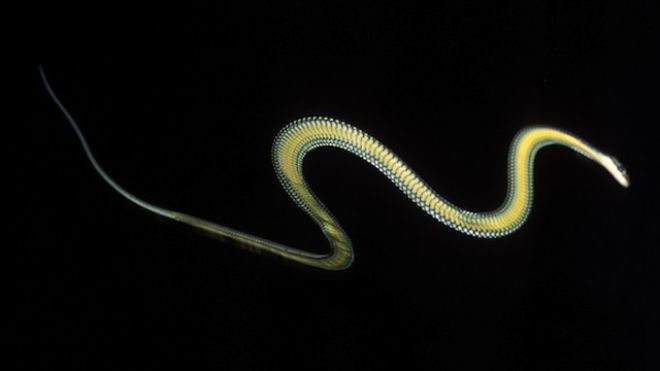
That airborne serpent is a paradise tree snake. The paradise tree snake is one of a genus of snakes that can glide. It and its relatives are all native to the rainforests of Southeast Asia. It is a diurnal predator, feeding on birds, rodents, and lizards. It also has a fair amount of predators, being a relatively small snake.

Oh, and it can fly. Technically, it can glide for over 79 feet. Yep.


To those of you who blinked and missed it: To start gliding, the snake The people in this video honestly do a better job of explaining the physics behind this snake's gliding than I ever could, but in layman's terms, how many of you know of flying rings? Yeah, it's kinda like that, only alive. 


As if a flying snake was not enough to scare quite a few people, these gliding snakes are able to steer. To put into perspective how hard this is, other gliding animals with limbs have a hard time steering in mid-air. Precisely because these snakes slither through the sky, they have excellent control.  Cool...if you're a snake person, that is.

Paradise tree snakes are not readily available in the exotic pet trade. They're around, sure, but by no means common. Dietary questions come up; anoles and pinkies are usually the answer. Beware of any of these that you find at herp shows. Even the snake in the video had some nasty parasites. They are also rear-fanged venomous, so please check your local laws before buying!


Friday, November 2, 2012

Blasphemy Week: Golden Lanceheads.

Y'know how I keep saying "if you want to stop the exotic animal trade, stop humans from living there?" It turns out there is indeed a place where humans are not allowed, and that still doesn't stop people from taking venomous, hermaphroditic snakes off the island.

Wait, what?


Bothrops insularis, or the golden lancehead, is found on exactly one island in the entire world: Ilha da Queimada Grande, located off the coast of Sao Paulo, Brazil. It eats birds and lizards as an adult, and is occasionally cannibalistic. The island supposedly gets its name from a plotted banana plantation that did not go through thanks to one very obvious thing: There is at least one snake for every square meter of the place.

The golden lancehead is the only species of snake on this island. What it lacks in biodiversity it makes up for in sheer numbers. Locals say that there are 5 snakes per square meter on that island. Discovery Channel says there is really only one. The point is, everywhere you turn, there's a snake. It's amazing that good pics of this thing exist; most people would probably drop their cameras.

Think the brown tree snakes are more terrifying? Golden lanceheads are highly venomous. The snakes' closest relative is the jararaca, another lancehead whose venom's ACE inhibitors have recently been used in medicine to treat hypertension. The golden lancehead's venom is at least 5 times as potent as the jararaca's, and the fastest-acting of any lancehead. Luckily, no bites have been reported...yet.

Unless you have a deathwish or are a herpetologist, DO NOT GO HERE. (Source)


Oh, and no humans are allowed on the island. Period. The Brazilian Navy will arrest you if you are there without a waiver. The population is said to consist of exactly one human in a lighthouse and the occasional herpetologists that get waivers to go on the island. Even the natives avoid this place. There are no human settlements there except to warn people that they might land upon an island of venomous snakes. Lovely.

A lot of golden lanceheads are also intersexed. In not-so-polite terms, they're shemales, hermaphrodites, or chicks with dicks. They contain the sexual organs of both sexes, which usually results in infertility. Usually. Apparently some can breed, but regardless, this questionable sexuality is the result of extreme inbreeding.


In case you haven't guessed: Yes, these snakes are critically-endangered. The island is still farm potential, but as we all know, island ecosystems are fragile. That includes island ecosystems containing creatures of hermaphroditic, scaly death. They're terrifying, but goodness knows what'll happen if this one snake gets taken out of the great Jenga tower called nature.

And yet we somehow have photographs of these beautiful hellsnakes, as well as a few specimens in captivity. OK, fine- the reptile lover in me is showing her scales. I do, however, realize that an island full of poisonous snakes would be terrifying to most people, so there you have it. As for why it exists to begin with...either there's a holy relic there or God is a sadistic SOB.

Sunday, October 28, 2012

Creature Feature: Tentacled Snake.

Look at that title. Really, look at that title and use your imagination. There are a million ways to get creative from the title alone. Did a snake do it with an octopus, and is this entry devoted to their unholy lovechild? No. Is it the ultimate in tentacle pronz? No. It's just a water snake that just so happens to have tentacles on its face.


The tentacled snake (Erpeton tentaculatum) is a rear-fanged water snake native to Southeast Asia. It is wholly piscivorous. Its entire life is spent in muddy lakes and rice paddies. Some even venture into seawater.  Unlike some snakes, which come in a rainbow, tentacled snakes are only striped or blotched. Like many water snakes, they have live babies. 

The tentacled snake was not science's most creative naming venture. The most prominent thing about this water snake is that, yes, it has tentacles. These tentacles detect fish better than the snake's tongue ever would. They use a blend of sight and touch - yes, these tentacles loop back to the vision center of the snake's brain. Imagine sticking your tongue out periodically underwater; that is why they evolved tentacles.

The evolution of tentacles is far from this snake's most impressive feat; how it uses them is just as cool as their existence: 


The way the tentacled snake manages to catch the fish is a whole different matter. In the video above, you can see the snake bending its body right after it detects the fish. This motion is enough to trigger the C-start (escape) reflex of the fish, sending it straight into the jaws of death. This snake is predicting what its prey will do next. That's pretty impressive.


Most of us think of the reptile brain as primitive. The revelation that snakes can meter out their venom and the behavior of the tentacled snake above should be enough to make one wonder how intelligent snakes really are. This one just so happens to have tentacles, making it either cooler or creepier. Your mileage may vary, of course.

Tuesday, October 23, 2012

Creature Feature: Brown Tree Snake.

Ever wonder where some laws come from? There are whole webpages devoted to cataloging unique laws that make no sense in other countries.

There are also some crazy laws that don't make it past the House and Senate. Thank goodness HR669 was one of them. HR669 would, in short, have made it illegal to keep any "exotic" animal - even things as small and cute as parakeets and chinchillas. When you think about where the law came from, it makes a modicum of sense...but that doesn't mean it needs to apply to the rest of the world.

This law originated from Guam. In case that means nothing to you, Guam has a snake problem. A big, brown snake problem that has killed off 90% of Guam's native fauna. While someone from Guam has perfect reason to be afraid of snakes in particular, their brown tree snake situation is insane. Let me show you.

From NatGeo. Actually kinda cute.


This is a brown tree snake (Boiga irregularis). It's a slender colubrid (i.e. not a boa, python, elapid, or true viper) that can get around ten feet long in extreme cases. It actually looks really cool for something with such a mundane name, and has very mild venom. The brown tree snake is endemic to northern Australia, Papua New Guinea, and that general area.  It has also been naturalized on Guam...and this introduction is consequently proof that there is no God.

The snakes were not consciously brought to Guam. They hitchhiked in some wood on a military boat sometime after WWII (some places say 1948). From there, one gravid female hit the jackpot: her babies now had a supply of food that rarely happens in nature. How bad was it for the ecology on Guam? Let me express it in numbers.

There used to be 18 species of birds on Guam. Fifteen of those 18 species are extinct. All lizards save the (also invasive) house gecko have also been devoured. This was an island with almost no natural predators, let alone any defenses against venomous, Australian snakes. 

All species of endemic mammals on Guam are now functionally extinct if they are not outright gone. There were only three mammals endemic to Guam, and they were all bats. To a snake's mind, a bat is a cross between a bird and a mouse. Those three bats were definitely on the menu.


Oh, and forget Burmese pythons being man-eating monsters. Brown tree snakes have absolutely no fear of humans. The snakes cause power outages, of all things. Although there is absolutely no way that a brown tree snake could fit its mouth around a human infant, some have tried. This was not an accidental feeding error of any kind; these snakes fully, 100% intended to eat human children. There have been at least 11 cases of this between 1983 and 1993. That's more than the recorded amount of man-eating python incidents. Nothing is safe from brown tree snakes.

Before you suggest anything about stopping these snakes, it's too little, too late. Repeated introductions of mongoose onto snake-invaded islands have actually proven to hurt bird species more than snakes (I'll get into why when I cover habu- I've already done them as food). Guam is slowly becoming an island of the snakes. Since it's a transportation hub, however, it could easily spread to other islands like Okinawa...and apparently also Texas. Even with dogs sniffing the snakes out, it sounds like Guam itself is pretty screwed.

That's the thing about Guam's situation: It's the exception rather than the rule. Not every introduced species will flourish like this. The worst invasions are accidental introductions like this. Illegalizing the pet trade will not stop the problem. At least we know what we're shipping. You wanna stop Guam from happening again? Ban humans.

Sunday, October 14, 2012

NARBC 2012 Coverage.

First off, the turnout was more impressive than last year in some ways, but a letdown in others. The biggest bummer is that there's a frozen rodent shortage going around.  Literally nobody was selling mice. That sucked, to say the least.

So, here were the highlights:


Cold-Blooded Creatures had a display outside the hall.  Among their offerings was the legendary super-tame alligator, Bubba. Disclaimer: Results with alligators are not typical. It's obvious that the people who tamed Bubba had a ton of experience with alligators before handling him. RESULTS NOT TYPICAL; do not try this at home. 


The first thing I saw upon entry into the actual convention hall: So. Many. LEOS! Actually, they had a few fat-tails, too. I'm still intrigued by lizards after seeing so many wild ones in Rome. Leos have a ton of colors, including eye morphs. I will most likely get a lizard in the future, but exactly what kind remains to be seen. Leos are a good starter bet, though.


This woman had a baby leopard tortoise in her hand. People do that at these cons - you can find a few new owners showing off their catches to other collectors. I wouldn't recommend letting people who have been touching unknown reptiles handle your new pet, though. You don't know where those hands have been.


In case I never touched on them before, NERD (New England Reptile Distributors) is one of the biggest ball python breeders in the world. They invented the spider morph and use it frequently in their projects. The 'next big project' involves a new gene called "Lucifer." Someone loooooves them balls.


To put things in perspective: these hatchies (also from NERD) were probably in the 10,000 dollar range. For real.


Retics! I can't get enough of the wacky paint jobs that people give the largest snakes in the world. I know balls are the ideal pet snake in several aspects and have a plethora of colors and patterns, but there's something about retic patterns that keeps making me go "wow." These guys are a different type of albino than my usual, though...


...that's better. :)


Like most geckos, crested geckos can drop their tails to distract a potential predator. Unlike with most geckos, however, the tails do not grow back. The result is a cute little lizard with a very stumpy tail at a discount price. Don't worry- the stumpy tail is not genetic.


This yellow monitor seemed rather stressed in its little plastic display box. Don't worry - wherever it winds up, it'll have more space.


This seller had few more random lizards, including a basilisk - my personal favorite lizard, but not for beginners. I'm a little bit wary of this particular vendor, who has been here every year. The beauty snake I checked out there once looked like it may have been a wild-caught import...but on the flip-side, they always have some really cool, unique stuff.


 This skink was so cute! Another con purchase being shown the world by her new owner, this girl was sooo sweet! She liked being scratched behind the ears to the point where she would cuddle right into your hand for more. Unfortunately, she never showed her blue tongue to the camera.


Aaaand my own personal catch from the convention: a female hypo boa. She was sold for only 40 bucks by people donating money to help save an endangered Siamese crocodile. Boa constrictors are a sort of standard introductory 'big snake' for people who aren't sure if they can handle a Burm, but still want to lean towards larger reptiles. They're also extremely photogenic; if you see a beautiful woman with a large snake, chances are it's a boa or Burmese python. So, yes, I am well aware of how big a boa can get.

P.S. - another bio-artist was sighted. She will get a free plug Monday. ;)

Sunday, October 7, 2012

Creature Feature: Indian Cobra.

Looking at the title, one or both of two things are probably running through your head: one, this is totally typical of me, and two, why am I picking on such a well-known animal? The answer might surprise you: In the wake of yesterday's little video on morality, is it possible for evolution to occur via religion?

As a rule of thumb, humans do not kill animals that they like. Chances are, if you eat meat and live in the U.S., you do not personally know the cow that your hamburger came from, and you would not eat your own cat or dog unless it came down to survival. Culture decides which animals go and which ones stay. In stark contrast to America's picky eating habits, we have China, where the best way to absorb an animal's qualities is to eat it. If something is considered sacred to a culture, it will usually be left alone.


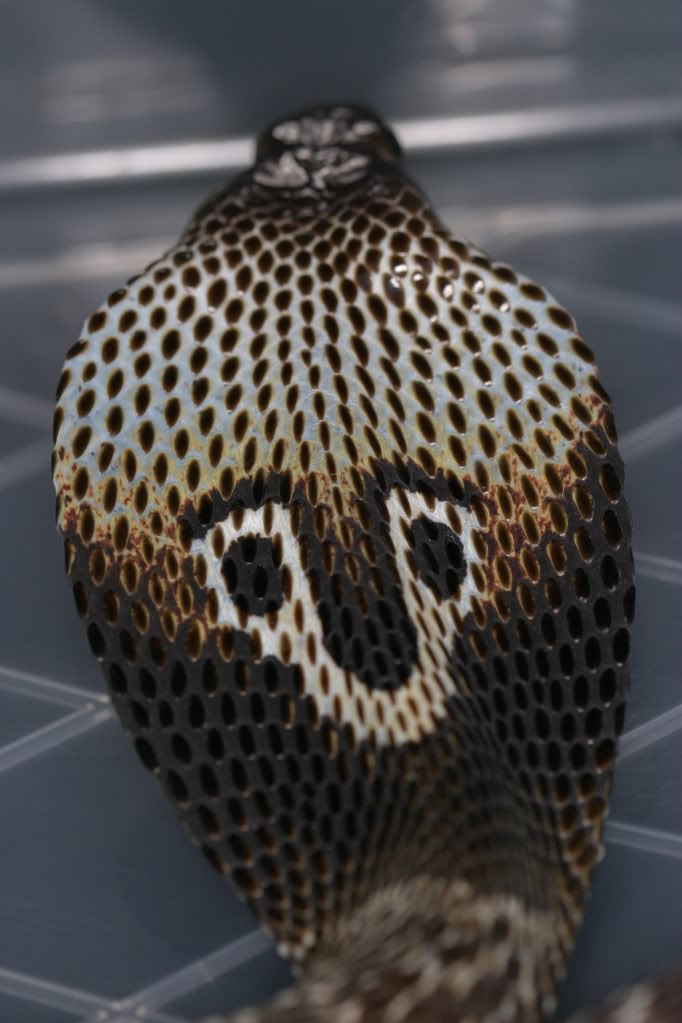
Everybody reading this probably knows something about the Indian cobra, AKA Spectacled Cobra (Naja naja). The first name comes from being found in India; the second, from the marks on its hood. It eats rodents, birds, frogs, and, yes, other snakes.  This is often the cobra used in snake charming, so you've probably at least seen a bad caricature of one.

India is practically known for snake worship. Buddha is sometimes seen shielded by a multi-headed cobra;  numerous deities show the cobra like a protective talisman; snake charming happened in India and almost nowhere else for a reason. India is the only place with an official 'Big 4' of poisonous snakes (although Australia probably has something similar). They have whole festivals in hopes of not getting bitten. They also have an interesting story to explain how the venomous Indian cobra got such interesting markings on its hood.

From http://www.profilekiss.com/.


Legend has it that Krishna, one of the biggest, most powerful gods in the Hindu pantheon, was asked by some cowherds to detoxify a river. All living things that drank from that river died, so yes, it was a pretty big deal. The source of the poisoning was the naga (big cobra) Kaliya, who, in some versions, was hiding from Garuda, a half-bird half-man that was the mortal enemy of nagas. Krishna still had to get the snake out of the river, and gave the cobra a stomping. Those footprints remain on the snake's flattened hood to this day. Another origin story reflects the pattern's similarity to the 'om' mudra, but that's far less exciting than a snake getting trampled.

The Indian cobra already has some respect for being in India's Big 4; that and the cobra's visually-impressive display were enough to get it deified. That has, intentionally or not, been taken a step further by selecting which snakes should live by the markings on their hoods. Although Indian culture is generally wary of killing any cobra, their neighbors in Pakistan are not so kind, and actually discriminate against cobras with hood marks and cobras without.

This really does look like footprints! Source:Wikipedia.


Pakistani culture (i.e. a culture in an area very close to India- no, I am not accusing the two of being the same) treats marked and unmarked cobras differently. As per Secrets of the Snake Charmer, black Indian cobras are called "Caro," "fierce," while the ones with hood markings are called "Padam," peaceful. Supposedly, a fierce cobra lives for 125 years before becoming 'peaceful.' Pure black cobras are usually killed; the ones with the footprints of Krishna on their hoods are spared. It is thus probable, although not really provable, that something similar could have happened in India.

If this is selective breeding, it is selective breeding of a most unusual sort. It's not like the snakes are being bred in a facility to have the most elaborate hood markings possible (although no doubt some have tried). It's more like snakes with the marks have a carte blanche to live fuller, happier lives than their unstamped counterparts.

Could India be unintentionally breeding cobras for hood markings? It seems likely. Now, what about other hood markings? You'd think that looking like a bull's-eye would be a bad thing.


Sunday, September 30, 2012

MYTHBUSTER OP: Five-Headed Snakes?!

Last night, a friend told me something interesting. A live, five-headed serpent had been found in the wild, alive and well. The radio shows described the image as looking "freaky." Supposedly, the polycephalous snake was taken into a temple because it was thought divine.

Aside from this report from Argentina, I have not seen anything that would cement this snake's existence as fact. I try to keep an open mind; after all, this blog covers a million 'impossibilities' that actually happen right under our noses. Five-headed snakes are also consistent enough in mythology that one must wonder if they can indeed occur in nature. It would not surprise me if they could exist, but actually seeing a good photograph of one strikes me as unlikely.


That said, every image of a five-headed snake I have ever seen has been a fake. The snake above is unfortunately a bad copy-paste job. It's obvious that the scales don't flow right, and it just looks bad. Others are more convincing, but none of them are the real McCoy.  Just because some are nicely done doesn't mean any of them are real. 

This is not to say that a five-headed snake is completely impossible. Two-headed snakes happen all the time. For whatever reason, turtles and snakes have a higher than normal track record of having two functional, separate heads. Hydras and genbu already have plausible reasons to exist.  A report of an amphisbaena surfaced recently as well. Five is unheard of, but there's always a first time. I have hope.


So now we have a rumored news report of a live, wild, five-headed snake. Can anybody confirm or deny this? There are certainly plenty of fakes out there. If a real 'naga king' has been found, it should be making world news.

Saturday, September 1, 2012

Creature Feature: Rainbow Boa.

Although some people might recoil at the mere thought of snakes, rainbows are one of the more positive things that they tend to be associated with. China and Australia both make mention of a "rainbow serpent" of some sort - in the case of China, it even has two heads! Considering that some snakes are iridescent, this should come as no surprise. It's still awesome when science and lore agree on something,  so here goes.


The rainbow boa (Epicrates cenchria) is a real snake- and what a piece of eye candy! They are native to Central and South America. Like all boas, they have live babies.Rainbow boas eat anything small and warm-blooded that they can sink their teeth into.

The rainbow boa is named for, you guessed it, its multicolored luster. Rainbow boas are highly iridescent, unlike some snakes that only yield a flash of color once in a while. A flash of cyan looks quite striking against the red and black patterning, too. Your mileage may vary on whether this or the sunbeam snake has more shine. Some people have hailed the rainbow boa as the most beautiful snake in the world, but it has serious competition for that title.


This shininess has made rainbow boas highly desirable snakes in the pet trade. A lot of specimens have been taken from the wild, decreasing the amount of rodent-eaters in the ecosystem.  Luckily, the upside of this is the abundance of rainbow boas bred in captivity.  I would still ask where any given rainbow boa came from; if the answer is "from Brazil," don't buy it! Boas are good for the ecology down there. There's no need to take them from the wild anymore.

Rainbow boas are not a beginner's snake. Beautiful though they may be, they do get around 6-7 feet in length. All of them require extra humidity unless you happen to live in a rainforest already. .I wouldn't call them a good 'first' snake; the guys at my local reptile place were honest when they warned me that Brazilian rainbow boas were fragile. Those that keep them well, however, will be rewarded with a real light show in their terrarium. These are snakes for looking at more than handling.

Tuesday, July 24, 2012

Creature Feature: Temple Viper.

There is no creature more prevalent in mythology than the snake. If a culture is near snakes, they've got stories about them. The snake is simultaneously hated and revered, cursed and respected. They are so different from humans that they must be magic. No wonder everybody talks about them!

Then there are some serpentine coincidences that cannot simply be dismissed as coincidences. The white snakes in Iwakuni are a good example; Japan is loaded with eagles, cats, and a million other things that would love to munch an easily-visible snake, but there managed to be a lot of Shirohebi in one place. The Temple of the Azure Cloud in Malaysia has a similar, much more deadly tale to tell...


...thanks to being the home of dozens of Wagler's vipers (Tropidolaemus wagleri), AKA "temple vipers." They are native to Thailand, Sumatra, and Malaysia. Arboreal snakes, they eat rodents, birds, and lizards. They are in the same viper group as rattlesnakes, which should give you an idea of how nasty a bite can be.


Temple vipers come in a million different color phases. Some are brown; some are orange; some are bright green. They used to be classified as subspecies, but now they're treated more like morphs. In temple vipers, the females are a lot larger (up to a meter long) than the males, so they're nice and easy to sex, too. Y'know, just in case you want the gender of the snake that bit you.

 I've gone into the neat adaptations of pit vipers before. Their teeth are organic syringes. They hunt you by heat and scent, both things that mammals have trouble concealing. This snake also has camouflage on its side, coupled with a nice strike that can probably catch birds in mid-flight.  The venom is hemotoxic, which is is own brand of hemorrhagic nastiness. On the bright side, I kid you not, some people think this snake's venom has the potential to remove wrinkles. Whatever floats your boat.

So, why are these snakes at the temple? Legend has it that a Buddhist monk decided to give shelter to the snakes of the jungle. Indeed, there are more snakes there than just the temple viper. Some of them have been defanged, but do you really want to risk messing with one that just got its teeth back in? Yes, snake fangs grow back. Just another reason that mammals are screwed by our own global warming issues.

Sunday, July 8, 2012

Creature Feature: African House Snakes.

After being pissed off at a certain statement, I decided that this blog needed to show off more cute scaly things. I just heard today that a ball python was in the news; snakes are getting a worse and worse rap every day. Time to fix that.


"House snake" can refer to any snake in the genus Lamprophis - literally "shiny snake." Unlike the extremely diverse python family, house snakes are all mid-size snakes (a little smaller than a corn snake - another common snake in captivity) native to most of sub-Saharan Africa. They eat rodents and other small land animals.

There is a lot of confusion over who's in what species; house snakes are poorly-researched, leaving much of the work to be done by captive breeders. Even the captive breeding results vary when it comes to hatching hybridized babies. To make matters even stickier, they are frequently mislabeled in the trade; almost everything is Lamprophis fulginosus. Thus, as much as I hate doing this, the whole genus will be covered in one entry.

The aurora house snake is a bit harder to find than other species.


Species classification aside, house snakes have a lot in common. House snakes are not venomous. They come in a lot of colors, often sporting iridescence. They only get around five feet long, if that. A million things eat them. Just about the only thing remotely terrifying about these guys are their slit pupils, which most hobbyists find cool.

African house snakes are the definition of cartoon snake: Green or brown, random markings, slit pupils, and otherwise a generic colubrid.  They're just cute like that, even as adults. I realize some people are ophidiophobes by default, but for those of us with the potential to like snakes, house snakes are as charming as they come.

And the albinos look awesome.


I'm honestly surprised that house snakes aren't more popular in the pet trade. They don't get too big, come in several color patterns and morphs (including albino), and are a great first snake. They can take a high temp range. No extra lighting required; they can breed with normal day sh normal light cycling. Everybody has corns and ball pythons; not many people have house snakes.  The only issue is that some hatchlings need their first few meals lizard-scented. The species thing is another problem entirely; let the pros deal with that one. 

Sunday, June 3, 2012

Unova Edition: The Snivy Hunt Continues.


Serperior has got to be one of the most frustrating entries on Bulbapedia. If it's a snake and has "green" or "royal" in the name, people instantly assume it must have some ties to Serperior, the final evolution of the Snivy family. The grass and vine snakes I will validate; there is one, however, that seems to have escaped the public's eye entirely. Hell, I didn't even know this snake existed until one of my kingsnake.com escapades:

From captivebredreptiles.uk forums.


Meet Baron's Racer (Philodryas baroni). It lives in Bolivia, Paraguay, and Argentina. Like most snakes, it eats small mammals and birds, as well as fish and amphibians. As the Greek name might indicate, it's arboreal ("likes trees") and can also be found around salt flats. It will flee before anything else, hence "racer."  Oh, and it looks a whole lot like a member of the Snivy family. Not dismissing the vine snake theory (which I admit is likely), but this similarity is just creepy. (Plus, if you're citing the royal python just because of the name, surely "baron" qualifies as well.)

Click around enough Baron's Racer pages and one will notice that they have a fair amount of natural color morphs. The wild versions come in green (like Snivy) and brown. Captive breeders have also been working on a bright blue morph (as they have with rhinoceros rat snakes as well). Hello, Shiny Serperior!

Japan definitely knows about this.


Baron's Racers, although not really harmful to humans, are technically rear-fanged venomous (as are some vine snakes). This means that they have some venomous fangs toward the back of their mouths. Symptoms of envenomation include localized swelling and inflammation, with symptoms progressing slightly upwards from the site. All symptoms ceased after 48 hours. Nothing to worry about, but, from personal experience (with a different snake, mind) still a little freaky. There have been no fatalities from Baron's Racers.


Along with looking like a Snivy, these snakes have one other neat trait: they can glide from tree to tree. This is an example of convergent evolution with the Chrysopeleia complex, also known as Paradise Tree Snakes. The Paradise Tree Snakes are native to Southeast Asia, as are the Ahaetulla vine snakes. There are quite a lot of such examples of convergence, including a rather striking one that I intended to cover earlier on this blog...but will salvage and polish up this coming week.

Baron's Racers are uncommon in the exotic pet business. They are not particularly hard to take care of, but not many people have them. The captive breeding age is about normal, with 3 years as the breeding age for females. The only reason they aren't more common is simply because not many have been imported. There are several good captive breeders, however, so please ask one of them if you want your own pet Snivy. Have a credit card or good ball python morphs ready; prepare to pay at least 150 USD and shipping.


(Interesting side-note: While working on a report, I found another bit to chew on relating to Serperior. Although Thai art is never explicitly cited as a source, the resemblance of a naga - a regal, jacketed snake- being eaten/vomited up by a makara to Serperior's own 'jacket' and stubby limbs is uncanny...and kinda disturbing. I'm probably just seeing things this time around, but the serpent devouring/vomiting is a pretty common recurring theme. This was just the first time I had seen it serpent-on-serpent. More here.)


C'mon, Bulba-people. Get your hands a little bit dirty in the exotic pet trade - or some good reptile books - next time a snake comes around. Maybe I'll have to make use of that account...

Sunday, April 22, 2012

Creature Feature: Blue Garter Snake.

Back in the world of the living, the author of these posts sometimes wonders exactly how people can be afraid of snakes. It's not just her weird definition of 'cute' talking - put simply, exactly how is a bright pink boa terrifying?

Garters are already pretty neat snakes. Along with boas and vipers, they are among the serpents that have live babies. They are the ideal pet snake for someone who hates handling mice; they can eat worms, fish, and other things neither cute nor fuzzy. They have some very mild venom in there, but don't worry about it - it's only toxic to things much smaller than a human.

Oh, and did I mention that they come in electric blue?


There are a number of blue garter snakes, but the most coveted are the Florida bluestripe garters (Thamnophis sirtalis similis). They are native to, go figure, Florida, and are a subspecies of the Common Garter Snake (T. sirtalis). They prefer to eat other aquatic things, e,g. frogs, fish, and worms, as opposed to mice.

Starting with the obvious yet again, no, that snake was not Photoshopped. The bluestripe garter really is electric blue, which is one of the few colors that corn snakes could never manage. They are being selectively bred for more and more blue. Hopefully, the breeders have enough artistic sense that we will eventually end up with electric blue stripes on a velvety black background.


(Not mine.

If you happen to live in Florida, it is possible for you to catch these snakes in your on backyard. It can be found from the Gulf Coast inland. Look for it in pinelands, hammocks, prairies, and marshes - basically, anywhere that isn't urbanized to hell and back. They're not a rare snake at all, and they look awesome.

To a degree, I can understand some people's severe fear of snakes. As a friend of mine aptly pointed out, however, can you really take a snake seriously when it has a bright, multicolored neon display for a color palette? I think bright colors are cool, especially when black is used as contrast. The more ways we herpers have to eliminate the fear of snakes, the better.

Sunday, March 18, 2012

Creature Feature: Rhinoceros Rat Snake.

So, I should be polishing my field report on my trip to Wat Dhammaran, a Thai Buddhist temple in Chicago. It's strange how at-ease I feel around Asian temples. This one's favorite theme was the image of Buddha enthroned and sheltered by nagas. That alone was enough to put me in heaven.

For those of you who have been corrupted by the internet, nagas are the rough Hindu/Buddhist equivalent of dragons - both the East and West kinds. They are often based off of cobras, which are themselves revered as the kings among serpents. They can also be hybrids of snakes and humans. Nagas are often respected as deities of water, with their own special type of water-borne fire in Thailand's Mekong River. That's not the only thing unique about them...

Nagas! on Twitpic

Remember how I said nagas are usually based off of cobras? Thai nagas are very not cobra-like. They have hoods if you squint, but that crest of 'fire' takes all of the attention away. It is almost as if they combined a cobra with an oarfish. Aside from the oarfish, however, there is one other animal that these giant dragon-snakes remind me of:


It's a living naga! Sort of. It's actually a Rhinoceros Rat Snake (Rhynchophis boulengeri). These snakes are native to China and Vietnam - no, not quite Thailand, but perhaps close enough to provide inspiration. They eat rodents, birds, and other small vertebrates.

The most outstanding thing about this colubrid is, of course, the scaly formation on the nose. It is excellent camouflage; see vine snakes and Baron's Racer for other examples of eerily-pointy snakes. It has green scales, too, so it'll look even more like part of the scenery.


Rhino rat snakes are expensive and among the more delicate captives. They are slightly tricky to breed, but not impossible. The females in particular are being bred for more blue in their palette. If you're an experienced keeper and are looking for something to add to your already-exotic collection, it's harder to get weirder than a unicorn-snake.

P.S.- new poll up! I'm equally fond of all of the ideas, but voted "La Vie En Blanc" just so that I could see what others were voting. XP

Sunday, February 26, 2012

Creature Feature: Return of the Burmese Pythons- Morphs + Hybrids.

One entry does not do Burmese pythons justice. Call me obsessed, but they really are cool snakes. I'm going to miss the dent in their population.

Specifically, the Burm ban prevents me from getting my all-time favorite snake: A Borneo Bateater.


The Borneo Bateater is a hybrid between a reticulated python (P. reticulatus) and a Burm (P. m. bivittatus). It was probably not found in the wild, and, if it was, it certainly did not consume bats.  Please; it's the hybrid of two large snakes. Bats would be a poor diet for it.

The Burmese python was one of the snakes that really got the reptile trade started. There was something really special about the first albino Burmese that came over approximately 20 years ago (anyone got a date on this? I used  to know it). It was the white tiger of the snake world, if you will. They were bred so often that, for whatever reason, albino Burmese have a higher fertility rate than their normally-colored counterparts.


Since then, the Burmese python has been bred with no less than ten different color and pattern morphs. These have been mixed and cross to the point where, not only can one have an albino Burm, one can have an albino granite, albino green, albino labyrinth...you get it. They all look really nice. The leucistic once thought legendary also proved heritable, so expect to see more hypo crosses, soon. Codominant traits are fun because they show up in the first generation! The people in the business are currently working on dwarf Burms, too, so size will not be such a big issue after a while.

I'll host it myself later...but that is a BEAUTIFUL eye.


Back to the Bateater. This hybrid has to be the most identity-challenged serpent on the face of the planet. Not only is it a hybrid, but it has the pattern and facial markings of a wildcat. Weirder still is that it is capable of breeding back to either parent, creating "jungle Burms" (3/4ths Burm) and "jungle retics" (3/4ths retic). Both of them look substantially different from the original species. Goes to show you what a little bit of experimentation can do.

Burmese pythons can cross into a lot of things, in fact. There are cateaters, which are the ultimate horror story python: African rock x Burmese, leading to a huge and possibly aggressive animal.  Burmese pythons have also been able to mate with ball pythons, leading to this:

Freaky. Trippy. Can I get it in lavender? :D


As for my actually getting a Batater? Too expensive right now. I'd love to have one, but I'm a responsible owner. Current means will not allow the author of this blog to possess a giant snake. Yet.