Showing posts with label wasps. Show all posts

Tuesday, November 23, 2010

Creature Feature: Emerald Jewel Wasp.

Enough of the cute and furry things. Let's do something shiny and insane...just like a Lady Gaga video.

The emerald cockroach wasp, jewel wasp, or Ampula compressa is probably one of the prettiest wasps you will ever see.  It lives in South Asia, Africa, and the Pacific Islands, and it is one sick, beautiful bug.


If you were smart, you probably skipped this entry at the mention of "cockroach." Despite being extremely adaptable and going virtually unchanged for eons, humans generally do not like cockroaches in their homes. This wasp's aim in life is to get rid of them in the most sadistic way possible.

Emerald cockroach wasps lay their eggs inside a cockroach's body. This is not unheard of in the insect world; there are a number of wasps that lay their eggs inside another insect or brainwash a caterpillar into guarding their pupae.

This wasp does both. She aims, very specifically, for the ganglion (nerve, roughly equivalent to a spinal cord) that controls the roach's front legs first. Her second sting aims for the brain - again, the specific part of the brain that controls the roach's escape reflex.


This is an act of violence, not love. 

Before I go on, think about that for the second. Not only has the wasp disabled the roach's limbs, she has turned off its flight instinct with a very precise injection. A cockroach that cannot skitter away from the light is a very dead bug. The rough equivalent in humans is this:


After brainwashing the roach, the wasp leads the zombie-roach to her burrow. She eats  bits off of the roach's antennae and lays one egg in the stunned cockroach. The larva hatches within the roach's body, slowly eating away at its corpse until it pupates. (The wasp larva eats just the right organs so that the roach will remain alive as long as possible.) Then the cycle begins again.

I bet you never thought you would wind up sympathizing with a cockroach, eh?

Tuesday, July 20, 2010

Creature Feature: Ichneumoninae.

Although many vertebrates may take on the pattern of "big, impressive male, small female," insects tend to see the world a bit differently. Many of you have probably heard of the praying mantis eating the male after mating (which, again, makes PERFECT sense to me), and of ant/bee queens. Sexual dimorphism in favor of the female is not a hard and fast rule for insects, but seems to be pretty solid in the order Hymenoptera - the order containing ants, bees, wasps, sawflies, and hornets.

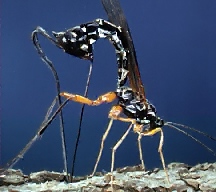
This brings us to ichneumonoid wasps. If you thought the reproductive system from the Alien movies was weird, bear in mind that the Xenomorph's way of doin' it was based LARGELY on this particular sort of insect (with later nods to eusociality).

If the earlier entry on botflies did not tip you off, chest-bursters are very, very real in the cruel world of nature. There are a number of ways that they can theoretically happen, but, in the case of ichneumon wasps, they deposit the eggs via a whip.


"If I be waspish, best beware my sting..." Yeah, I'm sure I butchered that Shakespeare quote, but stingers ARE derived from ovipositors. Way to lace an extra innuendo in there, Bard.

The females of Megarhyssa and Rhyssa in particular are equipped with slender, narrow ovipositors (tubes for depositing eggs). Although many insects have ovipositors of some sort, ichneumon wasps have ovipositors that curl over like scorpion tails. This has given them the nickname of "scorpion wasps."


Why does the female need such a long ovipositor? Ichneumonoid wasps lay their eggs inside other insect larvae. The infected larvae are, slowly but surely, eaten alive.


Despite their creepy appearance and alien reproductive habits, these wasps are quite efficient at pest reduction (like the giant hornets are). They also use polydnaviruses to suppress the host's immune response, which is more than can be said for the Xenomorphs.


Just pest control. Nothing personal.