Showing posts with label hymenoptera. Show all posts

Sunday, November 27, 2011

Creature Feature: Electric Ant.

A lot of people in the United States are freaking out about Burmese Pythons in Florida. While escaped giant snakes often make the news anyways, the problem in Florida is that a lot of them escaped and are breeding. This puts the native alligator population in considerable danger. It doesn't help that these particular snakes now have a reputation for being man-eaters after one devoured somebody's daughter.  Thing is, even with these points, there are always damaging invasive species wherever humans travel...and they don't have to be very big to cause a lot of damage.


The ant above is called the electric ant or little fire ant (Wasmannia auropunctata). As both common names imply, these ants sting like a bitch. They have a distinctly brassy color so that, should you see them on your food, you know to run the eff away. They are native to Central and South America. Ants are among the few species besides humans that wage war, but this ant takes the term "invasive species" to a whole new level.

See, along with Central and South America, these ants can be found in New Caledonia, Australia, Puerto Rico, Hawaii, the Galapagos, Africa, Israel, North America, and everywhere else where things do not freeze over. Presumably, this includes Hell. Wherever they land, they wreak unholy havoc on the local wildlife. Take, for example, this charming excerpt concerning what they do to Galapagos tortoises:

"...it eats the hatchlings of tortoises and attacks the eyes and cloacae of the adult tortoises. It is considered to be perhaps the greatest ant species threat in the Pacific region."

In English: It eats the tortoises' babies. As if that was not nuts enough, it goes for the eyes, the most vulnerable part of any animal, and the tortoises' junk. Your furry pets are definitely not safe, either - these ants will consistently go for the eyes and junk. Research is currently being done to see if these ants are affecting the eyes of Floridians or not, but given that the ants seem to be dicks, we would not be surprised. Even native ants - you know, the kinds of ants that HAVE queens and small armies - cannot usually fight these guys off. Hooo boy.


Did we mention that even the workers can reproduce in this species? No? Well, both male and female electric ants are capable of clonal, parthenogenic reproduction. All it takes is one ant hitchhiking to wreak havoc. Still worried about those massive pythons?

Tuesday, September 27, 2011

Creature Feature: Slavemaker Ants.

Of all the insects in the world, there are two that society does not hate: Ants and bees. (Butterflies are also likely on this list.) In the Western world at least, ants (and bees, but particularly ants, here) are characterized as hardworking, cute little fellows who only get the slightest taste of human wrath when they invade our picnic tables. Aesop, one of the most famous fable-makers of all time, treated the ant as the ideal worker (with bees having a similar connotation in a certain poem about women).

Ants have to be one of the most over-anthropomorphized insects of all time.  Yes, they are social animals like we are. Yes, they have cute little job classes like we do. Yes, we more or less gave the big female in charge the name of 'queen,' but what would you call the only ant who ever gets to mate (and how!)? They're still insects, and their colonies follow slightly different rules of conduct from human societies. It's not baseless, but still pushing the bar. After all, it's not like they wage war or take prisoners...

...oh, wait. They totally do.


There are some ants outright called "slavemaker ants." Most of them are found in Europe, with Ravoux's slavemaker ant (Myrmoxenus ravouxi) native to just Europe and the not necessarily evil Formica sanguinea reaching all the way to Japan. There are a few others as well. These ants all use similar processes in their survival; the one with "slavemaker" in its name is one of the few inherently evil insects on the planet. This blog has covered Japanese hornets; these ants are worse.

First, the queen of a slavemaker ant colony has a lot of very good sex back at the old anthill. Then, she slips into another ant colony, either by playing dead or by pheromone manipulation. Her sole goal in life is to kill the other colony's queen, then usurp the throne.


She then bathes herself in the old queen's pheromones like an insectoid version of Countess Bathory. Since pheromones mean quite a lot to insects, the workers are none the wiser as the new queen takes over. Naturally, she proceeds to lay her own eggs therein.

Other species of ants go on all-out invasions of other colonies, very much like human warfare. It's actually kind of creepy that ants and bees are called "eusocial" - does that mean that scientists consider their warlike habits a mark of a good society?

I'm watching you.


Saturday, November 27, 2010

Creature Feature: Africanized Bees.

There are a lot of mixed feelings about honey bees. On one hand, they make delicious honey and help plants have sex; on the other, their stings can hurt and trigger insane allergic reactions. On the the third (wait, where did a third hand come from?), they were bred into aggressive super-bees out for blood.


That is an Africanized bee. No, the Cherrios bee did not put on a bunch of gaudy jewelery and start rapping. See that little stick the bee has? It is going to kill you with that.

It all started when one Brazilian beekeeper tried to make his European honeybees (Apis mellifera ligustica) more viable. To do this, he purchased 26 Tanzanian bee queens (A.m. scutellata). He proceeded to breed them in an attempt to make a new bee that was stronger...faster...and more adaptable to the rain forest climate! (Actually, I have seen mixed things about this; some sources say that the hybridization was intentional at first, others say it occurred after the bees escaped.)

Then, by pure accident (or fate, take your pick), the Tanzanian hybrid bees were released. They mated with European honeybee populations. This was more like crossing a dog and a wolf than, say, two different types of python, so nature could definitely do it.

The fluke worked out fine for a while. The bees did adapt better to Brazil's tropical climate than just plain European bees. They are currently the preferred bee in South and Central America, despite a few unfortunate side effects of hybridization. The hybrid bees did very well.

Too well.


Wait a sec, if the Amazon already has bees, why bother with these? 

The bees took over much of South and Central America before slowly moving their way towards North America. As of 2003, they have slipped their way into North America as well. Geez, we knew these bees were created as a result of science gone horribly wrong, but I doubt the breeder had world conquest on his mind.


MWAHAHA!

One of the side effects of crossing African bees into the European sort made them aggressive (or, rather, defensively-aggressive). Although the African blood made them happier in such a hot, humid climate, they were also more easily agitated. They have the nickname "killer bees" for a reason.

These bees are just...jerks. If anything -any animal, even a human- walks by these things, they are going to get stung. The bees are extremely sensitive to noises of any sort, including the ones that come from vehicles. They are even douchebags to other bees, often killing European queens and effectively taking over the hive.


OH, you meant the bees. Right. We are still not amused.

When irritated, the Africanized bees swarm. They do not have more potent venom than the average honeybee; they just attack en masse, even if you have avoided the hive. The bees are also persistent, following targets for up to a quarter of a mile and stinging incessantly for the whole trip. People have died from massive bee attacks, but they are far more dangerous to the apiculturists that provide honey.

There is no visual warning that these bees are psychotic killing machines. They look pretty darn similar to your every day honeybees. (Only an expert can tell them apart, so if you're a certified entomologist, good for you.) It is only when you suddenly notice a giant cloud of bees coming at you that you realize your mistake.


This could be a hive of normal bees and you would not be able to tell. 

The best advice is still to let the bees be, but if you see them suddenly picking up shotguns, run like hell.

Tuesday, November 23, 2010

Creature Feature: Emerald Jewel Wasp.

Enough of the cute and furry things. Let's do something shiny and insane...just like a Lady Gaga video.

The emerald cockroach wasp, jewel wasp, or Ampula compressa is probably one of the prettiest wasps you will ever see.  It lives in South Asia, Africa, and the Pacific Islands, and it is one sick, beautiful bug.


If you were smart, you probably skipped this entry at the mention of "cockroach." Despite being extremely adaptable and going virtually unchanged for eons, humans generally do not like cockroaches in their homes. This wasp's aim in life is to get rid of them in the most sadistic way possible.

Emerald cockroach wasps lay their eggs inside a cockroach's body. This is not unheard of in the insect world; there are a number of wasps that lay their eggs inside another insect or brainwash a caterpillar into guarding their pupae.

This wasp does both. She aims, very specifically, for the ganglion (nerve, roughly equivalent to a spinal cord) that controls the roach's front legs first. Her second sting aims for the brain - again, the specific part of the brain that controls the roach's escape reflex.


This is an act of violence, not love. 

Before I go on, think about that for the second. Not only has the wasp disabled the roach's limbs, she has turned off its flight instinct with a very precise injection. A cockroach that cannot skitter away from the light is a very dead bug. The rough equivalent in humans is this:


After brainwashing the roach, the wasp leads the zombie-roach to her burrow. She eats  bits off of the roach's antennae and lays one egg in the stunned cockroach. The larva hatches within the roach's body, slowly eating away at its corpse until it pupates. (The wasp larva eats just the right organs so that the roach will remain alive as long as possible.) Then the cycle begins again.

I bet you never thought you would wind up sympathizing with a cockroach, eh?

Tuesday, July 20, 2010

Creature Feature: Ichneumoninae.

Although many vertebrates may take on the pattern of "big, impressive male, small female," insects tend to see the world a bit differently. Many of you have probably heard of the praying mantis eating the male after mating (which, again, makes PERFECT sense to me), and of ant/bee queens. Sexual dimorphism in favor of the female is not a hard and fast rule for insects, but seems to be pretty solid in the order Hymenoptera - the order containing ants, bees, wasps, sawflies, and hornets.

This brings us to ichneumonoid wasps. If you thought the reproductive system from the Alien movies was weird, bear in mind that the Xenomorph's way of doin' it was based LARGELY on this particular sort of insect (with later nods to eusociality).

If the earlier entry on botflies did not tip you off, chest-bursters are very, very real in the cruel world of nature. There are a number of ways that they can theoretically happen, but, in the case of ichneumon wasps, they deposit the eggs via a whip.


"If I be waspish, best beware my sting..." Yeah, I'm sure I butchered that Shakespeare quote, but stingers ARE derived from ovipositors. Way to lace an extra innuendo in there, Bard.

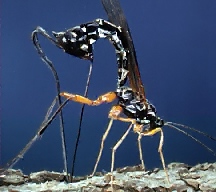
The females of Megarhyssa and Rhyssa in particular are equipped with slender, narrow ovipositors (tubes for depositing eggs). Although many insects have ovipositors of some sort, ichneumon wasps have ovipositors that curl over like scorpion tails. This has given them the nickname of "scorpion wasps."


Why does the female need such a long ovipositor? Ichneumonoid wasps lay their eggs inside other insect larvae. The infected larvae are, slowly but surely, eaten alive.


Despite their creepy appearance and alien reproductive habits, these wasps are quite efficient at pest reduction (like the giant hornets are). They also use polydnaviruses to suppress the host's immune response, which is more than can be said for the Xenomorphs.


Just pest control. Nothing personal.