Wednesday, August 18, 2010

"They Actually Eat That:" Cobra. (Snake Wine Pt. 2)

Let's take a little break from Madagascar. I'm sure they have some weird eats there; after all, lemurs are plentiful, and consuming elephant bird eggs led to said bird's extinction. However, last week I mentioned the consumption of venomous snakes...namely cobras.


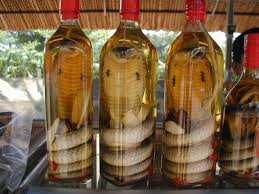
As seen last week, cobras are often stuffed into wine bottles. Other venomous snakes and scorpions are often thrown in to the mix for even more, umm, sexual potency. Although the idea of snake wine is pretty well spread wherever China took over, cobras in particular have a whole different level of culinary uniqueness to them.

Wherever cobras are found, people eat them. (An exception can be made for India; there are many religions there that would object, even though snake charming has just as many skeletons in its closet.) Cobra meat is usually the last thing on a Westerner's menu, but cobra cuisine is uncommon in Asia. It can be found in Vietnam, Thailand, Singapore, China...pretty much anywhere cobras live. They even have cobra burgers.

Burgers aside, there is always some sort of ritual before consuming a cobra. As with lobsters and sometimes fish, the consumer picks his (usually) own live cobra from a tank, cage or pen tied to the restaurant. Ideally, the cobra should be an aggressive little bastard just itching to pump your hand full of venom.


That one!

If the cobra is not aggressive already (you would be too, if you were at a restaurant and unable to eat anything there), the restaurant owner will rile it further. They will either prod it themselves or stick a mongoose in the cage to get the snake's blood boiling. This is thought to enhance the medicinal properties of the snake's flesh while being sick entertainment. (It's the kind of thing that, regardless of your stance on animal cruelty, you want to watch.)


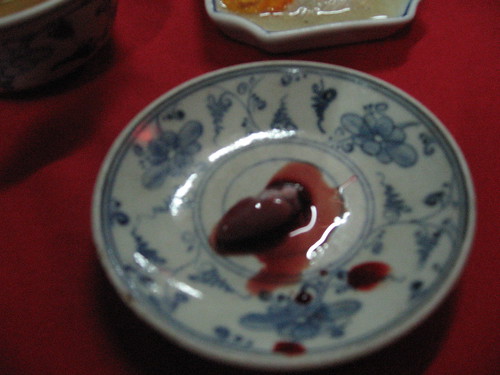
You get to drink the blood. And the bile. And swallow the cobra's still-beating heart.

Some say that the side-effects of eating cobra (especially the blood and bile) are a miracle cure, restoring everything from joint pain to baldness to nearsightedness. This is assuming that you went for a full-course cobra experience and not just a burger.

I could not find a GIF.

For all of you who are saying that this is cruel, it is. So are Western factory farms. That is where your burgers come from. The cobra gets a fight in before it gets slaughtered; cows do not. They also use almost every part of the cobra if you get the full course, which is more than can be said for modern Western cuisine. Being mortified at the ritual practice not help you here. Eating strong animals to increase one's own strength is also a common mindset and practice, especially in Asia. Do not ask how balut fits into this mindset; I have no idea.

On that note, it would be interesting if regular burgers got the same ritual treatment. McDonald's: A Bullfight before Every Meal!


Pictured: 5 Quarter Pounders, now with a side-order of badass.

Why go to all that trouble? In many places, serpents are still viewed as divine beings, or at the very least having some mystical powers. The people are literally eating the flesh of their god. This is like eating Christ's flesh and blood, only far more entertaining and with actual flesh and blood. It's a sacrifice that evolved into cuisine.

Their gods taste like chicken, apparently.

Tuesday, August 17, 2010

Creature Feature: Satanic Leaf-Tail Gecko.

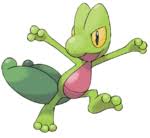
You didn't think that this whole week was going to be filled with cute fuzzy things, did you? Madagascar also has quite a few awesome Pokemo- I mean reptiles.


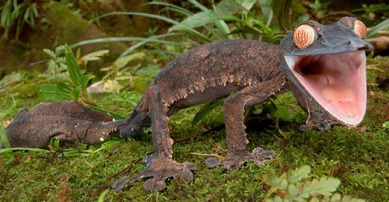
The model for Treecko was an actual creature called a leaf-tailed gecko. Three leaf-tailed gecko species are native to Madagascar; the fourth leaf-tailed species is native to Australia. You know, that other weird island.

All leaf-tailed geckos have flattened tails, leading to the generic name Uroplatus - literally, 'flat tail.' This leaf tail can be shorter or longer depending on the species. Some individuals even have notches in their tails that make them further resemble dead leaves.

Only one of the species endemic to Madagascar is called "satanic."


The Satanic Leaf-Tailed Gecko (Uroplatus phantasticus) is also known as the 'fantastic' or 'mythical' leaf-tailed gecko. Science acknowledges that these creatures are amazing right there in the name, and rightfully so: These geckos blend in so well that it is almost impossible to tell them apart from dead leaves. They are MASTERS of camouflage.


I will get one and name him Waldo.

So, why are they called "Satanic?" Probably the eyes.


Seriously, show one off around a Jehovah's Witness.

This does not, of course, keep people from keeping them. Would you let a silly thing like laws stop you from keeping one of the few lizards that comes in purple?

(On a completely unrelated note, expect this lizard to show up in a Lady Gaga video. THEN, expect the Illuminati buffs to pick on the gecko for being Satan.)

Monday, August 16, 2010

Creature Feature - Tenrecs.


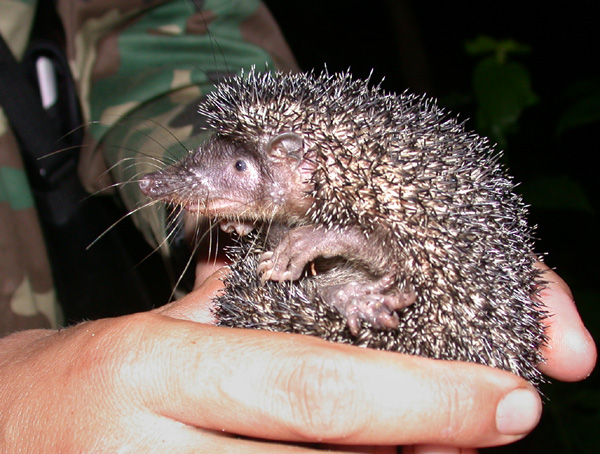
Wait...what? Hedgehogs live on Madagascar? Since when?!

Haha. If the title of today's post did not spoil it, that is not a hedgehog. It's a Greater Hedgehog Tenrec (Setifer setosus). It is one member in a family of weird mammals called Tenrecidae. Of course, a fair amount of these guys are native to Madagascar, but they can also be found in other parts of Africa.

This is going to sound unbelievable, but tenrecs are not rodents. Tenrecs - the whole family Tenrecidae - has members that are all scarily similar to rodents, mustelids, and occasionally marsupials that we all know. There is one that looks scarily similar to an otter, and literally swims like a fish.


Best otter cosplay EVER.

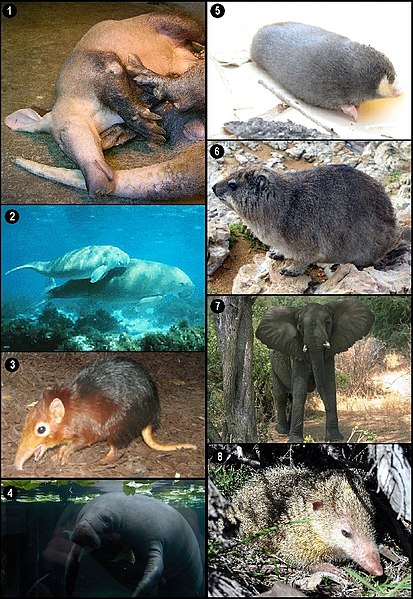
Instead of being related to rodents, tenrecs are more closely related to a group of mammals called Afrotherians. Please tell me that you did not just picture that Hedgehog Tenrec up there with a rainbow-colored afro.

The group (people are still unsure of exactly WHAT kind of group)Afrotherians refers to animals such as the hyrax (obscure), the elephant shrew (slightly less obscure), the aardvark (just plain weird), manatees and elephants.

Hold the phone. A little creature like this is related to elephants? How? WHY? Did Africa suddenly start sharing some of Austronesia's weed?!


The tenrec's family portrait.

Of course, this would have been nigh-impossible to figure out without doing extensive gene sequencing. Tenrecs look a LOT like rodents, and have even more weird things about them. If you thought the hedgehog tenrec was cute, congrats- they're popular in the exotic pet trade, and are becoming more and more common as a research subject. The scientists would like to know WTF happened there, too.

Remember that really weird naked mole rat that got its own entry a while back? Tenrecs, although not as close to reptiles and insects as the mole rats, do have a body temp low enough to warrant not having a scrotum, and the females can have as many as 29 teats. They also lack different holes for reproducing and defecating; it's all done through one cloaca. That's how birds and reptiles do it too, BTW; your balls-having dragonsonas have NO place unless you consider dragons mammals (thus defeating the purpose of having a reptilian fursona).

Happy Monday- for real, this time.

Sunday, August 15, 2010

Old News is Bad News...

...that needs to be stopped. Now.

While trying to prove Lucario's popularity (without resorting to furry porn), I came across a news article that made me die a little inside. Then I sucked it up and realized that, hey, this was what my blog was all about.

British children can more accurately identify 150 species of Pokemon than their own native wildlife. Granted, Britain does not have the most stunning wildlife in the world (the last British thing I did was the coot, remember?), but that's still a pretty depressing figure.

"An experiment involving 109 primary school children aged between four and 11 found that by the age of eight most were able to name 78 per cent of the 150 Pokémon characters such as Pidgeotto, Pikachu and Jigglypuff. The same age group could manage correctly to identify only about half of the pictures of animals and plants, such as "beetle", "deer" or "oak tree", displayed on cards shown to them by the scientists."


Holy carp. HOLY CARP. I mean, I grew up on Pokemon, too, but I knew what a deer was. I knew what a beetle was. I knew what an oak tree was. Maybe I was just extra-inquisitive, but this is sad.

Normally, I would praise Pokemon for encouraging conservation in its own bizarre way. After all, most Pokemon are based off of something real, even if that something is not organic. (For example, Bronzong is based off of an actual style of Japanese bell. I got a real kick out of it after my trip to the Ueno Museum.) You'd think that this would encourage awareness...

...of Japanese wildlife. Recently, they have given some other regions of the world a shot, but from what I have heard, Japanese children are more educated on the creatures of the world than those of Western nations anyways. It's the system's fault, but it's not; especially with the internet being as helpful as it is, it does not take a genius to Google, say, "Raticate" and learn that it is based off of a very specific water rat. Most people are getting only part of the fun of Pokemon.


I choose you!

This makes me sad for ALL the same reasons that Avatar suicides did: You are completely missing the point if you take the real world for granted.

Look, I like fantasy stuff, but I love the real world just as much. Animals do come in blue and purple. There are some immortal creatures and some with two heads. There are some creatures that you can cut; like those brooms in Fantasia, they will reproduce into identical individuals. I have found myself looking at real faeries in the woods on several occasions.

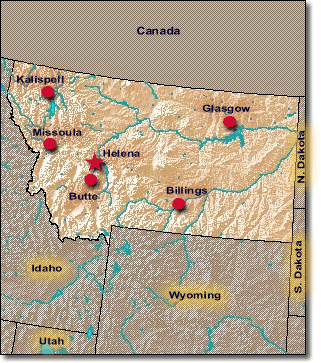
There is no saying that one cannot have an adventure in the woods, a park, or one's own backyard. Eragon is a good example; its setting is not based on the terrain of New Zealand or anywhere else exotic. It is based on the author's own experiences in his home state of Montana.


Unrelated to Hannah.

Montana. REAL special, right?

Pokemon has the same feel going. I used to catch bugs for kicks. It is based off of a REAL thing that people do with REAL animals.

Know what else it does, though? To catch the 'mythical' Pokemon (which are hardly mythical, nowadays), you have to work your way up. Catch what's around you. Maybe, if you're lucky, you will see Raikou in the grasses BUT you have to raise rodents, owls, pigeons, and bugs before you can handle it. Y'know, just like how you'd have to handle cats before you could handle tigers. Let's not even get into dragons and creatures that embody time and space; those would be a BITCH to handle. Does that resonate with anybody nowadays?

I fear for the world's future. There's nothing inherently wrong with Pikachu and his pals, but there is an increasing trend toward responding to a fake world better than the real one. At this rate, we are not going to have a world left.

Enjoy it while you can.

(X-posted on Card Games in Hell.)

Creature Feature: Madagascar Week - Aye-aye.

Lemurs are, as I said in my explanation of this week, non-simian primates. They are not technically more ancient than monkeys, but darn if they don't look the part. There are many genera of lemurs; I am not going to detail all of them right now.

Their name comes from the word for a certain type of shadowy, Roman ghost exorcised during the Lemuria. (The same name was used for a group of criminals in Baccano!.) This practice was later moved from May 13th to October 31st, the day of our modern Halloween. Every culture needs a day for the dead.

The real lemurs have cries that sound like hysterical human laughter; many are nocturnal, and have glow in the dark eyes; they have human-like hands, but everything else about them is more raccoon than monkey. This, my friends, is the uncanny valley of primates incarnate.

Some of them are also just downright terrifying.


Whoops, wrong picture.


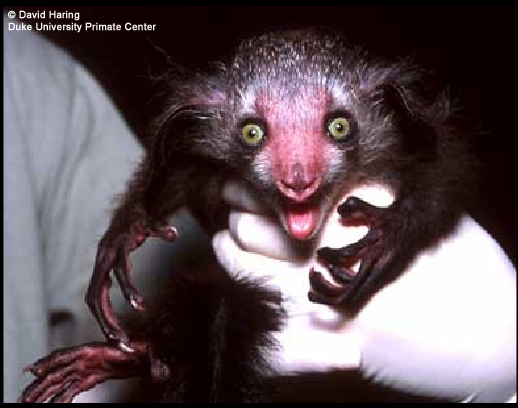
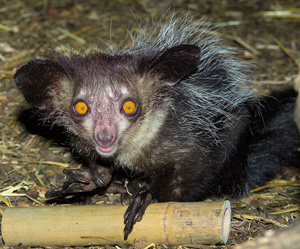
There we go. This is the aye-aye (Daubentonia madagascariensis), a fuzzball that is not even cute as a baby.


This would probably have been better for a Monday. I mean, really, this lemur looks like it had too much coffee. It's suffering from that horrible feeling towards the end of the work day when you've had too much coffee and want another cup, but the other five or so you've had today have already chewed up your metabolism and spit it out. I don't even work at an office and I am aware that this feeling is nastiest on Mondays.


The aye-aye looks a lot like Ke$ha in lemur form. It has wiry hair, a tail that looks like a toilet brush, wide eyes, big ears, and long fingers a la something from your worst nightmares. Maybe a Gremlins movie would do it justice.


Do not feed after midnight. Did we mention it's nocturnal?

Some have suggested that its name comes from either the aye-aye's cry (which it...doesn't have), human screams or a pseudonym. The natives might have been so scared of it that they thought up 'heh-heh' instead of saying its name. It's like Voldemort all over again!


The-Lemur-Who-Must-Not-Be-Named.

Unlike most lemurs, which already look like raccoons or some other furry animal, the aye-aye has teeth like a rat. These teeth grow constantly just like a rodent's, leading early scientists to classify the aye-aye alongside rats, mice, and beavers. It would not surprise me if the aye-aye brushed said teeth with whiskey.

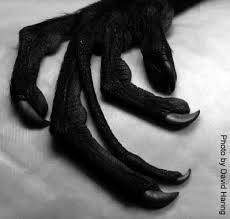
It also has a weird finger on each forepaw designed for picking grubs out of trees. It also flips a very mean bird. If this animal points at you with this middle finger, it is supposedly a death omen.


This lemur, like the chameleon, is viewed as universally evil by the non-scientists on Madagascar. Everyone on the island an overwhelming urge to get as far away from the aye-aye as humanly possible. Or just kill it. Or, in the most drastic cases, burn the whole village at the sight of it and move away.


Again, just like Ke$ha.

Happy premature Monday.

(...I kid because I love.)

Madagascar Week - An explanation.

Now, because I have absolutely NO idea what animal I'm going to be doing from one day to the next, I have decided to do a week of creatures from the African island of Madagascar.


Not that Madagascar.


As an island, Madagascar is home to some pretty weird stuff. It has monkeys that aren't quite monkeys; the basis for the Geico gecko came from Madagascar; some of the first coelacanths were found in its waters; probably only interesting to a reptile nerd like me, it is home to boas - a rarity in the Old World. It had giant birds until humans wiped them out.


I say, you really must stop doing that.

Lemurs are probably the most well-known creatures on Madagascar. The ring-tailed guy in the poster above is a lemur. Zoboomafoo is a lemur. They're kinda like monkeys, only a little more primitive...which, if I'm not mistaken, makes them the first primates I've ever looked over in detail.

Now, I'm not a mammal person, but some of these guys are pretty cool. Like hyenas, some lemur societies are matriarchal, and they have relatively little sexual dimorphism (sometimes tilting slightly in favor of the female). The natives have all sorts of lemur tales, ranging from the fuzzy little guys being ancestors incarnate (not a bad way to think!) to the aye-aye, a lemur so feared that the mere sight of one will cause people to burn their whole village down.

This is gonna be fun.

Saturday, August 14, 2010

Creature Feature: Tree Kangaroo.


How can you not love a kangaroo? They hop, and that alone is hilarious. Their babies are called joeys, which mother 'roos carry around in awesome pouches. They're like Australia's equivalent of deer, and we all love deer thanks to that traumatic scene in Bambi.


That movie also made us love skunks.

It doesn't matter that they are capable of drowning dogs or viciously kickbox. Kangaroos are so silly that making them talk did not make Kangaroo Jack any funnier.


Just about the least funny kangaroo in the world.

Now, imagine one in a tree. If you did not laugh, congrats: You're a cyborg.


Ditto if you don't melt at the face on one of these things.

Tree kangaroos (genus Dendrolagus) are exactly what the name says they are: kangaroos adapted to living in trees. They are native to New Guinea and the mountainous area around Queensland, Australia.

Bar the adorable face and arboreal habits, tree kangaroos are just like regular kangaroos. They still have the extremely large hind legs common to all macropods, bear their young in pouches, and eat plants.


Then you see the claws, and realize that this creature could gouge your eyes out with one swipe.

To climb, they hop, sliding along their forelimbs. Awkward though they may be on land, tree kangaroos are amazingly agile in the treetops. They can leap all the way down to the ground from 18 meters (59 feet) up! It must run in the family.

The really odd, wacked-out family.