Saturday, July 17, 2010

Creature Feature: Lizard Week- Komodo Dragon


I just got back from a 3-D movie about Sue, the world's largest most complete T-Rex skeleton. It rocked harder than the animatronic dinosaurs did. Besides a bunch of other awesome thunderlizards, the movie mentioned a sort of prehistoric varanid lizard that threatened Sue's eggs.

Strangely, this week had yet to touch varanid lizards (AKA monitors). These are the lizards that look like dragons (unlike the agamids dubbed "dragons" by goodness-knows-who), with long necks, forked tongues, and a largely carnivorous diet.


Neither group contains Trogdor, but varanids come closer.

The Komodo Dragon is the world's largest extant lizard. As its name implies, it is native to only a few Indonesian islands (Komodo among them). There are a number of theories surrounding its abnormally-large size, including insular gigantism and the Komodo being a living fossil. Its diet consists entirely of meat, whether it be living or dead flesh.

The Komodo, like the T-Rex, is not only a large predator, but a lazy one; it feeds primarily on carrion. Several experts have suggested that the T-Rex, too, was mainly a scavenger, even though it could take large chunks out of living prey as well.


THIS is how you film a Komodo Dragon HUNTING, Animal Planet!

In part because of its scavenging diet, the Komodo Dragon's jaws are filled with virulent bacteria. Some venom has been found in Komodo jaws as well, leading experts to wonder which is the real culprit. The venom contains anticoagulants and other things to, perhaps, make the bacteria's work easier. A single bite will kill regardless, leaving the giant lizard to scavenge away at its new feast.

As if to add salt to the poisoned wounds, the scavenging Komodo's teeth are serrated like saws. If they lose one, it grows right back. Komodos do not chew their food; they tear it off in huge, bloody chunks.


Unless you saw the dragons actually KILLING this, assume it was scavenged.

The Komodo Dragon has one more, far more bizarre trick up its sleeve: Should the need arise, the female can give birth to all-male babies without the aid of a male. This is because they, unlike mammals, have been blessed with the ZW sex chromosomes.

They have two different letters than we do. So what? Shouldn't parthenogenesis lead to clones? Like, exact clones?

Not so in the case of ZW species. The Z is the male and the homozygote in Komodo dragons. When two of a female's egg's fertilize each other, ZZ is inevitable (WW is deleterious). This leads to all of the offspring being male. More on that here.

It also makes an excellent case for Raptor Jesus.


This is sounding more and more likely. Also, check out the poppies in that picture...

Friday, July 16, 2010

Creature Feature: Lizard Week - Glass Lizards.


Wait, that looks like a snake up there. This is Lizard Week. Kuro's gone off the deep end again, hasn't she?

Actually, that is a lizard. It has ears, eyelids, and can regrow its tail if it breaks off (hence the name). In honor of its similarity to snakes, the genus containing glass lizards is called Ophisaurus - literally, "snake-lizard."


Seriously, that looks almost EXACTLY like my pet rosy boa, Eclair.

Unlike snakes, which rarely if ever eat insects (smaller snake species do, but the baby corns at Petco certainly do not!), nearly all Ophisauri are insectivores. Although the bulk of species are found in Indo-China, there are a few in Europe, at least one in North Africa, and some along America's Atlantic coast. They are not particularly exotic, but interesting creatures nonetheless.

Thursday, July 15, 2010

Creature Feature: Lizard Week - Horned Lizard.

Remember when I said that there was a little bit of confusion concerning the Thorny Devil? It was with this guy, the horned lizard (genus Phrynosoma). They are peaceful insect-eaters from the Southern deserts of North America. When a lizard from the North American deserts is getting confused with a desert lizard from Australia, you know something weird is up.

As with the whiptails, this unassuming lizard has a seriously effed up habit:

It cries blood.


CRAAWWWWLING IN MY SKIIIIN!

Yes, the horned lizard has fulfilled the dream of many an emo: Whenever it feels threatened, it ruptures small blood vessels in its eye sockets. This causes the blood to squirt straight into a predator's mouth. Supposedly, it tastes terrible to mammalian predators; no scientists have tested this theory by finding out for themselves. We like to think that the coyote in that clip left due to sheer "WTF?!"


At least no Jurassic Park dinosaurs have this adaptation. Pop music stars are another story.


Oh, come on. She was overdue for this one.

Wednesday, July 14, 2010

Creature Feature: Lizard Week- Frilled Lizard

Raise your hand if you have seen Jurassic Park. C'mon, don't be shy; we all went to Blockbuster and collected merch for The Lost World when it was about to come out.

(I'll take a photo of my plush dinosaur haul a bit later, LOL.)

If you have never seen Jurassic Park, know that there was a Dilophosaurus in it. It spat poison and had a neat frill that functioned similarly to a cobra's hood.


There is no fossil evidence for the frill or the venom, but it did cause a spike in interest for a certain real lizard.

That frill is similar to that of the frilled lizard (Chlamydosaurus kingii). The frilled lizard is yet another cool critter from Australia, and feeds on insects. (Oh, Agamidae, you so CRAY-zy!) True to its name, it spreads a giant frill around its neck when startled.


Then it proceeds to run on its hind legs away from the threat. This totally merits a Benny Hill sequence; it's HILARIOUS to watch, and has earned it the name "bicycle lizard."

Screw Jurassic Park. Australia is full of dinosaurs.

"They Actually Eat That:" Balut.

Is there anything cuter than a baby duck? They're so fluffy and yellow regardless of what species of duck is in question, and they follow their mommies around in such an adorable fashion.


Wait. This is leading to something horrible, isn't it?


Balut is a dish commonly eaten in the Philippenes, Vietnam, Laos, and, in general, Southeast Asia. As you can see in the vid, the egg is left to mature until just the right point: When the little duckling or chick inside has down, a beak, and a face. The exact maturity varies with location, but is no less morbid.

(I mean no disrespect - this is another cultural divide. Again, Americans eat crap, too. Next week, the spotlight will be on AMERICA.)

They actually eat that?!

Oh yeah. It is quite common as a street food in the Philippenes, and eaten on a regular basis in the other places mentioned above. It started as an aphrodisiac, and remains popular as such. It's also supposedly quite tasty if you can look a duckling in the eye and eat it.


Eat it, Hieronymus Bosch.

Just a little refresher on eggs: The ones that you get from the grocery store have no little chickens inside of them. They're duds. Birds lay eggs just because they feel like it sometimes; the hens that make grocery store eggs were not kept with rooster. There was never going to be any baby chicken in there.

If you feel like going off of eggs for a bit after this entry, I will not blame you. If, however, you go to the Philippenes, do give balut a try. You will be hailed as a hero back home for stuffing a baby duck in your mouth.

Monday, July 12, 2010

Creature Feature: Lizard Week- Draco volans.


First off, I love dragons. Any dragons. All dragons. That's why it makes me so sad to see European dragons pimped over all other dragon types; they're all cool, but European dragons (the kind with 4 legs AND leathery wings) are native only to monotheistic religions, so anything you have about them being a part of universal folklore is a load of BS. Yes, there are often things in lore systems that take the place of dragons (i.e. to be slain by a hero), but they are not all fire-breathing menaces. Nearly all of them either have snake in their names or are words (sometimes feminizations) for 'snake' themselves. The Western dragon is largely linked to monotheistic faiths which sought to make snakes even more evil-looking than they would be otherwise.


Tiamat also DOES NOT LOOK A THING like a Western dragon, contrary to what your D&D manual may tell you. One could argue about how she may have evolved into to Zoroastrian dragon, but that's still an instant alignment with Satan VS mother of all monsters. Seriously, D&D, fuck you.
You will see me use this image again. Sear it into your retinas.

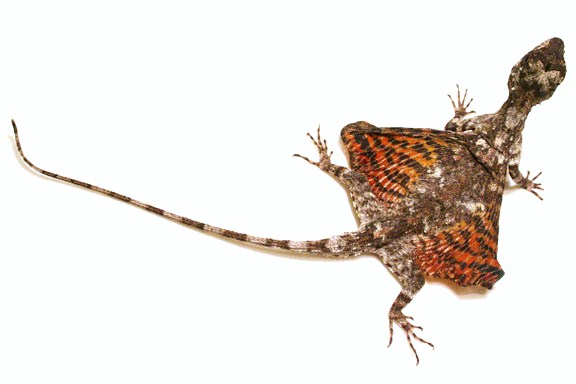
That's a rant for another day. Today's lizard is as close to a dragon as you will ever see in your pathetic human lifetime. It is so much like a dragon that its scientific name, Draco volans, literally translates to "flying dragon."


D. volans is native to Indonesia (like half of the awesome things I write about), but ranges all the way from India to the Philippenes. As this video will tell you, D. volans (as well as the other members of the genus Draco) can glide from tree to tree using specially-modified ribs. As if to spite me, any videos showing this feat usually show a snake chasing after the dragon. (The irony. It burns.)


How cute!

Please note that, unlike Saphira and those pet dragons in a certain dragon movie, members of the genus Draco tend to make very poor captives. Real dragons would, too.


Oh, Toothless? He's just happy to see you.

Sunday, July 11, 2010

Creature Feature: Thorny Devil.

Today starts Lizard Week! Yes, after doing this guy, I had so many ideas for lizard entries that I figured, "hey, why not?"

Yesterday's little gecko was a warm-up. Now we're getting into the really weird lizards. Many of them, including this one, are in the surprisingly familiar iguana family Agamidae.


The Thorny Devil (also Thorny Lizard, Mountain Devil, or just Moloch- a Semitic term associated with pagan sacrifice, i.e. Satan) lives in the more arid areas of Australia. It spends much of its time strutting while looking for ants to eat. When water runs down its back, it gets redirected into its mouth by special grooves - great if you live in a place where rainfall is rare.

But who cares about that? LOOK AT THIS THING. Besides the two horns on its head that give its name, its body is covered in spines. A lot of nasty things live in Australia. I cannot think of one that would find this lizard appetizing.


They're tiny. They need all the spines they can get!

The horny bulbs on its neck also double as a fake head. If the Thorny Devil feels threatened, it will duck down its head, exposing its thorns to the world.

The Thorny Devil is often confused with another horned lizard - the kind native to the Americas. This sort of horny lizard has its own peculiarities, which should also be covered this week. (Note: For a while, I was confused about this, too!)