Sunday, January 16, 2011

OMG SHINY! - Diamonds.

We start the week of shiny things with the biggest, fanciest, hardest shiny thing known to man: DIAMONDS!


Good diamonds are worth a fortune, a girl's best friend, one of the most common engagement ring stones, the birthstone for the month of April, and so on. These commonly-known diamond tidbits only scratch the surface of the hardest stone known to man. There is much, much more to diamonds than meets the eye, although a diamond's unique fire and clarity is most of its price.

HULK DIAMOND SMASH!


Besides the usual clear color, diamonds can come in any hue of the rainbow. There are even black diamonds like the one above. All sorts of lore accompanies diamonds of different colors; for example, black "carbonado" diamonds may have come from space, and the Great Hope Diamond is rumored to be cursed.


The Great Hope Diamond in particular illustrates a relatively-unknown property of diamonds: They glow in blacklight. In particular, the Hope Diamond, which looks blue in normal light, turns red-orange when placed in ultraviolet light. The exact color depends on trace elements within the diamond. Given that diamonds are usually thought of as a clear stone, it was quite a shocker to see a whole butterfly of multicolored diamonds in the Field Museum! (No, you cannot go see it- the exhibit was temporary.) This property can be used to determine whether a diamond is real or not; a real diamond should look like hippie gear under blacklight.

Or an eye, staring into your soul and waiting to curse you.


The truth is, however, that diamonds are carbon. Just carbon (trace amounts of other elements not withstanding). Carbon is an extremely common element that forms the basis for all life on Earth (thus "carbon-based lifeforms"). Other examples of pure carbon include charcoal and graphite, AKA pencil 'lead.' Notice how none of the nouns except "diamond" in this paragraph fall under the category of "hardest thing around."

Why not?


Basically, it depends on how the carbon atoms are arranged. The crystal structure of a diamond is what provides its literally adamantine hardness, luster, 'fire,' thermal conductivity, and other unique properties. To form this unique crystal requires high pressure and relatively low temperatures; otherwise, the diamond will instead become another sort of carbon. There are ways to transform diamond into graphite, but unless you happen to be an alchemist and are able to reverse it quickly, this rather extreme process (involving a vacuum and temperatures above 1,700 degrees C) is not recommended.


You must be more badass than this to turn diamonds into graphite. Seriously, that's just a dick move.

OMG SHINY! - A Week of Rocks.

Every day, I make it my personal mission to show you all something stunning. Sometimes it's a plant; sometimes it's an animal; sometimes it's neither here nor there, leaving scientists very confused as to exactly what box it fits into. One virus has gotten an entry, and there is still debate over whether viruses are alive or not. I have never done a post on something that was definitely not alive. 

"OMG SHINY!" week will consist entirely of awesome things that are definitely not alive. Rocks, stones and worse-than-senseless things will make up all of this week's posts. The good news is that they will be colorful, interesting shiny rocks that you will probably want to put on your finger when all is said and done.


This loses its luster pretty quickly, actually. 

Wow. I can't believe I've finally sunk to the level of doing pet rocks.

Saturday, January 15, 2011

Creature Feature: Gharial.

It's official: river carnivores deserve to be high-octane nightmare fuel. Piranhas are downright terrifying thanks to their reported ability to strip a cow to the bone in seconds, and anacondas occasionally get the limelight, but most aquatic terror comes from something in an ocean or lake.


Observant individuals probably noticed the Baiji's strange facial proportions for a dolphin. Were it not nigh-extinct, the Baiji could easily make for a dolphin monster in a horror movie. It looks that far away from the playful dolphins that, even though they rape and murder people, we all know and love anyways.

Now imagine those snout proportions on a much less amiable crocodilian.


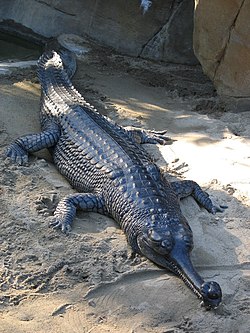
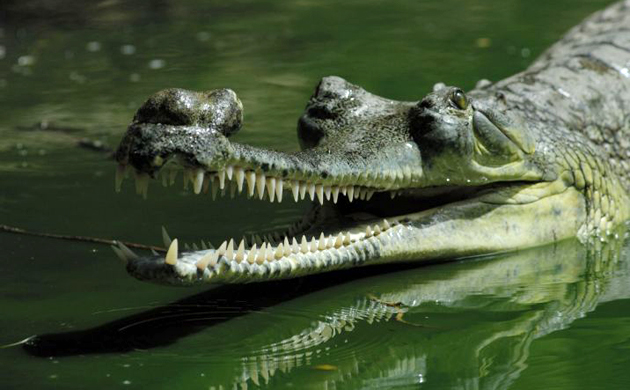
The gharial (Gavialis gangeticus) has a very long nose/mouth filled with lots of slender, sharp teeth, just like a river dolphin. It is native to India and is one of the few extant members of the family Gavialidae. It is one of the largest crocodilians at 5 meters in length and 650 kg. With that snout, a history dating almost all the way back to the dinosaurs, and the tanklike build of a large crocodilian, this has to be a real monster, right?

Gharials are harmless to humans, actually. The same weird-looking jaws that the river dolphin has make it impossible for the gharial to consume something as large as a human. Unlike other crocodilians, they also move poorly on land. Reports of gharials eating humans come from either a) the gharial's habit of swallowing stones and jewelry to aid its digestion or b) misidentification with other crocodilians. India has three different types of crocodiles, after all.


Besides an interesting evolutionary history, the gharial also has one very important trait that sets it apart from other crocs: They are the only visibly sexually dimorphic crocodilian. The males have a bulges above their nostrils called ghara ("pot") that gives the gharial its name. Not only is the pot-shaped growth attractive to female gharials, it helps the male breathe underwater and blow bubbles as part of its mating rite.

A crocodilian that blows bubbles. No wonder most of them are extinct.

Friday, January 14, 2011

Creature Feature: Bowerbird.

What really separates man from the animals? Some would say an awesome brain-to-body-ratio and very versatile, articulate digits; others would theorize less physical things like love, imagination, and art.

We could debate about love and imagination in the animal kingdom, but birds definitely invented art first. People likely invented music after hearing bird songs (which have cool tweaks of their own, such as dialects). Some birds, like humans, can see in color; this is best shown in the colorful plumage of parrots and the iridescent plumage of some other birds. There is at least one type of bird that uses modern art to win a mate.


(I've seen worse things called "art.")

Bowerbirds are medium-sized perching birds (passerines) in the family Ptilonorhynicidae. They are native to Australia and New Guinea and are thought to be related to either birds-of-paradise or lyrebirds. Bowerbirds cover twenty species in eight genera, but they all have one thing in common: They're into pop art in a big way.

And I shall call it..."CLOTHESPINS IN STICKS!"


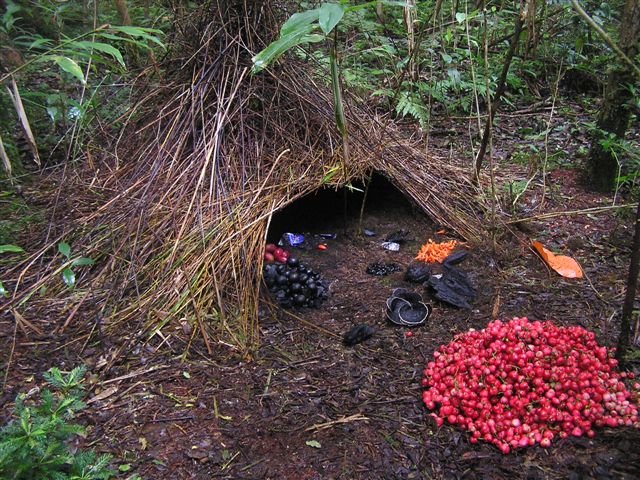
When mating season arrives, the male creates a two-walled structure out of twigs called a "bower." This bower starts simple, but quickly becomes more elaborate as items are added to it. Some keep the two-walled structure and add all sorts of junk; others add berries and make what must be a summer beach house to a songbird.

What sorts of items are stolen for this structure depends on the bowerbird; for example, female Satin Bowerbirds (Ptilonorhynchus violaceus) have evolved to like the color blue. Why? Who knows, but it results in a looot of blue things getting stolen in this video. This guy even opens someone else's car!


The female then chooses the male with the prettiest bower and/or flashiest plumage. Like lyrebirds,  bowerbirds are also excellent mimics, This is like walking into an art gallery, then making out with whomever made the prettiest painting. Naturally, this mating rite attracts more than one female to a single artistic male. Hey, a lot of human women would go with the bird that opened a car.


He also has the most gorgeous eyes I've ever seen on a bird. Look at that PURPLE!

Wouldn't it be great if human artists got that sort of treatment?

Thursday, January 13, 2011

Creature Feature: Black Mamba.

Is there any creature with a more exaggerated Hollywood reputation than snakes? (OK, maybe sharks.) Snakes do not bite people because they are the servants of some evil mastermind; they bite people because the humans are being idiots. Real snakes do not make good Hollywood monsters. Bar the speed in a strike, most snakes are not very fast at all.


Oh, except this one.

Now, without looking at the title of this entry, what would you call the snake above? "Get it the fuck away from me" is not going to please scientists. They decided to call it Dendroaspis polylepis (many-scaled tree asp) instead of something that really encapsulates how dangerous the black mamba is


That dull-looking snake is the infamous black mamba. It is not some massive, black snake with four-inch long fangs that could run through a guy's hand. It is a long (2.5 meter/8.2 foot), slender elapid with a pitch black mouth. It is native to East Africa.


The black mamba is the fastest land snake in the world, capable of moving at speeds of up to 16-20 km/h (or 10-12 mph). Whaddya mean that's not fast? It's fast for something that has much of its body  length on the ground most of the time, and probably faster than you. The black mamba is as fast as snakes get.


(No wonder Kenyans have a speed record.)

Even this lethal work of nature will not behave like the Seviper genetically-engineered bastards in Anaconda 3. The black mamba uses its speed to get away from humans, not maliciously bite them in the ankle. It gives plenty of warning signs, like the opening of its "your death is near" mouth, before striking. That mouth is enough to send large mammals scattering.

Do not try to be a hero in front of the mamba. This snake's venom contains a poison cocktail so strong that it can kill a human with just two drops. It even has its own name - dendrotoxin - because it is unique to Dendroaspis mambas and attacks muscle neurons directly. If you are bitten, seek medical help immediately. Do not suck the venom out; doing so will earn you a Darwin Award for pissing off the wrong snake.  (Plus, sucking venom out is STUPID.)


The black mamba has all the potential for a good movie monster - fast land speed, deadly venom, length, and a scary black mouth -   but nine times out of ten (i.e. if the director is sane), another, less deadly snake is used instead. The Papuan Olive Python (Apodora papuana) usually serves as the mamba's stunt double; even though it is from a different part of the world entirely and is nonvenomous, it has similar coloration to the black mamba down to the mouth. This was the snake used in Indiana Jones: Kingdom of the Crystal Skull, even though neither mambas nor pythons really fit the setting.


There are about a million things wrong with this picture, including "Peru does not have pythons" and "boas are very easy to come by."

Wednesday, January 12, 2011

Creature Feature: Baiji (Yangtze River Dolphin)

Speaking of Chinese animals in danger...


Yes, that is a dolphin. Didn't know that China had dolphins, did you? These are not the same dolphins that you see in aquarium and zoo shows; Yangtze River Dolphins (Lipotes vexillifer), AKA Baiji or "Goddess of the Yangtze," are native only to the Yangtze River in China.

Or, well, they were.

The Yangtze River Dolphin is the most recent marine mammal extinction to date: the Japanese Sea Lion went extinct in the 1950's and this dolphin went extinct in 2006. The last recorded living specimen died in 2002, and no new wild specimens have been confirmed. Not only is the Baiji one of the most recent mammals to go extinct, it is the first well-recorded cetacean to ever go extinct.


How the hell did that happen? Chinese medicine? Well, no, but the dolphin has a story in Chinese mythology. The legend goes that the Baiji is the reincarnation of a woman who refused her arranged marriage and was drowned because of it; the Baiji has been considered prosperous ever since. It was only eaten after the tradition of calling the dolphin a goddess wore off. Somewhere, a tiger is jealous.

The communist movement called the Great Leap Forward (1958-61) spurred China to not only abandon their traditions in favor of communism, but also encouraged anything in the name of modernization. The dolphin's river habitat was polluted and electric fishing was encouraged. Ship engines interfered with the dolphin's sonar (which was even more necessary than for other dolphins; the Baiji was almost blind). The Three Gorges Dam, a dam spanning the Yangtze River, was the final nail in the coffin. There are still some unconfirmed sightings, but by and large, this dolphin is considered dead, dead, dead.


Fail indeed. For once, traditional beliefs were PROTECTING an animal.

See? Communism does not work. Communists killed a dolphin.

"They Actually Eat That:" Tiger.

Tigers are one animal that I bet you thought that you would never see under "They Actually Eat That." Sure, it's easy enough to torment songbirds, make a soup out of duck's blood, use Rover as food, or shoot a kangaroo, but removing the Chinese king of beasts? That's almost blasphemy, isn't it?


Uuhhhh...remember this thing? The snake enshrined in booze?

For starters, humans will eat anything - and on "They Actually Eat That," we mean anything. Homo sapiens is an omnivorous species of ape that, when not given the proper mixed diet, goes insane. There is a disorder called pica that develops whenever people are sorely missing a needed nutrient. Eating anything we can is no longer just an option; it is a way of life.

That said, being an omnivore is just part of what makes humans a "broken" species. Unlike most animals, we tend to systematically eradicate things that we find threats or food. Hell, sometimes we don't even mean to do it - it happens because of little animals that we bring along. When we do mean to eliminate a species, it is because we have put two and two together and found a way to stop whatever is terrorizing us. (Making this worse is what I call the "OMG They Killed Kenny!" reaction - one human dies and everybody gets upset over it.) Humans are mean like that; such behavior is beyond self-defense.


Tigers, being large, threatening animals that can potentially eat people, are wiped out a lot. The Bali Tiger was eradicated not because it was awesome, but because it was seen as evil. The Javan tiger was killed off by a number of things, including general forest clearing and many of its prey species being threatened by disease and poisoning.  The Caspian tiger became extinct because the Russians just plain wanted it dead [insert "Soviet Russia" joke here]. Point is, we know how to kill tigers and are very, very good at it.


In Soviet Russia, tiger kills...no, wait. No it doesn't.

 What the hell made you think we wouldn't try eating big, bad tigers, just to prove that we really are the "1337 H4XX0rz" of nature?

They Actually Eat That?! 


China is big on eating and drinking tigers. Surprise, surprise.

In China, the tiger is king. Their symbol for 'king' is derived from the forehead marking of a tiger. There are no lions in China, so they made the tiger the ruler of everything with fur. A white tiger ("Bai Hu" or "Byakko") is the ruler of the Western quarter of the Chinese sky. It is also the sign in the Zodiac most likely to 'rise to the top,' so to speak, and is considered one of the most masculine animals out there.

This symbolic potency means that they are used for...everything that you would not use a dead tiger for. Their pelts are burned to keep centipedes out of the house. Their blood is used as a general "good health" tonic. The bones cure almost anything you can think of, including burns and malaria. The genitals, welllll...


You're gonna cut off my WHAT for WHAAAT?! 

Yes, they eat tiger penis as an aphrodisiac. If you see "Tiagra" appearing at your local organic health food store, stay faaaar away.

Before you all say how horrible this is already, China has over 6,000 (often abused) tigers in captivity thanks to the popularity of tiger medicine. After banning the trade of those magical tiger bones, tiger breeders are trying a new tactic: tiger bone wine. Apparently you can sell bones in wine but not by themselves. Oh, Chinese laws. 

This farming does, however, have an up-side. The Scimitar-Horned Oryx had a similar situation; its population is now limited to game reserves, but they're alive. At least if the wild tigers go extinct, there will be tigers left to replenish the Asian jungles. It is not a good situation, but it could be a lot worse.


I love you. Now stop eating my organs.