Wednesday, March 16, 2011

"They Actually Eat That:" Jellied Eels.


Oh, gods. How did lutefisk get two entries?

Kidding, kidding. That is a dish of jellied eels, not lutefisk. Blame the once-poor population of Britain, France, Italy, Germany...actually, pretty much all of Europe has some version of the horror that involves eels, vinegar, and occasionally gelatin.


A lot of places eat eel. It tastes like chicken mixed with fish by itself and can be amazing with the right sauce. Eels are common fish in sushi, but for once, this is not about Japan. They are the lesser of two evils this time around. Hell, shit is still happening there; cut them some slack.

Although now critically endangered, eels were once so abundant in Britain that they could be caught with ease. The Thames was repeatedly swept for eels with giant nets. The meat was then sold to the poor for cheap. While it sucks that Britain is eating endangered eels in its old-timey cuisine, the grossness is not so much that the British eat eels as it is how they eat eels.
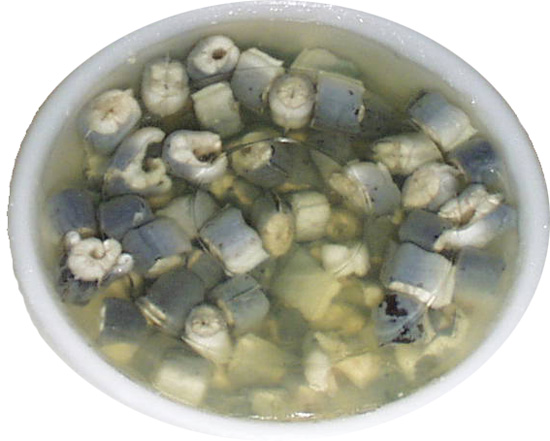


After being put in a vinegar broth, the eels' natural sliminess causes the base to gel up into something called aspic. That should ring a bell; it also came up in the SPAM entry. Anything so heavily preserved that it is on par with SPAM cannot be good. That goes double for anything with aspic.

Aspic is the word for ANY jelly made from a meat base. It is used as a preservation method and is very, very hard to make. Eels are naturally slimy creatures; they have no scales and, like hagfish, rely on a mucous coating for defense. They help make their own jelly. This does not make aspic any less disgusting. It just stacks slime on top of slime.
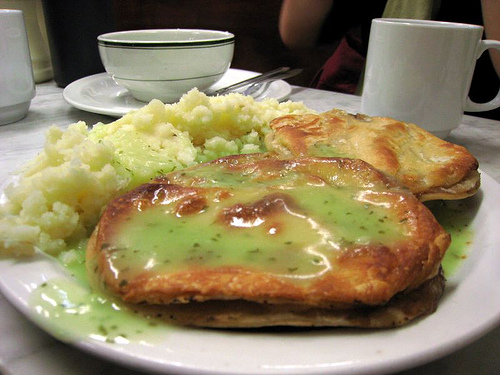
 

It gets worse. Jellied eels are often paired with pie and mash, which is nowhere near as delicious as it sounds. Pie and mash is, in a nutshell, pie crust, mashed potatoes, and sauce that, umm, looks like something Slimer sneezed up. Classy, Britain.

So, why do people eat jellied eels and snotcakes? For the sake of eating them, mostly. They are traditional British foods and, as such, have their own following. Eating eel is an acquired taste; how they acquired it in this day and age is anybody's guess.


Next Week: Frogs and snails and puppy dog tails...the French eat all except the last one.

Tuesday, March 15, 2011

Creature Feature: Yellow-Lipped Sea Krait.

Heeyyyy, remember that sea snake the mimic octopus was copying?


It's this one, the yellow-lipped sea krait (Laticauda colubrina). It is also called the banded sea krait or Colubrine sea krait. It is common to the waters around Southeast Asia like all sea kraits. Sea kraits typically feed on eels, which, given their similar forms, may seem ironic.

Pull up a list of the most venomous snakes and, if the author REALLY knows his/her stuff, this snake will be on it. There are a number of things that determine these lists (such as aggression, toxicity per injection, and toxicity in general), but this is usually comfortably on any list. Each bite can yield up to ten times the lethal dose.


The bands mean, "stay the fuck away."

Luckily, kraits are very chill snakes otherwise. Despite having venom strong enough to kill ten men, sea kraits frequently allow themselves to be handled, and rarely bite. The bite is painless and often blank. Hell, the snake might even lose its teeth just to make you feel bad for pissing it off. You jerk.


Neat tail is neat.

Besides being highly venomous, sea kraits are also the most completely amphibious of all reptiles. They are at home in the sea as well as on land. In the water, they are adept swimmers, undulating their paddle-shaped tails like fish and only coming to the surface to breathe. Unlike most marine reptiles, sea kraits can get up to 20% of their oxygen through their skin. Like marine iguanas, they have a special gland to help them expel the salt in their watery home.

Sea kraits can also move on land like normal snakes to digest meals, shed their skin, drink fresh water, and lay eggs. Sea kraits are the only sea snakes with scutes - the specialized scales that allow a snake to move on land. They exhibit homing instinct, so if you want them off your island, it will not happen; the snakes have made up their minds.


You won't like them when they're angry.


Tomorrow: Speaking of things that eat eels, humans have some REALLY gross ways of preparing them. Also, black swans aren't just for ballet, anymore.

(Phew! Italian midterm over with!)

Monday, March 14, 2011

Creature Feature: Malaria.

Malaria is one of those diseases that one only hears about in third world, tropical countries (but used to be more widespread). Most people only know that it is spread by mosquitoes and that it really, really sucks to get because there is no real cure. This is the tropical disease that single-handedly renders nations poor and incapable of economic recovery. It's that bad.

Actually, this is kinda cute.


Oh, and it's a critter. Not a virus, not a bacterium, a single-celled critter commonly called a protist. More accurately, any disease caused by a microscopic organism called a Plasmodium can be called "malaria." There are several Plasmodium species that can infect humans including P. falciparum, P. malariae, P. ovale, P. vivax, and P. knowlesi. P. falciparum is the one that most people are worried about, although any one of the above will at least ruin your year.

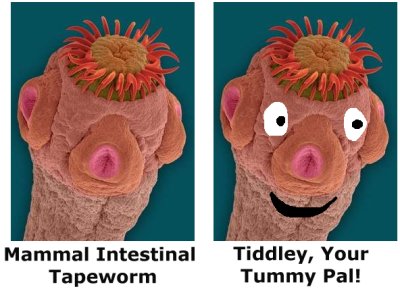
While most parasites try to make their presence as innocuous as possible, malaria does not even try. It can incubate for up to a year without any noticeable symptoms, but after that, its presence becomes known very quickly. This is not a friendly parasite; it makes a tapeworm look like a good neighbor.

 
Yeah. Kinda like this in comparison to malaria.

The symptoms of malaria vary slightly from species to species. Common indicators are fever, chills, and headaches. If left untreated, the spleen may also swell (do you know where your spleen is?), and, eventually, the parasites can cross the blood-brain barrier, causing coma and death. Since some  parasites use the liver as part of their life cycle, thorough tests for malaria require both blood and liver examinations.

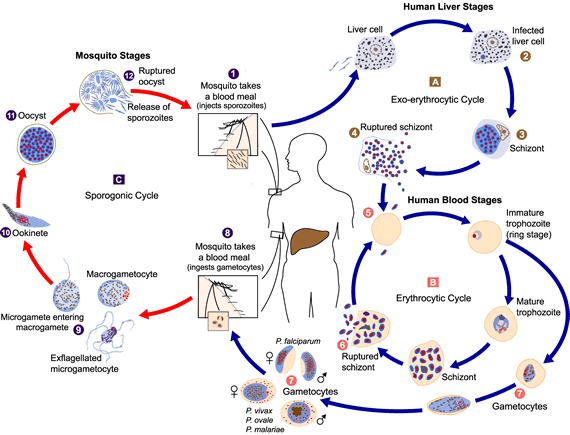
Malaria starts its life in the gut of an Anopheles mosquito. The mosquito bites an infected human, sucking immature plasmodia into her gut. They mature slightly into sporozoites and travel to her saliva. Then, she is ready to bite and start the cycle again. We realize that one mosquito may well look like the next to most of you, but please be on the lookout for this one:


Once inside a human, the sporozoites (the wormy things from earlier) rupture, releasing countless merozoites. These swiftly infect red blood cells and reproduce asexually within them. P. falciparum goes for the liver before heading towards the blood; when the infected liver cells burst, the malaria then goes for the erythrocytes. In short, these are protozoans that reproduce like a virus.

This might actually make a bitchin' roller coaster.
 

Over time, there have been a number of "cures" for malaria. The first was quinine, a substance originally found in the cichona tree in the Peruvian Andes. Several other drugs, including fakes common in Asia, have since been developed, but Plasmodium protists gain drug resistance just like bacteria and viruses do. They evolved with us and will continue to evolve with us.

We're fucked.


Tomorrow: It looks like a kingsnake, but it swims!

Sunday, March 13, 2011

Creature Feature: Flounder.


We know what you're thinking: What could possibly be weird about the little yellow and blue fish that follows Ariel around? Don't tell us that beneath that cute exterior lies a flesh-eating piranha. You must have something else shocking up your sleeve.

Why, yes. Yes we do. 

Let's start with real flounders not looking like the cartoon fish. At all.

Similar in color only.


Real flounders (containing many families) look a lot more like stingrays at first glance. They are part of a group called flatfish, which also contains sole, halibut, and a few other delicious entrees. True to their name, flatfish are flat and spend much of their time on the bottom of whatever part of the ocean, estuary or lagoon they happen to be in. Some have been found fluttering along the bottom of the Mariana Trench, one of the deepest ocean trenches found to date. All are carnivorous, eating crustaceans and fish fry before being fried themselves.

After watching a flounder swim around for a little, one eventually notices something strange: Its spine undulates more like that of a dolphin than a fish. Also, wait a minute - is that a gill slit on top? And a fin? Oh, goddess, what did nature DO to this thing?!


Flatfish, flounders included, essentially swim on their sides. That is why the operculum and pectoral fin are clearly visible on top of the fish. Those raylike fins would normally be located along the fish's back and underside. Technically, they still are, but the way the fish is tilted makes it resemble a weird ray.


Creepier still is the flounder's strange but logical eye arrangement. Baby flounder start with one eye on each side of their heads like normal fish; as the fish grows, it not only starts to prefer swimming closer to the bottom, but that eye moves to one side of its face. The eye migrates to the right in some flounders and the left in others. If Picasso designed a fish, it would be a flounder.

Flounder are perfectly evolved for life along the ocean floor. Having their eyes on top lets them spot predators more easily. Somewhat rarely for fish, they can also change color. Whether they are on sand, rocks, or coral, the flounder will always blend in. Flounder can even camouflage themselves on checkerboard patterns.

Evolved for fashion?

This excellent camouflage cannot protect them from man. Flounder and other flatfish around the world are so tasty that they often get overfished. Atlantic Flounder and sole are both fish to avoid if one is looking for sustainable flatfish. We can't help you if you're looking for a tasty substitute (although the author particularly likes halibut).

Tomorrow: Malaria. No, this entry is not about mosquitoes.

Saturday, March 12, 2011

Creature Feature: Mimic Octopus.

Nature is full of awesome mimicry. We've already covered the pseudo-poisonous coloration of the king snake family. Viceroy butterflies are a good example of a non-toxic creature mimicking one with a bad taste. Mimicking a toxic/bad tasting species while being harmless yourself is called Batesian mimicry and is found throughout nature.


This octopus does that and then some.

Discovered in 1998, the mimic octopus (Thaumoctopus mimicus) lives exclusively in the prey-rich areas of Indonesia and Sulawesi. It is considered the single most intelligent invertebrate in existence. Is it a manifestation of Cthulhu's almighty tentacles? Maybe.


In his city at R'lyeh, dread Cthulhu waits dreaming. Do not disturb.

All octopuses are carnivores, but they have predators, too. They are the masters of camouflage. Octopuses do not just change the colors of their skin, they change the texture as well. Push comes to shove, a lot of them have ink and can regenerate tentacles if one gets torn off. Octopuses have plenty of tricks up their sleeves simply by virtue of being Cthulhu's minions octopuses.

The mimic octopus makes other octopuses look like amateurs. It has excellent camouflage powers, copying other species of sea life in every way except genetics.

AWESOME chart from webecoist.com; feel free to open it in another window for a better look.


A number of factors affect what form the mimic octopus chooses to take. Depending on where it is located in the water, it can copy the shape and movements of a flounder (which is not like the friendly fish from The Little Mermaid at all) or the venomous lionfish with its flashy fins spread wide. Granted, the lionfish is not its most impressive imitation; for something without a spinal cord, it still does a damn good job.


If attacked, the mimic octopus may even imitate the aggressor's natural predator.  For example, a lot of things fear black and white sea snakes. They have good reason to; sea kraits are the third most venomous snake in the world and have menacing bands to look the part.  In a flash, the octopus can look like one of the most venomous creatures in the world. This is not just a color change; as you can see in the video, it makes its tentacles mimic the behavior of a snake as well.

These examples are just the tip of the iceberg; the mimic octopus has been known to copy up to 15 different species with surprising accuracy. Somewhere, viceroys are jealous. No wonder it wasn't acknowledged by science until recently - it does a fine job of keeping its true identity under wraps.

Tomorrow: Speaking of, flounders are pretty weird fish in and of themselves!


Friday, March 11, 2011

Creature Feature: Red-Eyed Tree Frog.

When you think "rain forest," what is the first animal that comes to mind? The elegant, stealthy jaguar? The multicolored macaws of the Amazon? How about this little fellow, who pops on rain forest/conservation-related merchandise every now and then?

If you know what a rain forest is, you have seen him.


Cha! Cha!, one of the mascots for the Rainforest Cafe, is a red-eyed tree frog (Agalychnis callidryas). Not too fancy in the name department, were you, science? The red-eyed tree frog, true to its marketing, is native to the rain forests of Central America. Like most frogs, it is a flagship animal for conservation.


 And why not? Frogs are cute, brightly colored creatures that depend on their external environment more than most animals. They breathe through their skin and have an underwater stage, meaning that both the air and water have to be very clean for a frog to prosper. The loss of frogs indicates that all is not well. Losing a fascinating, cute frog is a particularly painful blow.

These frogs are colorful, which means only one thing in frogs: Poison. Those blue stripes and orange feet are a warning. During the day, however, the frog prefers to conceal these warnings by folding its legs in, closing its eyes, and staying still and green as a leaf. Kermit lied; it's quite easy being green.


He's a trickster. You can see it in his eyes.

The red-eyed tree frog is not only colorful, but vocal. During mating season, the male frogs make noise by rattling the leaves they dwell on to scare off rivals- proof that arboreal creatures can communicate with vibrations. They croak deep sounds -one of which sounds like "chack"-  for mating and high-pitched sounds as a warning. Their range of noise-making should be no surprise given their relationship to the Chorus Frog - a frog so noisy that it is compared to a locust.It would be a shame if they suddenly went silent.


Plus, they're cute. 


P.S.- Sorry, Japan. My deepest sympathies; I will be buying a special something + 5 dollar donation to help you recover.

Tomorrow: It's almost as good as a Ditto...only real.

Thursday, March 10, 2011

Creature Feature: Whale Shark.

If we said that today's entry was a giant shark, many of you would flip your lid. After all, there is no "extinct" tag down at the bottom of this post. The idea of a shark over 12 meters (41 feet) in length sends most people screaming from the beaches.


Get outta the water! IT HAS SCIENCE IN IT!

Actually, today's shark is a perfectly docile creature, just like many, many other sharks in the sea.


Not all sharks are Jaws; the whale shark (Rhincodon typus) has diminished teeth in favor of filter feeding. The only thing these sharks attack are giant clouds of zooplankton (a fancy word for very, very small animals). It looks like a whale and eats like a whale, but that is definitely a shark. It is perfectly friendly towards humans; good thing, seeing as we all love to watch these leviathans swim! 

Reports of exactly how big the whale shark gets are often exaggerated. There have been reports of whale sharks up to 75 feet/23 meters. These are as valid as giant anaconda stories (i.e. "pics or it didn't happen").  The length stated earlier - approximately 41 feet or 12 meters - is as long as science has been able to confirm. If someone finds a bigger one, show us and we will gladly update our records; there's a good chance we might be wrong.

As menacing as whale sharks get.


We are still learning about whale sharks. Until 1996, it was thought that the whale sharks laid eggs. A catch revealed a female pregnant with 300 maturing shark pups - proof that whale sharks are ovoviviparous like boas and livebearing fish. Many more mysteries remain regarding their mating rights and exactly where they give birth. There is still a lot to discover about these massive, gentle sharks, and not all of it can be done by swimming up to them while scuba diving.

Whale sharks are native to warm waters around the world. With that distribution came an abundance of folklore and cute nicknames. The whale shark's distinct skin pattern has granted it the name "domino" in some Spanish-speaking regions. Stories about how coins (Kenya) or stars (Java and Madagascar) were planted on the shark's back are common.  The Vietnamese consider this giant fish a deity ("Sir Fish") and, umm, well...


...if you have been keeping up with this blog, you know what happens to Asian deities most of the time: They wind up on the menu. Shark fin soup can include whale shark meat as well. A single fin from a whale shark fetches a very pretty penny. There are bans fishing for whale sharks, but oil spills and unknown population numbers mean that this shark will be in the "vulnerable" category for a long time. Few aquariums can hold whale sharks; enjoy them while you can.


Tomorrow: Who's that red-eyed frog we keep seeing at the Rainforest Cafe, again?