Showing posts with label chondricthys. Show all posts

Tuesday, June 4, 2013

Shark Week: Nurse Shark.

This is a weird shark week. That means we'll be going off the beaten path, looking at sharks you never knew existed. Not every shark can be Jaws, so how about we switch to something more docile, yes?


This is a nurse shark (Ginglymostoma cirratum). Nurse sharks are fond of shallow, warm waters in the Pacific and Atlantic Oceans. They aren't dangerous to humans unless you disturb them, in which case prepare for a nasty bite from thousands of needle teeth. Small stuff on the bottom, be it fish, crustacean, or mollusc, is not so lucky. Their barbs function much like the whiskers on a catfish, meaning that stuff beneath the sand is not safe.

Nobody really knows why these sharks are called nurse sharks. They don't take particularly good care of their (!live) babies. The name could come from the shark's docile nature or how it "nurses" the sea bottom with its mouth, but the most likely explanation is the Old English "hurse," meaning this particular type of bottom-dwelling sea shark. In other words, name change via spell check. We've all been there.


Now, here's a puzzle: How do bottom-dwelling sharks, well, stay on the bottom? Most sharks need to swim constantly to circulate water across their gills.Nurse sharks circulate water by pumping it through their mouths. These sharks do rest a lot, sometimes on top of each other. They can be seen sleeping in masses of up to 30-40 members in one spot, meaning that these are relatively social sharks. How far removed is that from a terrifying great white?

In many ways, nurse sharks are the "Burmese pythons" of the saltwater aquarium trade. People see a cute juvenile, don't think it'll get very big, then wind up with a 10+ foot shark that no tank will hold. Good luck finding a home for a shark; most aquariums will not take them. Please do your homework before taking home any animal, especially a shark!

Sunday, June 2, 2013

Creature Feature: Basking Shark.

So, wait a tic. Is hakarl made of basking shark or Greenland shark? Actually, this is where the video got something wrong: basking sharks aren't poisonous. They can still be used for hakarl, but the curing does little more than make the meat extra-pungent. What is a basking shark, anyways, because the image of a shark basking sounds like something off of a cheap beach souvenir?

Source.


This is what a basking shark looks like. It is native to all the seven seas, presumably following the  plankton by smell. Being large, slow-moving, and calm, it has been a fishery staple for quite some time. It is the second largest fish in the world after the whale shark.

These sharks are big. You thought 23 feet was big? Nah, the basking shark can get up to 40 feet long. To reuse a bad joke, that's a lotta fish; it makes sense that some Vikings would want to preserve that. Numbers like that have not been seen for a while, but remember that the basking shark is kind of like a whale shark. Yes, it is similar to something with whale in is name for so many reasons.

Source: BBC, but sharks aren't mammals, silly network.


The basking shark, like the whale shark, is a filter-feeding shark. It eats whatever small things it swims through. That means it is only a threat to the tiny little creatures (zooplankton) that get caught in the basking shark's super-large mouth. Even though it may look a lot like a great white, it's not going to bite you. I would not, however, suggest going up to random large sharks and testing this.

Alas, this is another one of those creatures that is at risk of going extinct. Shark fin soup can come from these sharks, too. Shark liver oil was once popular, and Japan uses parts of this shark as an aphrodisiac. Basking sharks were once so common that they were thought pests. Now some areas ban catching them while others seem to have lost them entirely. If you see one of those sea monsters, look on at it in awe; unless you live at sea, they're an uncommon sight.

Maybe it's about time I did my own version of Shark Week...hmm...

Friday, December 21, 2012

Creature Feature: Zebra Sharks.

Sharks don't get enough love. Along with snakes and wolves, they are among the moat falsely-demonized animals in the modern media. Nothing makes people scatter quite like a triangluar fin above the surface of the water.  Thanks, Jaws - thanks a lot.

Source.


Zebra sharks (Stegostoma fasciatum) are among the awesome sharks that do not deserve a Jaws reputation. They can be found in the Indo-Pacific, or "anywhere from South Africa to Australia."  They eat fish, molluscs, crustaceans, and maybe even sea snakes. These sharks are nocturnal, so unless you happen to enjoy diving at night, don't expect to see one moving around much. They can usually be found chilling on the bottom of the sand near some coral.

At first glance, the zebra shark has none of the "sleek predator" features that Great Whites or tiger sharks have. The zebra shark is a carpet shark; along with having a nice pattern, it spends most of its time on the bottom instead of swimming menacingly up top. The location of the mouth on the bottom of its body and its overall appearance almost make it look more like a catfish than a shark.  It doesn't even swim like Jaws -it swims like an eel.

Source.


By the way, wondering why a spotted shark is called a "zebra?" The shark pups are striped, that's why! The young zebra sharks look more like young whale sharks than anything. The white lines and black bars soon make way for an almost cheetah-like look as the shark grows older. The young sharks look so different from their parents, in fact, that science thought that mother and child were two different species.

Source.


Zebra sharks are 100% harmless to humans. In many areas of the shark's range, they are even marketed as scuba diving attractions. It is perfectly possible to touch a wild zebra shark, just because they're chill like that. Just don't do anything stupid; people who try to ride the sharks can still get bitten. Jumping the sharks doesn't sound like a wise move, either. You don't have to tell your friends that zebra sharks are harmless; just say "I touched a shark" and watch their eyes widen.

Remember when we had an entry on eating sharks? In part because of their docility, zebra sharks are the most eaten sharks on the planet. These are the sharks used in the infamous shark fin soup. The liver is also used medicinally. This over-hunting has nudged the zebra shark onto the "vulnerable" status, but worry not; these docile sharks have a super-strong presence in captivity. You've got plenty of time to pet a shark.

Monday, October 17, 2011

Bio-Art: Jaws...in Formaldehyde?!

Art is meant to spark controversy. Modern art in particular really plays with what it means to be art. "But is it art?" can be asked of almost any modern art piece, especially when it comes to mixing art with science.


Damien Hirst is a British artist famous for a number of biological art pieces. He is a 46-year-old man still living in Britain. Among other things, he pioneered the "Britart" trend of the 1990's. He even designed a piano for Lady Gaga. We'll be seeing this guy again.

For now, though...


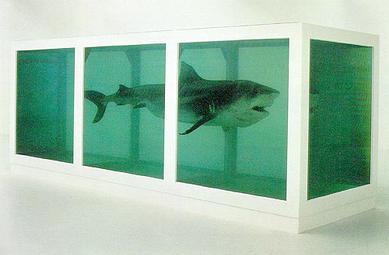
Yes, that is a real shark. No, it is no longer alive.

Damien Hirst looooves doing things in formaldehyde. Besides this shark, he has done preserved art with cows on several occasions, sheep, and dogs. There will be more of him in future weeks, but for now, know that he wandered a tiny bit into hubris territory by plating a cow's horns and hooves in 18-karat gold. Of course he put it in formaldehyde. 

The Physical Impossibility of Death in the Mind of Someone Living is one of Hirst's many formaldehyde pieces. It was commissioned in 1991 by one Charles Saatchi, who apparently had nothing better to do than get his name attached to an undead shark. The tiger shark itself cost 6,000 British pounds. The whole display cost 50,000. Whatever floats your boat, Saatchi...whatever floats your boat.

I HUNGER.


As per the reeaaaalllyyy long title, the shark is supposed to be so lifelike that it can inspire fear even after death. Small wonder; if you saw a 14-foot shark up close and personal, you would probably flinch. The first shark decayed after a while in its original gallery, and, after being replaced in 2006, was temporarily moved to the New York Metropolitan Museum of Art. It left there in 2010, making one wonder where the giant shark is now.

You could almost say Hirst jumped the shark. Naaaah...let's not. He probably still has a few ideas left.

Thursday, July 21, 2011

Creature Feature: Megalodon.

As I was saying yesterday, sharks are the most feared creatures in the sea. If people see a shark fin sticking up from the water, the whole beach gets evacuated. The sail of the deadly man-o'-war may be mistaken as an inflatable pool toy, but the fin of a shark looks sinister. Never mind the rows upon rows of teeth in its mouth, or that its torpedo-shaped body is much better adapted than yours for swimming.

Hell, sharks even made the mammoths piss themselves. Sharks have been around since before the dinosaurs, but did not reach the epitome of "death by teeth" until the Cenozoic. The monster of the seas back then was not the Great White, but a far more massive shark called megalodon. (Carcharodon megalodon? Nobody's really sure.)


C. megalodon was the terror of the ancient seas.  Fossils show that it ate dolphins and could easily have swallowed modern dolphins whole. A single tooth was 7 inches long. This thing made Jaws look like a cute, fluffy kitten.


What did it eat? Everything. Nothing was bigger than C. megalodon. It joins Andrewsarchus in the "We know this thing was huge, but we don't know how huge," category. All we can guess is that this was a gigantic shark from the teeth alone. What we have says that it should have been around 16 meters (52 feet) in length. That's larger than the whale shark, which is a giant plankton-eater.

The largest TWO are megalodon.


How the hell did this massive predator die out? Cooler waters and a shortage of food.  For once, humans are not to blame at all. Other predators, including orca relatives, simply gave C. megalodon trouble. Yes, it ate delphinids, but the dolphins and whales were eating its food right back. Flipper has once again saved us from shark attack.

Wednesday, July 20, 2011

"They Actually Eat That:" Shark.

Wait. What? What the hell are sharks doing here? Sharks are the undisputed, murdering psychopaths of the ocean. The appearance of a shark fin is usually a sign to get the eff outta the water. They can't be an aphrodisiac, what with concealed junk and all, so what the hell are they doing on this column?

Silly. Humans will put ANYTHING in their mouths. Sharks wind up in nets just like other fish do. Of course they get eaten.


Or, well, their fins get eaten. Shark fin soup is the main shark dish that gets environmentalists in a tizzy. It is, of course, found in China and several other places that carry on Chinese traditions (such as Thailand). Since the fin has no flavor of its own, the broth and other ingredients make the soup palatable.

The fin is said to have numerous health benefits, including helping the lungs and kidney function properly. It also has a unique texture somewhere between crunchy and chewy. The soup is served at banquets, weddings, and business meetings as a show of respect to guests. It is popular enough to make a dent of 70-90% in many shark populations.


The kicker: Only the fins are used in the soup. The rest of the shark is tossed into the ocean, fully alive but unable to swim. Other little fishies probably say "serves you right!" and spit on the shark's rotting, finless corpse as they swim by. Considering this is coming from China - the place that eats all sorts of animal parts - this wastefulness is especially shocking. Plus, killing off apex predators isn't cool.

Shark meat is not nutritious. Cuisine or not, it contains very high levels of mercury, just like eagle meat would have contained tons of pesticides during the DDT days. The bigger the fish, the more mercury it has. Bioaccumulation. Learn about it.

Saturday, July 9, 2011

Creature Feature: Sawfish.

Once upon a time, an evil genius wanted sharks with laser beams attached to their heads. After being frozen, the sharks he wanted became endangered, and since that red tape would have been a mess to deal with, he wound up with no laser-bearing sharks. Until...


For those of us who cannot afford frickin' sharks with frickin' laser beams attached to their heads, here's a shark with a chainsaw on its nose:


Technically, that's a sawfish (genus Pristis), not a sawshark, but it's still a neat-looking chondrichthian. Sawfish are found in the sub-tropical areas of the Atlantic and Indo-Pacific oceans, and can cross freely between bodies if salt and fresh water. It lives in muddy water and is nocturnal. Depending on the species, sawfish can get anywhere from 4.6 to 23 feet (7 meters) long.

That sawlike nose is not a bad Photoshop job - it's the sawfish's main sensory organ. Like the ridiculous-looking duck bill on a platypus, it is used to feel around for prey in the mud. The spikes on the sides of the saw impale whatever they flush out and need to be cleaned every so often. When sawfish are born, the rostrum is covered by a membrane that prevents the mini-saws from cutting up the mother as the baby rays make their exit.
Imagine this coming out your rear end. You're welcome.

All sawfish and sawsharks are critically endangered. Overfishing and difficulty of cultivation in captivity are the main causes. Some fishers collect the rostra as novelties and believe that the fish put up a good fight once hooked. Fins from sawfish supposedly make the best shark fin soup, and the liver is used in traditional Asian medicine. They cannot grow quickly enough to meet the demand for their body parts.
 
The overall strangeness of the sawfish has made it a staple in popular culture. The Aztecs called it an 'earth monster' (so where's its giant immortal thing, 5D's?).  As mentioned earlier, Asian cultures use it for food and exorcism. It is uncommon in works set under the sea and is usually used as a tool due to its crazy sawlike rostrum.

Riddle me this, Dr. Evil: If nature can't sustain a shark-like ray with a saw on its nose, what makes you think that lasers on a shark's head would work?

Friday, July 8, 2011

Creature Feature: Blue Spotted Ribbontail Ray.


OK, so it's not as cute as we remembered it. Sue us. It's still one hell of a trippy ray, even if it is not necessarily cute.

The Blue Spotted Ribbontail ray (Taeniura lymma) is found throughout the warmer parts of the Indian and Pacific Oceans. It eats molluscs, sea worms (which are pretty cool in their own right), shrimp, and small bony fishes. Surprise, surprise, it's found in weirdness hotspots like Indonesia, Australia, and Madagascar. It usually stays on the bottom of coral reefs, and can also be found in tide pools and beds of seagrass.

Feeling a sense of deja vu? That's because this little ray has a lot in common with the blue-ringed octopus, another brightly colored creature that's toxic to boot. Although not as poisonous, the sting from one of these rays still hurts. Please stay away if you see a blue-streaked tail sticking up out of the sand.

Or you might be on drugs, in which case stay the eff out of the ocean. :)

Blue-spotted rays are one of many types of chondricthians (sharks, rays, skates etc.) that bear live young. These rays give birth by "aplacental vivipary." The baby rays feed on yolk and uterine milk (mucous, protein, and fat - essentially gourmet snotballs) until they are finally pushed out of mommy ray's belly. They look more or less like adult rays, only smaller. Aww!

Like tiny, acid-drenched pancakes that can sting you!


Pretty though these little rays are, do not try to get one as a pet. The ray is considered near-threatened due to toxic fishing in its area. Moreover, captive rays of this sort have notoriously short lifespans in captivity. Many of them die almost as soon as they are brought into captivity. Even rays that look perfectly healthy develop unknown complications and die. They have no less than five species of tapeworm associated with them, but remain one of the most common rays in the aquarium trade. Stick with lionfish if you want a really impressive aquarium; at least those have a lower chance of going belly-up.

Thursday, March 10, 2011

Creature Feature: Whale Shark.

If we said that today's entry was a giant shark, many of you would flip your lid. After all, there is no "extinct" tag down at the bottom of this post. The idea of a shark over 12 meters (41 feet) in length sends most people screaming from the beaches.


Get outta the water! IT HAS SCIENCE IN IT!

Actually, today's shark is a perfectly docile creature, just like many, many other sharks in the sea.


Not all sharks are Jaws; the whale shark (Rhincodon typus) has diminished teeth in favor of filter feeding. The only thing these sharks attack are giant clouds of zooplankton (a fancy word for very, very small animals). It looks like a whale and eats like a whale, but that is definitely a shark. It is perfectly friendly towards humans; good thing, seeing as we all love to watch these leviathans swim! 

Reports of exactly how big the whale shark gets are often exaggerated. There have been reports of whale sharks up to 75 feet/23 meters. These are as valid as giant anaconda stories (i.e. "pics or it didn't happen").  The length stated earlier - approximately 41 feet or 12 meters - is as long as science has been able to confirm. If someone finds a bigger one, show us and we will gladly update our records; there's a good chance we might be wrong.

As menacing as whale sharks get.


We are still learning about whale sharks. Until 1996, it was thought that the whale sharks laid eggs. A catch revealed a female pregnant with 300 maturing shark pups - proof that whale sharks are ovoviviparous like boas and livebearing fish. Many more mysteries remain regarding their mating rights and exactly where they give birth. There is still a lot to discover about these massive, gentle sharks, and not all of it can be done by swimming up to them while scuba diving.

Whale sharks are native to warm waters around the world. With that distribution came an abundance of folklore and cute nicknames. The whale shark's distinct skin pattern has granted it the name "domino" in some Spanish-speaking regions. Stories about how coins (Kenya) or stars (Java and Madagascar) were planted on the shark's back are common.  The Vietnamese consider this giant fish a deity ("Sir Fish") and, umm, well...


...if you have been keeping up with this blog, you know what happens to Asian deities most of the time: They wind up on the menu. Shark fin soup can include whale shark meat as well. A single fin from a whale shark fetches a very pretty penny. There are bans fishing for whale sharks, but oil spills and unknown population numbers mean that this shark will be in the "vulnerable" category for a long time. Few aquariums can hold whale sharks; enjoy them while you can.


Tomorrow: Who's that red-eyed frog we keep seeing at the Rainforest Cafe, again?

Sunday, February 13, 2011

Creature Feature: Cookiecutter Shark.

And now for something completely different: A shark that makes perfectly circular wounds with its teeth.


These cuts were made by a shark. Not a lamprey. Not a crazy sea worm from some B-horror movie. A shark, as in, related to Jaws. It lives in only a few little spots in the ocean, but those spots are riddled with hole-pocked animals.

This shark has binocular vision, just like Prasina vine snakes and humans.


The cookiecutter shark (Isistius brasiliensis) is one of the smaller shark species referred to as 'dogfish.' These are not the same sharks as the menacing Tiger and Great White species; they are a lot smaller (14-15 inches at most), which honestly makes them creepier when looked at head-on. The cookiecutter shark is particularly uncanny in this regard - it has binocular vision and a mouth straight off of an alien monster.


The  cookiecutter's crazy, suction-like mouth almost looks like it does not belong on a shark. It nonetheless fits the cookiecutter's semi-parasitic life style; cookiecutter sharks swim around taking bites out of whatever they happen to encounter. These chunks are usually 2 inches (5 cm) in diameter and 2.8 inches (7 cm) deep. They can appear on anything - fish, other sharks, whales, dolphins, undersea cables, submarines, human bodies, anything. The U.S. Navy was once forced to retreat because the sharks had caused their submarines to leak. Our finest, everyone!

Besides the strange cutting pattern, the cookiecutter shark also has a number of other weird things about it. It undergoes a migration from miles beneath the sea (literally the "twilight zone") to the surface every day. Oblivious porpoises and other predators may mistake the school of sharks for much smaller, tastier fish thanks to some of the best countershading on the planet.


The cookiecutter shark may look rather drab on top, but it possesses photophores on its underside that make it glow in the dark (a feat so amazing that creationists are all over a creature CLEARLY from the damper reaches of Hell). Its underside glows bright green except for one strange, collar-like ring around its neck (thus a scientific name derived from "Isis," the Egyptian goddess of light). Glowing in the dark is pretty cool, but the collar baffles scientists; the current theory is that it serves as a lure,  making this the first recorded instance of reverse-bioluminescence as a hunting mechanism. Trippy.

Tomorrow: Happy Valentine's Day! Those kissing fish are not as lovey-dovey as one may think.

Saturday, January 1, 2011

Creature Feature: Manta Ray.

How could I have not done a ray yet? After all, a stingray killed one of the greatest naturalist-entertainers of all time, Steve Irwin. They're also as weird as they are deadly, looking somewhat like flattened sharks (a la Looney Tunes steamroller) with venom in their tails.

If the shark is the undisputed King of the Ocean like the lion is usually seen as the King of the Jungle, then the manta ray has a reputation as Satan of the Sea. (Bear in mind that that is a HUGE title - the sea has a whole depth at which things suddenly turn uglier than Dante's Inferno.)  With those huge batlike wings and little 'horns,' it is easy to see exactly why:


If you saw a ray with pointy little horns and a 25-foot (7.6 meter) wingspan beneath the water, you would probably think it was a manifestation of the hellish abyss, too. Small wonder that it got to be a villain on the Little Mermaid animated series. 


Manta rays are not Cthulhu's minions. Really. Of all the rays, the manta ray is 100% harmless. It's a big ray, and probably the most intelligent, but it's a filter feeder. That means it eats tiny little sea creatures, just like humpback whales. Just about the only thing remotely demonic about it aside from its appearance is its slimy body. Looks can be deceiving.


The manta ray's place as a menacing animal spawns, in particular, from two horror films from the 1930's: The Sea Bat and The Sea Fiend, later re-released as Devil Monster in 1946. The makers of these two movies were unaware of the manta's nature as a filter-feeder. It has since been used to make at least one theme park ride (at Sea World, go figure) sound more intimidating. (Noah's Ark had the sense to use a stingray for their theme park instead.)

It's not all bad press for the manta ray. The Peruvian Moche people worshiped everything in the sea, including the giant batlike fish that breached every so often. Nintendo has blessed it with not one, but two Pokemon.


They are also a huge attraction due sheer size. There are organized tours to see manta rays and several places to feed them. Only five aquariums in the world have manta rays, and only one is in America; if you wish to see one, you're better off booking a trip to Thailand or Bali for snorkeling. Maybe you'll even get up close!