Monday, January 9, 2012

Bio-Art: Fossil Fighters.


Is that the most badass way to start a week of entries or what?

For the past week or so, I've been hooked on the sequel to the above game: Fossil Fighters Champions. I was a total addict for the first Fossil Fighters, too. In a nutshell, the whole premise of the game is digging up fossils, reviving superpowered dinosaurs, and then pitting them against each other in death matches. It's cracktastic.

If you are familiar with Japanese 'mon' series, two should immediately come to mind: Pokemon and Dinosaur King. Yes, this is another one of those infamous monster fighting games from Japan. If one fused the basic idea of Dinosaur King with the bright colors of Pokemon, one would get something like Fossil Fighters...but not quite.
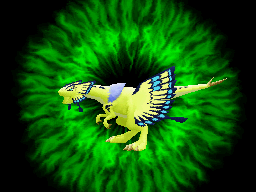
If Tefflaceras is indeed a thing, I'm sure it didn't have wings like that. Also, Ancient Fairy Dragon just got competition.


Fossil Fighters blows both Pokemon and Dinosaur King out of the water. The stories for both games, although a bit predictable in places, are amazingly dark for kids' games (one involves David Icke's reptoids; another, necromancy)  and have nice little twists that I never saw coming. The element system is simple, the battle mechanics strategic (beware of rotating moves!), and the attacks, while a mite unrealistic (although dinosaurs just snapping at each other WOULD get old after a while) are pretty darn cool. The game was popular enough to spawn a sequel, Super Fossil Fighters/Fossil Fighters Champions, which featured a few new mechanics and online play.

The Vivosaur (we have to be fair: plesiosaurs, pterosaurs, and ancient mammals aren't dinosaurs) designs were among the best little Easter eggs of the game for me. The designs often have to do with the meaning of the dinosaur's name, which, as a linguist, is a real treat. For example, "Krona," a giant mosasaur, has Roman numerals on its body like a clock (think "chronological," "chronic," etc.). Coatlus, based off of Quetzalcoatlus and my favorite Vivosaur in the first game, is modeled after its namesake feathered serpent deity. Krypto, who only appears in FFC/Super, is modeled after Anubis, the Egyptian god of mummification (i.e. crypts). I could go on with this. There are a lot of in-jokes being ignored.

Crysosaurus has ice on it in this game? Noooo...really?


I cannot think of a better way for kids (and anyone else) to learn about ancient fauna. Aside from dinosaurs, the original Fossil Fighters also had prehistoric mammals like Andarch (Andrewsarchus) and the rather bizarre Jara (a tapejarid pterosaur). Fossil Fighters Champions has ventured into invertebrates, fish, and synapsids. There are several times I have gone "that's a thing?" at something in Fossil Fighters, only to go online and find out that, yes, things like slingshot deer actually existed. The series overall contains 90% real paleos and 10% "fun" creatures, such as chickens and aliens. Hardcore paleontologists will be impressed with you after playing this game - just don't ask if T.rex ever had a Harley-ish paintjob. The answer is no.

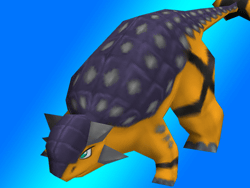
So, is it worth giving a try? If you've ever enjoyed Pokemon and/or loved dinosaurs, you betcha. The storylines are more carefully thought-out than anything Pokemon has ever concocted. Some of the dinosaurs are really creative; you'll laugh when you see the ankh on the Ankylosaurus. Effort and heart went into these games, and if they improve your hand-eye coordination and paleo knowledge, so much the better. The graphics are much better in FFC/Super, especially in the cut scenes, but there are some elements of the first game that I still love. If Pokemon falls to the ancient behemoths of Fossil Fighters, all I'll have to say is "it's about damn time." This is a must-see for any fan of video games with a love of prehistoric creatures.

Creature Feature: Orchid Mantis.

Why, in all of the entries here, have mantids gone unnoticed? There is certainly something bizarre about a bug with 'arms' as its first two legs. Mantis heads make good bases for alien heads. Mantids in general should have been covered here a while back, but for now, we are only looking at the weirdest of the weird. Even mantises have their freak shows.


 That insectoid flower (or floral insect) is an orchid mantis (Hymenopus coronatus). Like all mantids, it is predatory. Don't let that pink fool you; the orchid mantis will eat any small bugs within its reach. We wish Avatar had one of these, but they are only native to the rainforests of Indonesia, Malaysia, and Sumatra.

The orchid mantis has some of the best camouflage in the insect world. Its lower legs look almost exactly like flower petals. Its abdomen and eyes have stripes like flowers, too. One could probably stick this mantis into a bouquet of flowers and not notice until the bug flew off. Ladies, hold onto your monocles - that flower's alive!

Image by Luc Viatour at www.Lucnix.be. Go visit him now!


The mantids are not born with this stunning coloration. They start as orange, antlike nymphs. With each shed, they become steadily more colorful. The mantis takes on the coloration of whatever flower becomes its home - usually a papaya or orchid blossom. This leads to a great variety of patterns in mature specimens. There are some theories that climate, rather than just surrounding flora, may have an impact on the insect's final colors. Bear this in mind if you plan on taking one home and breeding it.

As one might imagine, orchid mantises are uncommon in the exotic pet trade. In captivity, they live almost exclusively on fruit flies. They are docile and can easily be handled. Provide sufficient decor for the mantis to molt and otherwise feel comfortable. Although not for beginners, if you are looking for an exotic insect, this mantis might be up your alley.

Saturday, January 7, 2012

Creature Feature: Synthetoceras.

Here at the Wonderful World, we do occasionally try to stick to the old title and make a mythical creature real. There was a whole week devoted to the possible sources of mythical creatures, including how, and if, they ever existed or potentially could exist. Bear in mind that these entries were not necessarily complete, meaning that I could have totally missed something obvious. In this case, it was our bad twice over. Ladies and gents, we present to you...the quadricorn:


Actually, Synthetoceras looks more like a kirin from Twelve Kingdoms, but the joke was too silly to resist.


Synthetoceras ('fused horn') was a genus of artiodactyls that lived in the Miocene Epoch - 13.6-5.33 m.y.a., or "after the dinosaurs" for those of you keeping track at home. Fossils of this genus have been found from Wyoming to the lowermost tip of Illinois. Synthetoceras ran parallel to modern cervids in terms of size (ranging from roe deer to elk) and presumably niche, but was not directly related beyond having cloven hooves. It may have been more closely related to camels than to deer.

We know what you're here for, however. How about that crazy horn?


(c) Murray Alcosser.

The type species of the genus, S. tricornatus, had three horns in total. It was about 7 feet (2m) long, making that strange horn quite imposing. The two near its eyes looked fairly normal, being short and curved like cow horns. The last horn, located on its nose, was bifurcated at the tip (making it not quite a quadricorn). Since only males had these horns, it is assumed that it was used for territorial battles or courtship.

Beyond that, we do not know very much about Synthetoceras. We think it lived in herds and overall behaved much like modern deer. The only real difference would have been the headgear, which even the most crazy conspiracy theorist could not mistake for the head of Satan. Satan with a slingshot horn...come on.

Friday, January 6, 2012

Creature Feature: Microraptor.

I once overheard a conversation stating that, if one adds an extra pair of wings onto anything, it instantly becomes a mythical creature. Put wings on a horse and you get a pegasus; wings on a unicorn implies an alicorn; wings on a lion is usually some sort of sphinx, or, if you prefer, the sacred beast of Mark. This logic falls flat on its face when it comes to dinosaurs.

Yes, four-winged dinosaurs were a thing.


Meet the bird-dinosaurs in the genus Microraptor. They are among the smallest dinosaurs ever found, being about the size and weight of crows. The fossils for Microraptor were found in China, making the scientific names even harder to pronounce than the typical Greco-Roman used in naming dinosaurs.  They ate small mammals and very little else - just like modern raptors! They lived during the early Cretaceous, AKA the period we all REALLY know about despite "Jurassic" being stamped on everything dinosaur-related.

Microraptor did indeed have all of its limbs converted into fully-feathered wings.  However, it was probably more of a glider than a flyer. Scientists think that it flew in graceful, U-shaped arcs from one tree to another. The hands on both wings probably had little use beyond grabbing tree bark.


 Even with some very well-preserved fossils, we cannot tell the proper limb arrangement of this dinosaur. Earlier proposals showed it flying with one wing more or less behind the other, sort of like a dragonfly. The more likely arrangement positions the wings in an X-shape like a biplane, giving the evolution of flight an uncanny parallel to the history of human aviation. We think Microraptor could fly normally as well, but was primarily a glider.

There are debates over whether this four-winged raptor left any evolutionary descendants or not. It is perfectly possible - people had been suggesting a four-winged dinosaur as an avian relative since the 1900's - but there's no conclusive evidence to say one way or the other. The biplane-raptor likely died off, leaving other raptors and feathered dinosaurs to become the birds we know today. Just because it's cool doesn't mean it works.

P.S. Darn Fossil Fighters Champions, eating me alive...

Wednesday, January 4, 2012

"They Actually Eat That:" Silkworms.

It's official: China (with trade partners in Korea) is the king of strange food. Sure, everything in America is processed to hell, but they have zombie jellyfish salad. Nothing says "we're willing to turn ANYTHING into food" quite like zombie jellyfish salad. (Disclaimer: I've had jellyfish salad. It was interesting.)  Silkworms have also got to be pretty high on the list of creepy foods for most people.

The world's only domesticated moth has been caught by China's habit of eating anything that so much as twitches. These little silkworms are sold at night markets as fast food and in supermarkets boiled and canned. They can be found roasted, fried, or just boiled. Hey, want worms with that?


Actually, this is one of the more practical, yet still weird, things China eats. After silk is made, there are a lot of half-metamorphosed larvae left to deal with. The silk-making process requires that one boils the cocoons anyways; half of the cooking is done to make qipao and other lovely silk items regardless of whether the boiled insects were eaten or not. May as well make use of those bodies!

So, what does silkworm taste like? Most foreigners mention the strange smell before the taste, but after they pluck up the courage to put one in their mouths, the insects are tolerable. One person visiting Shanghai described the taste as being similar to lobster brain. I have also seen someone saying they'd be "better with a little crunch to them. " It's probably an acquired taste; once you can stomach the little buggers, they really aren't that bad. Should you be in China or Korea, give silkworm a try.


Why eat the worms? Why not eat them? Insects are little sacks of protein, and these particular sacks are farmed en masse anyways. Bon appetit!

Tuesday, January 3, 2012

Creature Feature: Ribeiroia


Wait. Frog Week is done. Why is there another frog up here? Can't we look at the Indus River Dolphin or someth-


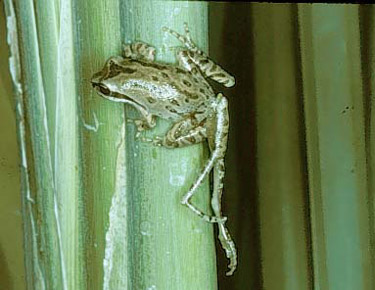
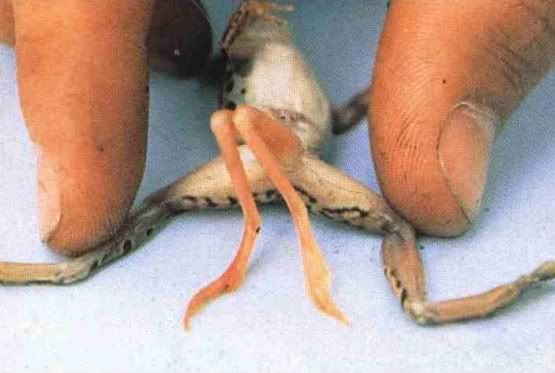
Oh, snap. Those extra limbs are freaky. These are the frogs that were made into malformed skeletons for MALAMP. As the bit for that project said, these multi-limbed frogs are mostly found in North America - i.e. many of our backyards. They are getting more and more numerous every year, so we should probably learn about what causes them.

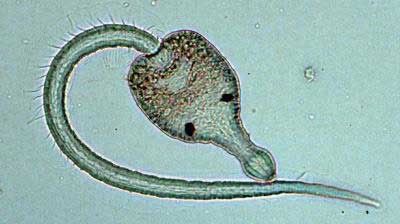
Prior to the discovery of a parasite in the frogs, people assumed that the freakish limb deformations were mankind's fault. We were thinking that these freaks were the result of nuclear waste, mercury, or some other sort of pollution-related mutagen.  Today, we still haven't quite ruled pollution out, but we have changed our prime suspect to this:


Without bringing toxic waste into the picture, multi-limbed frogs are typically caused by a parasite called Ribeiroia. There are three species- one in North America (R. ondontrae), one in Guatamala and the Caribbean (R. marini), and one in Africa. All of the above are parasitic flatworms that infest frogs to further their life cycles. They are usually found in freshwater ponds and wetlands (you know, places where there are frogs).

Like many parasites, the life cycle of these little flatworm is surprisingly complex. Ribeiroia starts out in the gut of an aquatic snail, then reproduces asexually into flagellated juveniles. These little not-sperm then find a tadpole and encyst themselves into what would be the tadpole's legs. It is suspected that this is done because frogs thus deformed are more likely to be eaten by birds (who will then complete the cycle by depositing the parasite's eggs). The alternative explanation? There is no God.


Bio-Art: Tara Galanti's Flying Silk Moths.

As I said waaayyy back when in my silkworm entry, silkworms make cattle look good in terms of how well they can survive in the wild. They can't fly, are really, really slow, and do not even eat without human assistance. The most they can do is occasionally interbreed with their wild counterparts. It's a pretty sad life, especially since so many silkworms die young.

Well, except the silkworms in Tera Galanti's "Wings" project.  The silk moths there are capable of flying farther than, say, the moths found in China. They have been deliberately bred to fly instead of produce silk. Although their flight is not monarch butterfly-level inspiring, it is still very cool to see some of the moths retaining wild characteristics after generations of breeding without it.


Tera Galanti originally began breeding silkworms to get over her fear of moths. After a moth distracted her into a traffic accident, she eventually decided to confront her fear in the form of breeding the silk moth- the world's only thoroughly domesticated moth. Even before her project,  she noticed that a few of her moths were capable of fluttering. Flying moths were the next logical step.

The moths were selectively bred by first isolating the cocoons. Then, she made sure that the females were all high up, guaranteeing that only the males who could get that high would make babies. She also put them in cute little setups like this. Feel free to click around there, by the way.

The next step in the project would naturally be releasing the moths outside. Where would such moths go after being unable to fly for so long? Who knows! The question is the same for domestic chickens bred to fly, and, in an extreme case, Heck aurochs. How would nature react to suddenly having these old species back? (Note: The Indian Jungle Fowl is darn close to a chicken, and it's not dead yet.) We don't know, but it would be fun to find out.