Tuesday, March 6, 2012

Freak Week 3.5: Angora Rabbits.

In looking over past Freak Weeks, one can see that dog, cat, and cow breeds dominate the pages. This is not because other domesticated animals do not have breeds, but rather because people have bred those animals into a greater number of freaky varieties. That's part of why I am broadening this week's "freakishness" - to give other animals bred in captivity more of a spotlight.

By the way? Bunnies are very good breeders. So are mice. Watch in awe and terror as your expectations of cute are perverted beyond your wildest dreams!

How fluffy do you like your bunnies?


Along with the Angora cat and goat, Angora rabbits (Oryctolagus cuniculus, for those curious) originated in Turkey. They are known for big, fluffy coats that make them look more like Easter bunny plushies than actual rabbits. They are most likely the oldest breed of rabbit in the world. Although they come in a variety of colors, the REW (ruby-eyed white; albino) is the favorite among breeders.

Angora rabbits were the first official breed of rabbit. Turkey had been breeding them for goodness knows how long before sharing them with other countries. They were first popularized by the French in the 1700's. They then proceeded to spread all over Europe, finally hitting the United States in the 1900's. Since then, they have become one of the most popular rabbit breeds around.

When fluffy becomes TOO fluffy.


Angora rabbit fur is so thick and fluffy that it can be woven into wool. They are usually shorn like sheep every three-four months. This excessive wool growth can lead to a condition called "wool block" - a hairball from hell that can form in Angora rabbit digestive tracts. Unlike other popular fur animals, rabbits usually do not produce many allergens. Give Angora rabbit sweaters a try if you happen to be allergic to sheep wool.

Rabbit breeds, including Angoras, have a registry. There are several subbreeds (that's a thing, trust me) and color variations of Angora, so if you like your rabbits fluffy like pom-poms and capable of giving you wool, you have a good variety to choose from. As you can imagine, the most maintenance you will do on this rabbit will involve grooming. It's about time somebody selectively bred bunnies; after all, they breed like rabbits.

Monday, March 5, 2012

Bio-Art: A Tribute to Selective Breeding.

But is it art?


Long story short: Kuro realized she had been bad and needed to make a Theme Week for March. Freak Weeks are always fun, and this week will be no exception.

That said...it's about time this column covered selective breeding  - the first form of biological art known to man. Charles Darwin bred pigeons to help propel his evidence for natural selection, but it is an art when you get right down to it. Even when breeding animals for things like taste, aesthetics always play a part in the breed's development. Prove me wrong.


Selective breeding is exactly what it sounds like: Breeding plants or animals for certain traits. This can be just one trait, like milk production, albinism, or docility. Eventually, many breeds become multi-traited creatures inbred to hell and back.  Most modern breeds consist of physical build, personality, color, and, of course, a solid name and line. It helps if these are registered in pedigree books.

Not all captive bred animals qualify as breeds. The validity of a breed depends, first, on whether the animal can be considered domesticated or not. That in itself is a very hard thing to prove; definitions of domestication vary between "can be bred in captivity" to "must have a social structure at which humans can be considered the alpha." One extreme allows lions; the other excludes white mice bar brainwashing.

Are they still domesticated if they try to take us over?
 

With the vagueness of a breed in mind, many true breeds are severely inbred. This leads to defects like crossed eyes (which have been bred out of Siamese cats), hip dysplasia (in small dogs), and usually an overall shortened lifespan in comparison to their wild/not inbred counterparts. Breeds are not necessarily superior to mutts. If, however, a certain trait is desirable enough, it may get bred in...

Bred for size and little else. Shame they were covered already.


Nature breeds creatures to survive. Humans breed them to be pretty (or edible). We shall see how these differences pan out in Freak Week 3.5 - in which we will cover things that may or may not be actual breeds. Look forward to it!

Sunday, March 4, 2012

Creature Feature: Protoceratops.

(Apologies for the delay on this one, too. No excuses except "Kuro needed sleep." Hope to get on a better schedule during Spring Break.)  


There is nothing that captures the imagination quite like a dinosaur. It blows our minds to think of a world dominated by creatures not even remotely like us. In this fantasy, however, we frequently overlook that not all dinosaurs were huge, and there were plenty of mammals, too. 


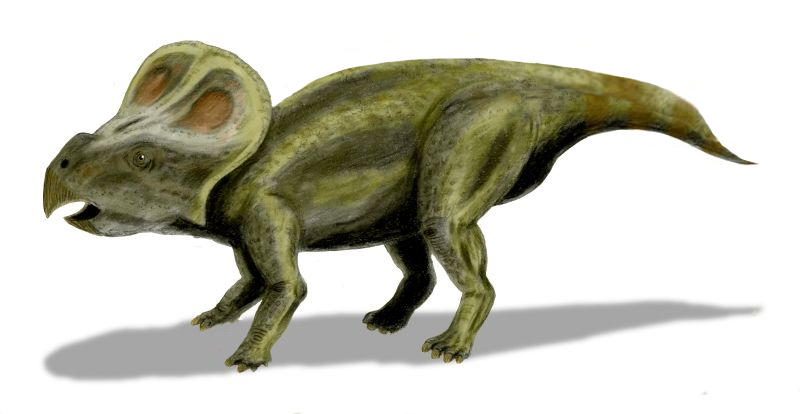
Protoceratops was one of the smaller ceratopsid dinosaurs out there. It had been found mostly in Mongolia and, like most things with parrot beaks, ate plants. It was roughly 2 meters long at most and would barely stand up to the waist of an adult human. Forget that motorized Triceratops; let your kids ride on the back of a real mini-dino sometime.

As the name might imply, Protoceratops was one of the first real ceratopsids to hit the scene in the Early Cretaceous. It has the characteristic frill (whose purpose is still unknown), but also shares some primitive features with not-so-famous dinosaurs like Psittacosaurus - an even smaller dinosaur named after its parrot-like beak. Those are pretty neat, but do not have as many clearly ceratopsian features as Protoceratops. Proto's a transition form, if you will.


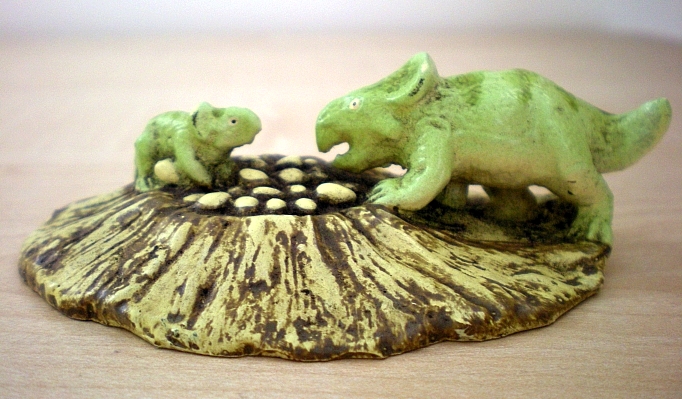
The first fossilized dinosaur eggs ever came from a Protoceratops. These are largely assumed to be from Protoceratops simply because of the area they were found in; nobody knows for sure whether baby protos hatched from them or not. Baby Protoceratops were found in 2011. It has been suggested that Protoceratops, as well as other ceratopsians, took care of their young.


Protoceratops may well have been the origin of the gryphon. Take a look at the beak on a Protoceratops and one can easily see where the idea of a four-legged eagle beast came from. Furthermore, the particular area in which the Protoceratops was found has been known for gold deposits, explaining the gryphon's reputation as a keeper of treasure. The invention of the modern gryphon coincides with the introduction of Scythian traders to Greece. Dragons weren't the only mythological creatures with a link to dinosaurs.

Protoceratops is also a Vivosaur in Fossil Fighters, for those of you interested. In the first game, it was able to become a Tricera - fitting, no? Just sayin'. 

Saturday, March 3, 2012

Creature Feature: Alpine Black Swallowtail Butterfly.

Raise your hand if you are interested in Japanese literature. I do not mean manga. I mean actual literature. There is a short story called The Lady Who Loved Insects. Read it. It describes the author of this post to a T.  Want my life story? Read that. The main character keeps snakes and caterpillars. My kinda girl, there.

Japan would know about people with an avid interest in nature. Apparently, even when that short story was written, people had an amazing interest in biology. The Heian lady there was very well aware that all of her fuzzy caterpillars would turn into butterflies, and even went so far as to let them outside and sit on a fan decorated with Chinese poetry. Given that Japan has one of the most beautiful butterflies in the world, however, one can hardly blame her for liking caterpillars.


The Alpine Black Swallowtail (Papilio maackii) is native to Japan, China, and Korea, even peeking into Russia. As caterpillars, they eat prickly ash and Amur cork leaves. Their favorite nectar as adults comes from various orange trees. Most importantly, however, they are drop-dead gorgeous as butterflies. (The caterpillars don't seem to be particularly impressive. Someone prove me wrong.)

Unlike in many species of...well, animals in general, the female is more brightly colored than the male. The women have more blue in their scales while the males are a duller green. Both sexes still look iridescent and worthy of the name "peacock." Unfortunately, that belongs to another butterfly (Inachus io).


Swallowtails in general have some weird mating habits. Large groups of females will form around one male in hills.  They're mostly virgins, although how entomologists figure this out I have no idea. Anyhow, they perform a courtship dance. The male, once he has picked his favorite, literally plugs her with his sperm inside so that no other man may have her. Shame mammals are not that efficient; sperm plugs could put Jerry Springer out of business.


Feel like you've heard of this one before? If you've ever played Animal Crossing, the "peacock butterfly" is in that game. Don't get confused; they mean this one, not the one with "Io" in its species name. (Not that I mind the Greek references.)

Thursday, March 1, 2012

Creature Feature: Marsupial Mole.

Along with being great pets most of the time, desert animals can be among some of the weirdest animals on the planet. We are used to things that live on our surface world. It is all to easy to forget that there are creatures dwelling in areas in which humans cannot reasonably function. Specifically, humans are visual creatures, so when we see creatures that live in a lightless environment, they have an unsettling effect on us.


Except that one. That one's cute.

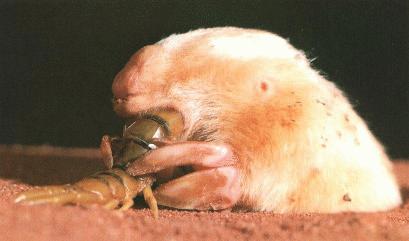
Meet the Marsupial Mole. Like most marsupials, they are native to Australia (specifically the arid deserts). Most of their time is spent underground, where they do almost everything. They eat beetle larvae and caterpillars in the wild, and have been observed eating spiders and lizards in captivity as well. There are two varieties (Notoryctes typhlops and Notoryctes caurinus), both being the only extant members of the family Noryctidae.

Marsupial moles are probably one of the weirdest examples of convergent evolution ever. They diverged from the main marsupial family at about the same time as the dinosaurs went extinct. In the meantime, they have evolved to look a lot like moles mixed with Weasel Balls. They have the same reduced eyes and spaded paws as normal moles. Otherwise, they deserve to be on the "cutest marsupial" list alongside koalas and numbats.

Still kinda cute.
 

Marsupial moles are perfectly adapted to the deserts of Australia. They mate, eat, and do presumably everything else underground. Their eyes are just lenses beneath fur, making them completely blind, and they lack cute mammalian ears. Like naked mole rats, they are effectively ectothermic mammals.  They are the only mammal species in which the neck vertebrae are fused to the back of the head to provide more force when digging. They do not even require much oxygen; despite being mammals, their requirements are so minimal that the oxygen that seeps through the sand will suffice. They are so ill-adept at being on the surface that their floundering underground is reduced to an awkward waddle as soon as they leave the sand.

Living underground all the time unfortunately means that we know almost nothing about these weird marsupials.  Tunnels are extremely common; it's the actual moles that are hard to find. They can be bred in captivity, but even then, that tells us nothing about numbers in the wild. It is suspected that these furry little critters are more common than once thought, but because they are hard to record, they are Endangered on the basis of being data deficient.


The Aborigines were aware of these weird little animate cat toys as well. The Southern Marsupial mole is called Itjaritjari, which sounds a whole lot cuter than comparing it to a mole. On a tangentially-related note, we have no idea what Nintendo would call this if it ever got made into a Pokemon.


Wednesday, February 29, 2012

"They Actually Eat That:" Plantains.

(Apologies for the delay. I had a paper to write.) 

 So, it's time for another installment of "weird things Kuro found while shopping on Devon Avenue!" After doing an entry on Goya, the giant guinea pig, I came across these chips in Devon market. They're made of plantains, which are not usually found in North American cuisine.


But what exactly is a plantain, anyways?

A plantain (Musa) is kinda like a banana, only smaller and green. They are native to Indiaand Southeast Asia in general. However, they are popularly grown in the Caribbean and Africa as well. They are frequently used in Caribbean, African, Indian, and South American cuisine. Other areas such as the Philippines and some southern states use them as well. 

A plantain looks like a slender, green banana. If you manage to find ripe ones, they will actually be brown; don't let that throw you. They can usually be found in the fresh produce sections of most supermarkets.


Plantains and bananas are indeed closely related, but before you decide to try the other banana out of curiosity, there are a few key differences you should know. For starters, plantains cannot be eaten raw; they must be cooked regardless of what growth stage they are at. If cooking a banana sounds disgusting to you, plantains are a lot starchier than bananas. They are treated more like tubers (i.e. potatoes) when cooked. In short, they're almost vegetables.

Since the plantain is darn close to a potato, plantain chips are a rather popular snack food. They can also be cooked with a variety of spices. There are recipes for plantains from Ghana, Puerto Rico, and India. Yes, they have plantain curry. Pick your favorite way to eat 'em and dig in.

Tuesday, February 28, 2012

Creature Feature:...Gold Skulltula?

Confession: I am taking my sweet, sweet time with Legend of Zelda: Ocarina of Time for the 3DS. Almost to the end of the Shadow Temple, which is...I want to say the second to last. Then there will be mini-quests to do, simply because the game is set in a world almost as awesome as ours.

Just as a reminder, here's a real, live Gold Skulltula:


Kidding. The Gold Skulltulas in Zelda were clearly based off of Argiope savignyi. They can be found from Mexico to Bolivia. They are not necessarily gold; the golden female above was one of several color variations.  For those curious about the generic name, "Savigny" happened to be the last name of Marie Jules Cesar Savigny, the first person to describe the genus Argiope. He was a guy, by the way.

For those of you who do not know spiders, they can be classified in terms of how they weave their webs. Argiope spiders are particularly creative orb-weavers. A. savignyi can weave a number of patterns into its orb web. Among them are a cross-shape and disc-shape. Sometimes, these designs are combined into a super-pattern. The resulting web, regardless of pattern, is very sturdy...which results in one of the few things this spider is known for:


Yes, that is a bat in that spiderweb. Yes, the spider is being a vampire and slowly sucking out its inner juices. Gold Skulltul- I mean A. savignyi is one of the few invertebrate predators of bats. Specifically, they feed on the proboscis bat (Rhynchonycteris naso) - a strange critter in and of itself. These aren't even unhealthy bats - just unlucky bats who don't see the Argiope's web. They are successfully entangled within two hours. Again, pick your favorite; some wouldn't be rooting for the spider or the bat in this instance.

As a friendly reminder: Wild A. savignyi do not grant you magical items every time you kill ten of them. Do not carry a hookshot around in preparation. If you happen to think you have a hookshot at your belt, by the way, please see a therapist or look for "Zelda Addicts Anonymous."