Monday, September 6, 2010

Creature Feature: Bushmaster.

Ever notice how it's mostly anacondas and other large constrictors that get the bad horror movies? There is a snake in the Amazon that is so much more worthy of a good horror flick that it...well, OK, it IS funny that Hollywood has not gotten its mitts on this one, yet.

To review (or, if you have never seen my anaconda entry, go see it now), anacondas are boas from the genus Eunectes. They live almost entirely in the water. The positioning and shape of their eyes (they have 8-shaped pupils! HOW COOL!) makes them look like aquatic puppy dogs. The green anaconda is the heaviest snake in the world and constantly vies with the reticulated python for the title of 'longest.' Its name shows none of that badassitude.

You know what the name Eunectes means? "Good swimmer." Way to make ANYTHING sound menacing, Greek.

There is a far more imposing snake called the bushmaster (Lachesis muta). Like most vipers, these snakes are deadly even as babies. At a maximum length of 12 feet, the bushmaster is the longest pit viper in the world.

Unfortunately, the best pic I could find showing its length was tiny.

Wait, what's a pit viper? Was "viper" not intimidating enough?

Pit vipers refer to snakes such as rattlers, lanceheads, bushmasters - anything in the subfamily Crotalinae. They live in Asia and the Americas. If you have ever encountered a rattlesnake, you have met your first pit viper.


Pit vipers are so named for the heat-sensing pits between their eyes and nostrils. In short, they detect infrared radiation. Although boas and pythons also have labial pits, the pits on pit vipers are a lot more sophisticated - pit vipers can strike accurately at an item 0.2 degrees C higher than the background temperature. Nobody is quite sure how this accurate heat sense looks to a snake, but it is a mighty fine sense indeed.

In case you do not get the implications of heat pits, allow me to clarify:

You can make your footsteps as quiet as those of a mouse. You can wear camouflage garb. You can wash away a lot of your scent. You cannot conceal your body heat. Mammals are homeotherms - their body temperatures stay relatively constant. If a pit viper wants to kill you, it will kill you.


A GOOD movie monster in action.

"What's in a name?" Shakespeare asked. "Bushmaster" sounds more intimidating than the infamous boid mentioned earlier, but there is even more horror laced into its scientific name. If the generic name "Lachesis" sounded familiar to you, but you could not quite place where you had heard it, perhaps this will refresh your memory:


Lachesis was the Fate that determined the length of one's life in Greek mythology. Add on the 'muta' part of the name and you have, literally, a silent killer. Even science admits that this snake can fuck you up (and not in the good way).When science says that something is deadly, it's deadly.


Pictured: Beautiful, silent death.

Catch on, Hollywood. This thing has tales of dread (and sometimes seduction) in areas to which it is native. You cannot beat that.

Sunday, September 5, 2010

Creature Feature: Hummingbird Moths.


Look, up in the sky! It's a bird! It's a plane! It's a bee!

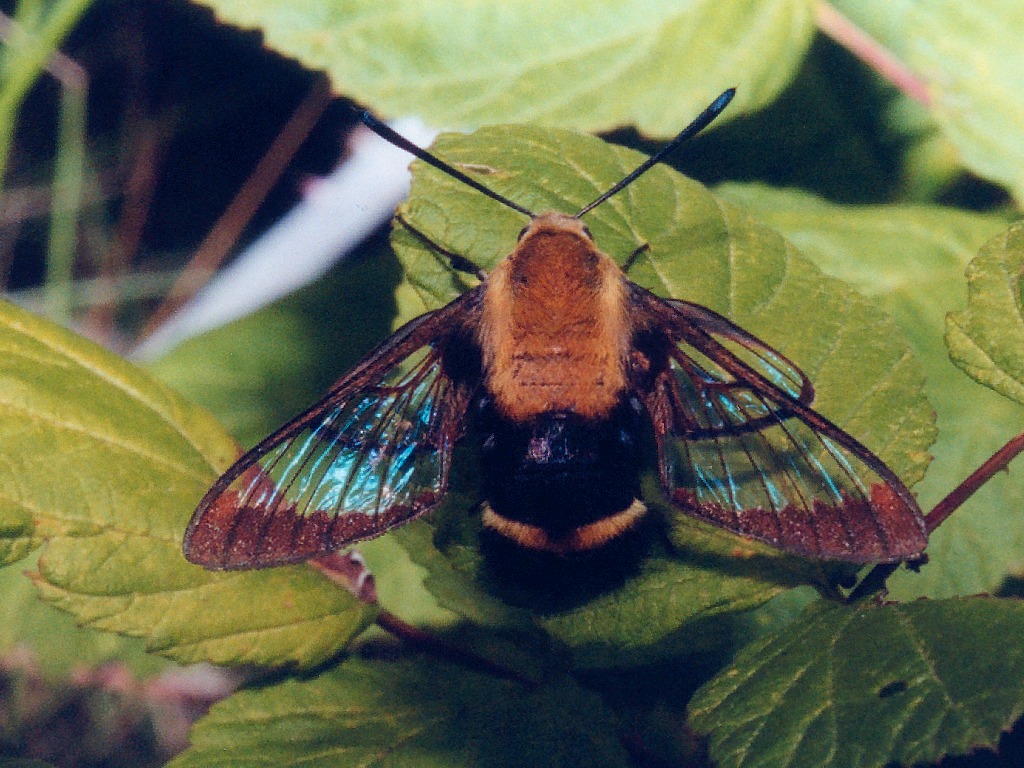
Actually, it is not any of the above. It's a hummingbird moth (genus Hemaris). Moths like that are also called "Clearwing" (US) or "Bee" (UK) moths, depending on where you are.

Hummingbird moths are related to the death's-head moth (which is one of the in-progress entries from when I was in Europe). The group is collectively called 'sphinx moths' or 'hawkmoths.' Sphinx/hawk moths are the only moths capable of hovering, like, well...like hummingbirds.


Unlike most lepidopterans, hummingbird moths have very few, if any, scaly patches on their clear wings. This plus their diurnal habits and coloration make them resemble bees. Their hovering flight patterns and flower choices, however, are more akin to hummingbirds. They look like bees until you realize that they do not fly like bees or resemble tiny hummingbirds until you see their clear wings. In short, the hummingbird moth is convergent evolution on speed.


Hummingbird + bee = this.

A while back in August, I encountered one of these charming little creatures. The Mexican guy working there said that these moths sting worse than bees and was stunned that I managed to watch the moth without a single injury. Hummingbird moths do not sting at all. (If memory serves, no lepidopterans do.)

Hummingbird moths are native to North America, South America, Europe and Asia. Look for them in a backyard near you.


This one's from Vietnam and I cannot tell.

(For fun, these guys were probably the basis for the wings of the Ikran species in Avatar.)

Saturday, September 4, 2010

Creature Feature: Eclectus Parrots.


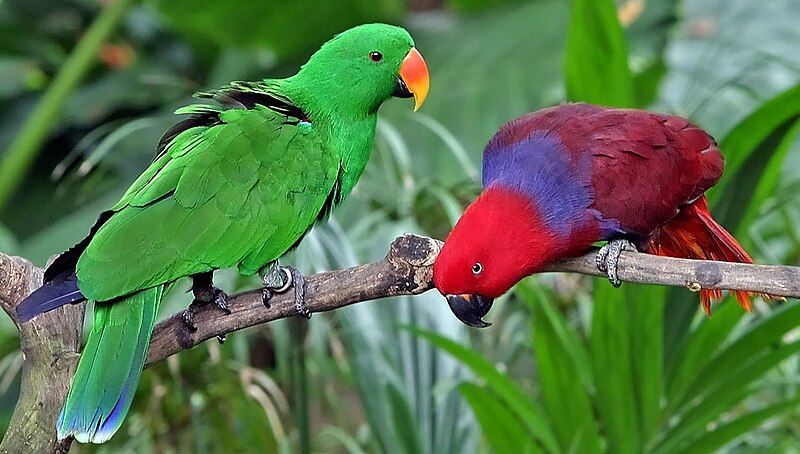
Quick. Which bird is male and which is female?

If you guessed the green one for the female...you're wrong. In Eclectus Parrots (Eclectus roratus), the female is bright red and purple. (Seeing one in person today was exciting - the Greek "phoenix" comes from the word for deep red/purple.) This is the opposite case from most sexually dimorphic birds. Both sexes look stunning in their own right.


This could be a manga cover.

These parrots are native to Papua New Guinea and the surrounding islands. They are sometimes considered pests for eating fruit off of trees, but really, birds will do that. These strike me as an animal that would be more valuable alive than dead - their colors make them uncommon in the exotic pet trade. (Also, DAMN YOU Austronesia for having such awesome parrots!)

There are at least nine subspecies and several extinct types of Eclectus, all exhibiting this elaborate dimorphism. The type most commonly found in captivity in the U.S. originates from the Solomon Islands.

Eclectus parrots are the only parrots that exhibit acute sexual dimorphism. The differences between the two are so obvious that they were not considered the same species until the 20th century. I imagine that the only way they found out otherwise was, well...the hard way.


Nice gold under this girl's tail, too! Perfect phoenix palette!

Friday, September 3, 2010

Creature Feature: Three-toed Sloth.

This is my punishment for being so damn slow on these things: Friday's 'take it easy' animal is the Three-Toed Sloth.


(Not the yukkuri.)


How the hell did evolution create this? If a chicken can cross a road, surely a three-toed sloth (genus Bradypus) can. It's flat and slow enough to be mistaken for roadkill.

Sloths were not originally the laziest creatures in the world. They used to be gigantic beasts that gave the African elephant a run for its money as the world's largest land mammal. Like elephants, these mammals were herbivorous, but may have had some animal protein mixed into their diet; several of their adaptations resemble those in carnivorids. (This is controversial, but since the idea of a GIANT carnivore is so intimidating, nature programs capitalize on it.)


Holy ****.

Humans suck, Pleistocene megafauna varies inversely with human activity, BLAH BLAH BLAH. You've heard my shpiel on this before. There are a few rumors of this creature still roaming the Amazon, but the end result of this massive sloth extinction was particularly pathetic.


Sloths went from being massive badasses to creatures that sleep 15-20 hours a day. This thing is so slow that algae grows in its fur as it hangs, day after day, in the treetops of the Amazon. The algal growth provides excellent camouflage; as the animal stays nearly motionless in the treetops, it resembles a pile of dead leaves.


Or Chewbacca's long lost cousin with different teeth.

Three-toed sloths only leave the trees to take a crap; they also urinate more when it rains. That's a lot of timing required to go to the bathroom! It gets weirder: Like naked mole rats, three-toed sloths have extremely slow metabolisms and little to no internal temperature regulation. This makes them akin to big, fuzzy reptiles.

Nobody knows when three-toed sloths mate, but science's best guess is between March-February. Once born, the baby sloth stays attached to its mother's nipple for nine months; it drinks what little milk there is as soon as it is produced.


Born to climb.

Thursday, September 2, 2010

Creature Feature: Northern White-Faced Owl.


If this little owl did not make your heart melt or your eyes pop, then, again, you must be some sort of cyborg.

Popo-chan up there is a Northern White-Faced Owl (Ptilopsis leucotis). Like all owls, these birds are nocturnal and feed primarily on rodents. It lives in the areas between the Equator and Sahara of Africa and is not endangered at all. (Good, I might want one for a pet at some point.)


Although there is nothing particularly unique about the Northern White-Faced Owl except its defense mechanism, boy is it a doozie! This owl has become quite popular in Japan due to the above video and it is easy to see why:


YOU say no to that face. From Sora no Woto.

(Actually, they are quite fond of owls in general over there. One word for 'owl' is a homophone for one of the words for 'happiness.' There were little owl trinkets EVERYWHERE when I went there!)

As the video demonstrates, this owl can take on two VERY different forms depending on what type of enemy it is facing. When faced with a slightly larger owl, the White-Faced makes itself look MUCH bigger:


BOO! Sorry, I have another animal for Halloween.

When up against a considerably larger owl, Whitey will do the exact opposite thing: Mimic a dead branch by essentially shriveling itself. You would think that the moving gaze of a dead branch would give away the fact that there is more to this owl than meets the eye, but damn if it doesn't look like a vampire when in this mode:


Now we know why owls are named after blood-sucking night demons, eh?

That's almost octopus-level shapeshifting. Or, alternatively...


MORE THAN MEETS THE EYE!

Wednesday, September 1, 2010

"They Actually Eat That:" Loach Hell

Tofu is one of the big foods in the snake oil-pandering health food business. It is essentially 'soy cheese' - fermented soy protein curdled into a solid chunk. The result is often used as an alternative to cheese and ice cream made from cow's milk and is basically thought of as one of the healthiest Asian foods around.

How can you screw that up? By putting loaches in it.


First off, just what is a loach? A loach can be any number of fish found in the order Cypriniformes, but usually refers to fish of the family Cobitidae. They are not particularly impressive fish by any means, although I am sure that one day a loach will make it onto this blog. You know, except for this entry...which involves harming several baby loaches at once.


In this case, you guessed it, we are talking about putting baby loaches into tofu. They swim into the tofu to escape the boiling water, only to slowly die anyways. Their rapid squirming creates holes that resemble those of Swiss cheese within the tofu. (Should you desire that effect, this is not the only way to do it.)

They actually eat that?!

Nobody is really sure about this one. There are people who say it's true and others who say that it's false. We think it originated from a Korean restaurant only to be botched by would-be loach eaters in Japan, but some people say that there are sparse specialty restaurants that serve this hellish tofu. There is something called 'loach hot pot' that definitely exists and is just as sadistic. If his weird tofu does exist, it's rare; if not, it has more truth behind it than some of Ripley's stuff.


Loach hot-pot is JUST as nasty.

Is it plausible? Well, it's no weirder than anything else that has ever appeared on this column...

Creature Feature: Sirens.

If you read that title and went "WTF, mermaids?!", there are a few things wrong with your way of thinking. The original sirens were avian and later became mermaid-like creatures. The mermaid idea has snuck into several scientific terms including a usually fatal syndrome that merges a human baby's legs together (Sirenomelia). Also, manatees and dugongs are in the order Sirenia; supposedly, some extremely drunk sailors thought that they resembled human women with piscine tails.


EXTREMELY drunk. I want what they had. Alas, this is NOT the most perverted manatee joke I could make.

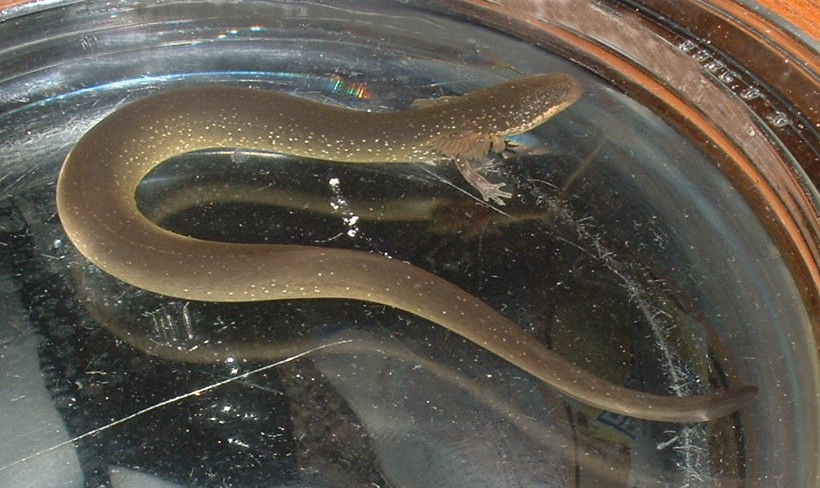
Great though manatees may be, this is not about them. There are far lesser-known amphibians that are also called sirens (family Sirenidae). Unfortunately, they sing about as well as Britney Spears and are nowhere near as sexy.


On second thought, that tail doesn't look half bad...

When was the last time you saw a tetrapod with two forelimbs that were definitely not fins and no hind limbs to speak of? If you said "naga porn," good for you; you have a VERY DIRTY MIND to which I can relate.

Sirens are native to the Southeastern U.S. and Mexico. Even though those limbs look stubby, like other salamanders, sirens can leave the water if the ground is wet enough. Similar to the axolotl, sirens retain their feathery juvenile gills. (Their juvenile gills are comparatively useless.)

Sirens can breathe through both gills and lungs. They are one of the most ancient groups of salamanders and boy does it show. They share the burrowing habits of lungfish. When they hunt, they inhale their prey. It's like a lamprey did it with a lizard.


More on sirens here. They're cool creatures!

...I should really do lampreys sometime.