Thursday, July 14, 2011

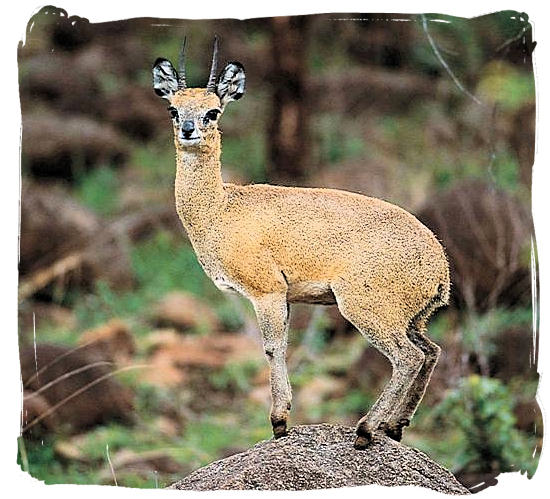
Creature Feature: Klipspringer.

"Human feet are inefficient!" We have said it again and again: human feet fail at being anything but mildly dextrous snowshoes. We have no claws, and although our five digits were useful for climbing trees, they are not so useful for running. As a rule of thumb, the fastest creatures are the ones who have the least of their bodies on the ground at any given time.


Nowhere is this more true than with the klipspringer (Oreotragus oreotragus - no relation to Oreo cookies). The klipspringer is a small antelope native to the rockier parts of southeastern Africa. It's so agile it makes other ungulates look like awkward turtles by comparison. The klipspringer looks at us and laughs its adorable little tail off as it dashes up the cliffs like so:


See that? That was Bambi ballet dancing (note: antelope like the klipspringer are not as close to deer as they look). We're not kidding - the klipspringer has evolved to walk on its toes just like a ballerina, only all the time. Ungulates normally walk on their toenails, but the klipspringer takes it one step further by walking on the tippy-tips of its toenails. The digits are so narrow that all four feet can fit on the surface of a rock the size of a Canadian dollar coin.


The klipspringer's rocky, dry habitat has given it another useful adaptation: It does not need to drink. At all. Like many desert animals, it gets all the water it needs from the succulents it eats. It is also one of the few truly monogamous mammals, staying in breeding pairs instead of large herds. Not that we would mind herds of cute, athletic antelopes dancing on their tiptoes.

Wednesday, July 13, 2011

"They Actually Eat That:" Brains.

OK, I'm sorry, guys, but a certain awesome friend of mine came over. We had a great time at Lincoln Park Zoo except for the subpar organic fare. Bottom line, I barely had the spring left to do one entry, let alone two.

That means this one's gonna be really nasty, 'kay?


There are a lot of jokes about eating brains thanks to the relatively new zombie fad. Why brains? Well, presumably, since zombies have few brains of their own left, whatever parasite/virus drives them to bite people also requires their brains to further replicate themselves. Said it before and I'll say it again: This sounds like the work of a prion, that one nasty little Mad Cow-causing protein that photocopies its butt all over your gray matter.

So why the hell are people eating brains?!

They Actually Eat That?! 

But of course! When I say that people use every part of an animal, I do mean every part. Brains are sometimes tossed in with various other viscera into "offal," the catch-all term for "miscellaneous bits that we don't know what to do with." These bits and pieces often become cuisine, as with the sheep brain dish from Spain and the cow brain dish from Portugal. In Mexico, they eat pig brains in quesadillas. Better watch out in places that speak Spanish or Portuguese; every one of them seems to have some sort of brain dish.


Like this, only in a fun little wrapper and ground up so you can't tell.

It gets worse: As in Indiana Jones, people did eat monkey brains at one point. This was known to happen more in China than in India. It was part of Chinese imperial cuisine in the Han Dynasty. As with almost every other weird food from China, this was thought to cure impotence. Oh, China, there is rarely a week when I cannot mention you on this space.

Other countries also supposedly eat monkey brains. The little belt of countries around China still eats monkeys, as more or less confirmed by this man's experience in Singapore. The practice of eating monkey has led to the overhunting of monkeys in Indonesia, and brains are included as 'edible' parts of said monkey.


Now THAT is what I call brain food.

Eating brains goes back a long way. Chimpanzees are not only known to eat other chimpanzees (including babies), but also eat the brains of monkeys for extra fat in their diets. Perhaps that explains the modern fascination with zombies: We are genetically programmed to eat brains.

Tuesday, July 12, 2011

Creature Feature: Barn Owl.

Let's get back on dry land for a moment, shall we? After all, there are plenty of perfectly strange things on our surface world.

Owls always have an interesting place in human culture. In Japan, they are carved everywhere because the word for owl sounds like one of the words for happiness. The Romans thought owls were vampires ("striges;" thus the term "strigiformes" for the order of owls) even though they were also the sacred bird of Athena/Minerva. The overall impression is of a nocturnal, intelligent bird with a cute little beak, an oddly human face, and the ability to scare the crap out of people. In modern times, the association with witchcraft still stands.


You've got mail, Harry!

The Barn Owl (Tyto alba) is one of the most common owls in the whole world. It is so named because it often hangs out around barns to eat the tasty little mice therein. It has a pale, heart-shaped face, excellent hearing, and wings that are almost silent in the night.

The Barn Owl in particular also gives one perfectly good reason to believe that owls are true night spirits. They have a very humanlike face that gives them an 'uncanny valley' feel, which puts some people off. Some rural communities go so far as to call Barn Owls "Death Owls," "Demon Owls," and "Ghost Owls." A lot of the birds die because of the association with evil. There may well be a reason for this:


OK, y'know what? Somebody needs to use that screech in a movie. That is one of the single most intimidating displays you will ever see from an owl. It's even more intimidating when combined with bobbing, a motion used to make the owls look scarier, and beak-clicking. Well, their scare tactics are working:


...Yeeeeaaah, this thing should replace the black cat as the usual witch's familiar. Look forward to another owl on 7/15 - the release date of the last Harry Potter movie! MIDNIGHT SCREENING FTW!

Monday, July 11, 2011

Creature Feature: Nemertean Worms.

There is something to be said for the phrase "learn something new every day." Even I, in all my wormly knowledge, did not know about these:


They are called nemertean worms, and are a whole phylum of carnivorous worm awesomeness. I only had the faintest knowledge of their existence (i.e. "huh, nice worm, wonder what it is?") before finally getting their name on a BBC broadcast in Best Buy. They fascinated me, moving swiftly towards the seal corpse alongside starfish and various other eager feeders. The last time I had seen worms like that was in a 'pseudo-pond' in micro-bio!

Nemertean worms are very diverse. Worms like the seal-eaters above can be found in both fresh and salt water with one lucky species found on land in Java. They can range anywhere from a few millimeters long to 100+ feet, making these worms the longest animals alive.

Nemerteans have interesting anatomy. They have probosces that may or may not be armed with a sheath with which they probe their prey. These worms are thus classified based on whether their probosces are 'armed' with solid piercing materials or not. The ones with sharp points on their probosces can also be toxic. Said toxin is under examination as a possible means of memory enhancement.


As with many worms, nemerteans have amazing regenerative capabilities. Cut off a piece of one of the larger ones and it becomes a whole new worm. They can also reproduce sexually (with or without hermaphroditism). Even the most durable vertebrate looks fragile as glass by comparison to these guys.


It feels like a single entry does not do these worms justice. They are so cool, but I only just learned about them. It's hard to sandwich the awesomeness of ribbony, velvety carnivorous worms into an entry like I would with a single species.

Sunday, July 10, 2011

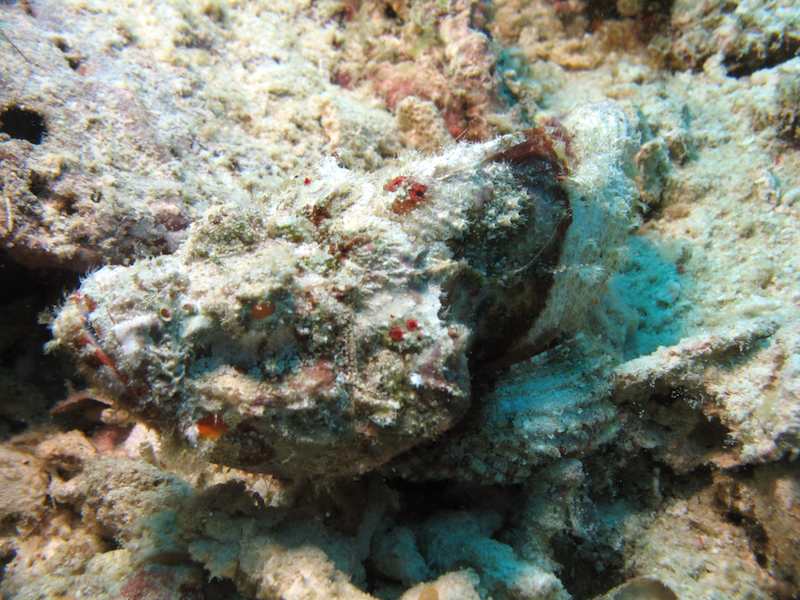
Creature Feature: Stonefish.

Oh, the ocean. Will you ever stop being strange? Land life looks soooo dull compared to all the weirdness you have to offer. Like this thi-....


Wait, where did that weird fish go? Come back here, you!


There it is!  That's a reef stonefish (Synanceia verrucosa), a strange-looking fish native to the coral reefs above the Tropic of Capricorn. They range from the Red Sea to Australia, the official Land of Weird as far as we are concerned. They wait, nigh-invisible, for shrimp and small fish to swim by, then snap them up before looking like rocks again.

The stonefish does a very good job of not being seen. It has camouflage that allows it to blend into rocks almost perfectly. It does not stand up when asked to stand and does not tell its neighbors where is is leaving on vacation. Of course, if a diver's foot comes down on it due to this amazing camouflage, all hell breaks loose.


The reef stonefish is the most deadly fish in the world. Not only does its sting hurt enough to make victims want that limb amputated, but there is a nasty poison cocktail in a stonefish's 13 dorsal spines. A sting can result in shock, paralysis, and tissue death if it's injected deeply enough. It can be partially denatured by soaking the affected area in hot water, but that will not be enough to stop one from shouting curse words for a week.

Watch your step. You never know who might be down there.

Saturday, July 9, 2011

Creature Feature: Sawfish.

Once upon a time, an evil genius wanted sharks with laser beams attached to their heads. After being frozen, the sharks he wanted became endangered, and since that red tape would have been a mess to deal with, he wound up with no laser-bearing sharks. Until...


For those of us who cannot afford frickin' sharks with frickin' laser beams attached to their heads, here's a shark with a chainsaw on its nose:


Technically, that's a sawfish (genus Pristis), not a sawshark, but it's still a neat-looking chondrichthian. Sawfish are found in the sub-tropical areas of the Atlantic and Indo-Pacific oceans, and can cross freely between bodies if salt and fresh water. It lives in muddy water and is nocturnal. Depending on the species, sawfish can get anywhere from 4.6 to 23 feet (7 meters) long.

That sawlike nose is not a bad Photoshop job - it's the sawfish's main sensory organ. Like the ridiculous-looking duck bill on a platypus, it is used to feel around for prey in the mud. The spikes on the sides of the saw impale whatever they flush out and need to be cleaned every so often. When sawfish are born, the rostrum is covered by a membrane that prevents the mini-saws from cutting up the mother as the baby rays make their exit.
Imagine this coming out your rear end. You're welcome.

All sawfish and sawsharks are critically endangered. Overfishing and difficulty of cultivation in captivity are the main causes. Some fishers collect the rostra as novelties and believe that the fish put up a good fight once hooked. Fins from sawfish supposedly make the best shark fin soup, and the liver is used in traditional Asian medicine. They cannot grow quickly enough to meet the demand for their body parts.
 
The overall strangeness of the sawfish has made it a staple in popular culture. The Aztecs called it an 'earth monster' (so where's its giant immortal thing, 5D's?).  As mentioned earlier, Asian cultures use it for food and exorcism. It is uncommon in works set under the sea and is usually used as a tool due to its crazy sawlike rostrum.

Riddle me this, Dr. Evil: If nature can't sustain a shark-like ray with a saw on its nose, what makes you think that lasers on a shark's head would work?

Friday, July 8, 2011

Creature Feature: Blue Spotted Ribbontail Ray.


OK, so it's not as cute as we remembered it. Sue us. It's still one hell of a trippy ray, even if it is not necessarily cute.

The Blue Spotted Ribbontail ray (Taeniura lymma) is found throughout the warmer parts of the Indian and Pacific Oceans. It eats molluscs, sea worms (which are pretty cool in their own right), shrimp, and small bony fishes. Surprise, surprise, it's found in weirdness hotspots like Indonesia, Australia, and Madagascar. It usually stays on the bottom of coral reefs, and can also be found in tide pools and beds of seagrass.

Feeling a sense of deja vu? That's because this little ray has a lot in common with the blue-ringed octopus, another brightly colored creature that's toxic to boot. Although not as poisonous, the sting from one of these rays still hurts. Please stay away if you see a blue-streaked tail sticking up out of the sand.

Or you might be on drugs, in which case stay the eff out of the ocean. :)

Blue-spotted rays are one of many types of chondricthians (sharks, rays, skates etc.) that bear live young. These rays give birth by "aplacental vivipary." The baby rays feed on yolk and uterine milk (mucous, protein, and fat - essentially gourmet snotballs) until they are finally pushed out of mommy ray's belly. They look more or less like adult rays, only smaller. Aww!

Like tiny, acid-drenched pancakes that can sting you!


Pretty though these little rays are, do not try to get one as a pet. The ray is considered near-threatened due to toxic fishing in its area. Moreover, captive rays of this sort have notoriously short lifespans in captivity. Many of them die almost as soon as they are brought into captivity. Even rays that look perfectly healthy develop unknown complications and die. They have no less than five species of tapeworm associated with them, but remain one of the most common rays in the aquarium trade. Stick with lionfish if you want a really impressive aquarium; at least those have a lower chance of going belly-up.