Thursday, October 6, 2011

Creature Feature: Howler Monkey.

Yeah, I know what you're thinking. Enough with the creepy stuff - show us some cute and fuzzy! We haven't had any wild fuzzy things in a while. Maybe a monkey would be nice.

Wait a minute. Have we EVER done a monkey, here? We've done lemurs and a few other primates, but never an actual monkey. So, for those of you who like monkeys, here you go:


A Howler monkey is any particularly loud member of the genus Alouatta. They range from southern Mexico to northern Argentina, so they are prime mascot candidates for any and all rainforest conservation programs. They eat mostly leaves, but have been known to raid chicken coops as well. They sleep 5 hours a day, but for those other nine hours...hoooo boy.

Howler monkeys are the loudest land animal. Their guttural vocalizations, rightfully called "howls," can carry for up to three kilometers. Not only do they have loose skin around their throats to amplify their calls, but their hyoid bone (a bone that, for us, is between the chin and the thryoid gland) vibrates extra. Howler monkeys are the only mammals to have hyoid bones like this; birds and dinosaurs did/do, too.

I AM HERE. YOU ARE NOT. DEAL WITH IT.

The actual purpose of these howls is foggy. The current theory is that the males of howlers are super-territorial, so the howl keeps other males out. It may also protect the male's mates (with howlers having a 1:4 male-female ratio).  Until we get a translator for howler monkey, we will not know for sure.

Howler monkeys have a few other neat things going for them besides their voices. Like humans, howler monkeys can see the RGB spectrum. The howler monkey was a deity to the ancient Mayans, who considered it the patron animal of writers and artists. We would have said "patron animal of rock stars," but that works, too.

Wednesday, October 5, 2011

"They Actually Eat That:" Almonds?!

There are few things more disappointing than trying to go on a fancy diet and realizing that one ABSOLUTELY ESSENTIAL ingredient is preventing you from doing it. For me, that ingredient is almonds. They are in 90% of all protein bars, but I am allergic to them, so no vegetarianism for me.  Almonds can also be used to make vegan milk, high-protein butter for peanut allergy sufferers, and, of course, sweets like marzipan. Almonds are even mentioned in the Bible since they're native to Israel.

Almond lovers everywhere are probably saying, "OK. We know you're allergic. That doesn't mean you can deprive the rest of us of almonds." What the HELL are almonds, one of the most popular nuts in the world, doing in this column, anyways?

Weeeeeelllllllllllllllllll....


...it turns out almonds, peach pits and apple seeds are all sources of naturally-occurring cyanide. For those of you who do NOT read mystery novels, cyanide is one of the most popular poisons in murder cases. It's sneaky, quick, and the only way you will ever survive is if you call Poison Control within minutes. The final sign of cyanide poisoning is cardiac arrest, so if people suddenly start dying by heart attacks, start suspecting a mass cyanide poisoning. Or a Death Note, take your pick.

(From what the URL says.) Side-effects may include seeing goth-punk Grim Reapers that like apples. Hey, wait a minute...
 

Cyanides are simple, tightly-bonded molecules of carbon and nitrogen found in many edible plants, including almonds. Mind, it is in minute quantities, so nobody really notices...until they have something tasting slightly of almonds that is clearly not supposed to have that flavor. Then, of course, call medical staff as soon as possible. Things with even minor amounts of cyanide can still poison pets like dogs, so please do not share your trail mix with Fido.

Even if you successfully avoid almonds and their relatives, there is a chance you could get some cyanide in your diet. Exotic fish tend to be stunned and killed with cyanide, which in turn poisons their surrounding environment. Indonesia has the worst of the ocean's cyanide poisoning. Don't eat exotic fish - you don't know how they've been killed.


Tuesday, October 4, 2011

Creature Feature: Sword-billed Hummingbird.

After doing the last few entries without a spinal cord, here's another vertebrate. This also satisfies your RDA of cuteness, so brace yourselves:


Source: RedOrbit. 

The little fellow up there is a Sword-billed hummingbird (Ensifera ensifera). It is native to the more northern parts of South America including Peru, Bolivia, and Venezuela. Like all hummingbirds, swordie up there feeds entirely on nectar. It likes long-corolla'd species such as Passiflora mixta.

Let's be fair: Hummingbirds are pretty weird already. They are the only birds capable of hovering and flying backwards. They have the highest metabolism of all vertebrates. Despite both of the above, some hummingbirds have been able to migrate. Basically, they have evolved to be pollinating insects with spinal cords.

This has not even touched on the crazy, crazy bills some hummingbirds have to drink their weights in nectar. Some hummingbirds, like the sword-billed hummingbird up above, have bills so specialized that they are designed to get at the nectar of only one particular sort of flower.

Yes, that bill IS to scale.
 

The Sword-billed Hummingbird has the dubious honor of being the only bird with a bill longer than its body. It has an unusually long tongue to match.  So long is this bill (5.5 cm for a 14 cm bird) that the hummingbird cannot preen itself with its bill; it must instead use its cute little feet. Its long bill is specifically designed to stick into long, slender flowers, but y'know what? I'll let your dirty mind tell you exactly why I cannot finish that sentence.

Monday, October 3, 2011

Bio-Art: (Gene)sis.

Science and religion have been at odds since the ancient Greeks. Yes, really; there was a time in ancient Greece when church and state were not separated, and people got in trouble for saying that the sun and moon were not gods. Fathers of democracy, everyone!

Regardless of who started it, harsh debates between religion and science sprout up every time a new discovery that could cure Alzheimer's hits the presses. Now that we know how sex works, there are questions about exactly when life begins, hindering valuable stem cell research. Let's not get into chimeras and cloning, even though we probably should. The general thesis behind all those things is the same: Creation is God's domain, and even attempting to create new life artificially is an act of hubris. Apparently said hubris does not include Chihuahuas.

From ekac.org.


Then there's (Gene)sis - Eduardo Kac's personal message to God encoded in 4-letter DNA. He took a bit of the Bible, and transferred it into Morse code. "And God said, Let us make man in our image, after our likeness: and let them have dominion over the fish of the sea, and over the fowl of the air, and over the cattle, and over all the earth, and over every creeping thing that creepeth upon the earth."- now in GFP DNA for all to see. It's neat that someone translated the beginning of the Bible into a custom gene - a molecule that makes up all life as we know it. In the Beginning was the Word indeed.

We can understand people getting up in arms about human cloning, but this? This is chewing God up, putting him under ultraviolet light, and spitting him out. Alba was all right. How are people not offended by this? Yes, glowing things are always cool, but it's like Eduardo Kac has made himself a lightning rod for divine wrath. This is hubris if I ever saw it manifested into the coolest form possible (aside from creating Satan in a test tube- now THAT would be cool).


After being exposed to UV light so often, the DNA began to mutate. What used to be coherent words (in Morse) became swapped strings of gibberish as the bacteria multiplied. Supposedly there is a site where one can alter the composition of (Gene)sis for oneself, making the process go even faster. I am not sure if this is still up; the URL in my book seems to be wrong and/or dead. 

More importantly, what do you, the readers, think of this work? Is it blasphemy (like Chihuahuas should be)? Does mankind really have a God-given right to tweak nature as it so desires? Eduardo Kac loves to incite discussion, so discuss, discuss, discuss! 

Sunday, October 2, 2011

Creature Feature: Fiddler Crabs.

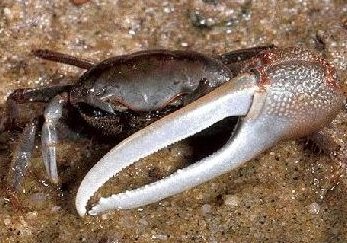
Look around at most crablike monsters. There will be a good chance that one claw is larger than the other. As in, possibly bigger than the crab's entire body. Since these are monsters we are talking about, they may even come with electric spikes or blades in between the two parts of the claw.

This is a particularly worrisome one.

Surely such a disproportionate crab can't be real. Just imagine a crab like that. It would lose balance all the time...right?


The hundreds of fiddler crabs (genus Uca) exist to prove you wrong. No matter how off-balance they may look, the male fiddler crabs do not tip over on a regular basis thanks to their massive claws. The smaller claw is used almost solely for bringing food (algae and bits of dead flesh) into the crab's mouth. The group is successful enough to inhabit the marshes, beaches, and mangrove swamps of the East Pacific, West Atlantic and Indo-Pacific.

Male fiddler crabs are all endowed with giant claws on one side or the other. They are so named because the smaller of the two claws sometimes looks like it is 'fiddling' the larger claw. Really, the smaller claw is just used for eating, making the fiddler crab one of the few animals that can eat and fight at the same time.


Besides engaging in combat with those massive claws, fiddler crabs are one of the few crustaceans out there with a sophisticated communication system. The crabs will often wave to each other with their large claws. Variations are made depending on visual distance. This is particularly true of courtship displays, which sacrifice feeding time and must be seen as soon as possible. This form of communication is almost like crab semaphore when studied closely. Maybe those PETA folk were onto something; that's pretty smart for a crustacean!

Mind, this doesn't mean that other crabs are ill-suited as monsters. I'm stunned that a certain other crab lacks more monsters, to be honest. More on that when the Week of the Abyss starts up, just in time for Halloween!


Saturday, October 1, 2011

Creature Feature: Land Planarians.

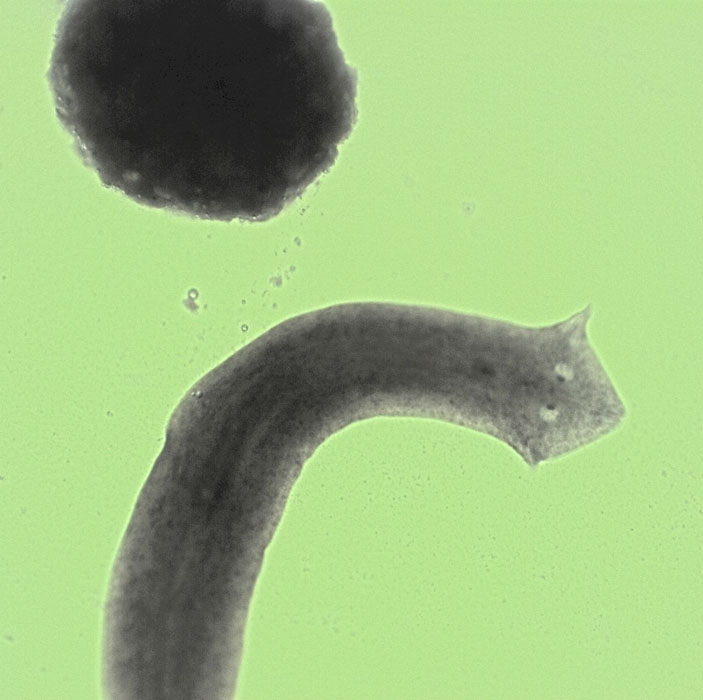
As you all (hopefully) well know, the authoress of this blog finds planaria to be among the cutest creatures in existence. Some people are freaked out by simple earthworms, but what's there not to like about cross-eyed flatworm? Heck, they even look like they're smiling if you catch them on a good day. Even without that luck, they are eternally cross-eyed, which is pretty amusing itself.

ETERNAL DERP.


Then there are land planarians. Yes, flatworms can go on land. Did you think you were safe just by avoiding the water?

Land planarians (family Geoplanidae) are a lot less cute than their water-bound counterparts. They look a lot more like nudibranchs that made it onto land. These worms come in trippy colors and are definitely predatory, eating any invertebrates smaller than themselves. They cannot live outside of rainforest regions. When they do have the right environ, they do well enough to cause problems to native invertebrate fauna.

TRIPPY! Credit is on the pic. :3
 

The way these land-bound planarians hunt is quite ingenious: Many invertebrates leave a slimy trail in their wakes as they squish along. As soon as night falls, the planaria come out and follow the chemical trails to find slugs, snails, and their favorite foods, earthworms. They are also cannibalistic, showing that even flatworms can be quite vicious!

Land planarians are so successful in the right environment that they have been used to curb invasive snail species in Hawaii and the Pacific Isles. On the flipside, they also threaten any native snails. Somehow, land planarians have caused issues in the British Isles - how they survive there, we do not know.

From Whatsthatbug.com. Go there.


Unfortunately, not many people are looking into these exotic worms. Despite their flashy colors and ecological significance, land planarians remain one of the least studied invertebrate groups in existence. This must be fixed.

Thursday, September 29, 2011

Creature Feature: Upside-down Jellyfish.

Cnidarians, as creatures, are underrated. Sure, they don't have claws, teeth, or even spinal cords, but that does not make them any less fascinating than large predatory mammals. The only two biologically-immortal animals in existence are cnidarians. All those pretty fluorescent proteins used in labs come from jellyfish and anemones. A box jellyfish will kill you more quickly than a tiger. Hell, cnidarians even have a sort of agriculture.


Cassiopea jellyfish are also aptly called upside-down jellyfish. They are found in swamps and mudflats of hot, humid areas like Florida, Hawaii, and Southeast Asia. Instead of stinging like normal jellies, they secrete their venom into a mucous cloud above them; said fluid is extremely itchy to swim through. They are not born upside-down, but do eventually spend their lives as living, tentacled pancakes secreting itchy fluid into the water.

Upside-down jellyfish often have algae growing on their tentacles. Specifically, zooxanthellae, a type of protist algae (as opposed to stuff like cyanobacteria), take up residence in the jellies' tentacles, making them look more like flora than fauna. The algae get a more or less safe place while the jellyfish get food. They even get free water circulation from the Cassiopea's pulsating bell. It all works out.


Of course, some things take advantage of these jellies' unusual anatomy. Sea urchin crabs steal them and put them on their backs as goofy-looking, living protection. Loggerhead sea turtles and ocean sunfish love these jellies (they're probably whole foods!). Admittedly, when you look like a salad bar, you are asking to be food no matter how toxic you are.

Cnidarians: Is there anything they can't do? Yes, we're pretty sure they can do tentacle rape, too.