
In order to celebrate the release of Black and White (which some of you may regret me celebrating), this week's Creature Feature will be replaced by "Who's That Pokemon?"
Remember that article I found a while back? The one about how kids can identify Pokemon more readily than local wildlife? Many Pokemon are based off of real creatures. Some of them have already been covered in this very blog. This is just to drive seven of those connections home.
Yeah. Have a whole week of creatures that you wish you could stick into little balls IRL!
Sunday, September 12, 2010

Saturday, September 11, 2010
Creature Feature: Bdelloid Rotifers.

Back in microbiology class, we looked at some pond water beneath a microscope. Among our fauna to look for were rotifers- single-celled animals so named because of their circular mouths ("rota" meaning "wheel" in Latin). That, and they swim around as though they are driving little cars.

This little thing is like Speed Racer on drugs, swear.
I had no idea that rotifers had such interesting sex lives...or lack thereof.
Bdelloid rotifers do not have sex. At all. They have not had sex for 80 million years.
This is not the first time that parthenogenesis (yes, all rotifers are female) has come up on this blog. It was especially common during Lizard Week. Many invertebrates can self-fertilize, reproduce simply by being cut in half, or have the junk of both sexes. Animals have some pretty damn freaky ways of mating, so hearing about something that just doesn't get it on period is unusual.
More importantly, how does that work?
One of the main benefits of sexual reproduction is that, in the process, genes mix. This allows for new mutations to pop up every now and then that allow a species to become more or less fit for survival. For an asexual species to not only populate but thrive, there had better be a pretty damn good substitute for gettin' jiggy with it.
They have one. Actually, they have two.
Bdelloids steal genetic material from other organisms. These genes are fully functional; if the original bearer of that gene was poisonous, the rotifer will be, too. Gene swapping is common in bacteria but rare in animals. If it were more common, we'd all be plastic surgeons stealing each other's awesome hair, racks and other talents.

In humans, this has horrible results.
These rotifers are also very hard to kill. They can survive being dehydrated - sometimes even giving birth while in the same state as a Frito−Lay product. Also, out of all the animals in the world, they are the MOST capable of surviving radiation. Hail your new overlords: Rotifers and cockroaches!
Friday, September 10, 2010
Creature Feature: Okapi.
Imagine if a deer and a zebra somehow, by some ungodly chance in nature, had a baby. That is only half of the weirdness that went into the okapi.

Stop looking at my butt.
The weird-looking ungulate above is called an okapi. Like giraffes and zebras, they are native to Africa. Instead of the oh-so-loved African savannah, okapi live in montane rainforests; their coat has become water-repellent to deal with the weather. They are herbivores, but consume charcoal and clay for a few extra minerals.
The okapi, despite all appearances, is not related to zebras at all. Their closest living relative is the giraffe. It shows in the okapi's large ears, ossicones (on males), short manes and very, very long blue tongues. The okapi's tongue is about a foot long - long enough to clean its eyes and the entirety of its ears (both inside and out). The okapi is as much a living fossil as the coelacanth.

Did this okapi eat yesterday's slug or is he just happy to see us?
The okapi was known by the native peoples of Africa long before the Europeans ever found a single specimen. It was recorded over 2,500 years ago in an Ethiopian carving at Persepolis. It was largely believed to be a sort of "African unicorn." After its discovery by Europeans, carvings and images of it began popping up left and right.

This better be pretty friggin' important. Is the meadow on fire?
These animals, though not endangered in and of themselves, are elusive and threatened by habitat loss. Although they are fairly common in zoos now, I can never seem to catch these guys on display. Sucks.

Or, alternatively...
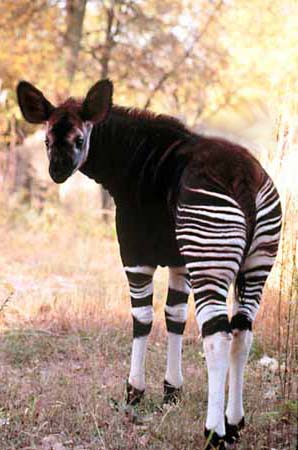
Stop looking at my butt.
The weird-looking ungulate above is called an okapi. Like giraffes and zebras, they are native to Africa. Instead of the oh-so-loved African savannah, okapi live in montane rainforests; their coat has become water-repellent to deal with the weather. They are herbivores, but consume charcoal and clay for a few extra minerals.
The okapi, despite all appearances, is not related to zebras at all. Their closest living relative is the giraffe. It shows in the okapi's large ears, ossicones (on males), short manes and very, very long blue tongues. The okapi's tongue is about a foot long - long enough to clean its eyes and the entirety of its ears (both inside and out). The okapi is as much a living fossil as the coelacanth.

Did this okapi eat yesterday's slug or is he just happy to see us?
The okapi was known by the native peoples of Africa long before the Europeans ever found a single specimen. It was recorded over 2,500 years ago in an Ethiopian carving at Persepolis. It was largely believed to be a sort of "African unicorn." After its discovery by Europeans, carvings and images of it began popping up left and right.

This better be pretty friggin' important. Is the meadow on fire?
These animals, though not endangered in and of themselves, are elusive and threatened by habitat loss. Although they are fairly common in zoos now, I can never seem to catch these guys on display. Sucks.

Or, alternatively...
Thursday, September 9, 2010
Creature Feature: Sea Lizard/Blue Dragon.

Oh, crap. Not ANOTHER thing we have to fear from the ocean!
Actually, this one's relatively harmless. The sea lizard (Glaucus atlanticus) will not eat you unless you are a cnidarian or fellow slug. This creature is not to be a confused with lizard fish; the sea lizard in question here is a small, blue sea slug native to most of the world's oceans.
Sea slugs have been blessed with such a variety of shapes and colors that even perfectly sane people wonder what they're tripping on. For starters, all gastropods are hermaphrodites - they have male and female junk. If that was not trippy enough, name a color; sea slugs come in it. Name a type of locomotion; sea slugs can do it (or at least look like they're doing it). Name a land animal; it probably has a counterpart in sea slugs. All things said, they are AWESOME creatures that I am ashamed for not doing an entry or five on earlier. (I do not know HOW, but Pokemon managed to de-awesome them.)

DUDE I CAN TOUCH THE RAINBOW! IT SMELLS AWESOME!
These particular sea slugs have gills that look like feathery feet or fins alongside their bodies. They swim upside-down; the name 'gastropoda' means 'stomach-foot,' and this thing is walking on its back like something out of a horror movie 24/7.
Now, hold on a second...aren't colorful things usually poisonous? In this case, yes and no; many sea slugs, these guys included, gain toxic attributes from their food. G. atlanticus in particular feeds upon the stinging tentacles of the Portuguese Man o' War (Physalia physalis)- a cnidarian colony (not a jellyfish) known to be deadly to humans. The Glaucus is completely immune to its venom. Like in some caterpillars, the poison in the tentacles gets used for the sea slug's own defense.
Look, but think before you touch. Enjoy the acid.
(By the way, fun fact: The generic name for 'Glaucus' comes from the myth of Glaucus and Scylla. Look it up if you like; Circe's involved!)
Wednesday, September 8, 2010
Creature Feature: Skinny Pigs.
Wait, isn't that title an oxymoron? Skinny...pig?
It's a breed of guinea pig, actually. A hairless breed of guinea pig.

Well, it DOES look more like a pig now.
Remember the cardinal rule with mammals: If it has fur, it's cute. If it does not have fur, it will only have a small cult of people who think it is cute. It will also have PLENTY of movie opportunities because hairless mammals are freaky.

Somehow, having SOME fur makes this thing even creepier.
Skinny pigs originated from a strain of hairless lab guinea pigs (that almost sounds redundant...) which had been used in immunology research. This has raised some questions about their overall hardiness, but unlike hairless dogs, there are not many negative traits linked to guinea pig hairlessness. (Now, from what I can tell, there IS some hidden negative trait that would lead cavy enthusiasts to outbreed to hairy carriers every other generation. I have yet to see the linked defect mentioned.)

Warning: Do not feed after midnight.
There are technically two breeds of hairless guinea pig: The Baldwin and the skinny pig. As the name amusingly implies, the Baldwins have significantly less hair and also sport wrinkled skin. The two strains of hairlessness are not at all compatible.

The Baldwin does not look any less creepy.
The skinny pigs actually have some hair on them; fuzz on the feet and muzzle is normal and a breed requirement. This can lead to some pretty freaky results. Bear in mind, however, that skinny pigs were lab experiments to begin with. That usually does not bode well.
Seriously, though? A guinea pig is one ugly creature without fur. It looks almost like a naked mole rat less accustomed to living underground and without a freakish hive society. Bar the side-effects of having no hair (namely thermoregulation issues), however, they make as good a pet as any guinea pig.

...Or so they say.
"They Actually Eat That:" Guinea Pig.

Guinea pigs (Cavia porcellus), although not quite as cute as baby ducks, are still adorable. They look sort of like the offspring of a rabbit and a mouse, but with even less tail. They have been bred in a million different colors, patterns and hairstyles. (Or, well, as many colors as melanin will allow...which is not that many.)

Pictured:
No, these rodents are not from guinea and they are definitely not pigs. They are related to the wild cavies of South America. The "Guinea" supposedly comes from French Guyana - I'm sure it's a common mistake. They have a piglike build and eat a lot, but otherwise are not terribly porcine. They also make those cute little piggie noises that gave them the native Ecuadoran name of "cuy."

Cuy, cuy, cuy...
Oh, and they're food, too.
They Actually Eat That?!
Yes, they are raised for food. They were food and traditional medicine before they were pets. They were domesticated in approximately 5000 B.C. by the native peoples of the Andes mountains.

Even cats won't eat these guys.
Why on earth eat something that adorable? Rodents, guinea pigs included, are whole foods. Nature did not design them to be cute; she designed them to be food for other animals and to keep plant populations in check. Cuteness was pretty much coincidental (as you will see on today's animal) until people started messing with them.
On that note...
Tuesday, September 7, 2010
Creature Feature: Hydras.
The hydra is probably Greece's most notorious drakon. She (yes, she; nearly every Greek monster was female) fit the niche of 'impossible-to-kill dragon' very well. Her blood and footsteps were highly toxic. She could regenerate every head except the one immortal head in the center (which is why hydras based off of Greek lore always have an odd number of heads; I have heard anywhere from 3-9 as a starting point). That's right, zombie logic completely fails against this thing. Even Herakles/Hercules struggled with this one.

Greek dragons are JUST SNAKES, people. Also, for some reason, these heads look male.
She is also probably the most botched of any Greek monster; as the name would indicate, a hydra is a waterborne creature. The Greek hydra never breathed fire. Ever.

Is it really THAT much of a bitch to CGI acid instead? Seeing shit corrode can be just as awesome...
She did, however, loan her name to a tiny little cnidarian like so many other badass mythological monsters:

Real hydras are tiny, water-dwelling creatures in the genus Hydra. Hydras can be found in unpolluted, freshwater bodies of water in most temperate and tropical regions.
They are visible to the naked eye and resemble small, not-as-colorful anemones. They spend their entire lives in the sessile polyp stage -that is, they always look like little anemones and spend most of their lives in one spot. Basal disc, tube, tentacles. Simple as that. (Well, OK, do you REALLY want me to get into cellular differentiation specifics, here?)
Like the mythological hydra, these creatures have insane regenerative capabilities. They are just like planaria in that, if cut with a surgical knife or other sharp instrument, the two halves will form two fully functional individual hydras. In less-severe cases, the tissue regenerates whatever is needed. Apt name was apt.

Hydras are also poisonous, albeit not to the degree of their mythological counterpart. Most cnidarians, including corals and jellyfish, have cnidocytes - hooked, venomous cells that paralyze whatever they are about to eat- in their tentacles. Hydras are harmless to humans; jellyfish are another story.
Some types of algae take advantage of the hydra's predatory nature and have formed symbiotic relationships; the hydra gets rid of stuff that would nibble them and the algae provide some supplementary energy.

Not sure if this is algae...but it is pretty.
Hydras never seem to age. Like the immortal jellyfish (another cnidarian), they are considered biologically immortal. All cells continually divide, making them hard to poison as well. If the situation with immortal jellyfish is any indicator, hydras may become capable of world domination.

This is how hydras reproduce. Perfect monster fodder.
They also have some interesting reproductive habits, but compared toThursSaturday's animal, reproducing asexually and using sex as a last resort is hardly weird.
Greek dragons are JUST SNAKES, people. Also, for some reason, these heads look male.
She is also probably the most botched of any Greek monster; as the name would indicate, a hydra is a waterborne creature. The Greek hydra never breathed fire. Ever.

Is it really THAT much of a bitch to CGI acid instead? Seeing shit corrode can be just as awesome...
She did, however, loan her name to a tiny little cnidarian like so many other badass mythological monsters:

Real hydras are tiny, water-dwelling creatures in the genus Hydra. Hydras can be found in unpolluted, freshwater bodies of water in most temperate and tropical regions.
They are visible to the naked eye and resemble small, not-as-colorful anemones. They spend their entire lives in the sessile polyp stage -that is, they always look like little anemones and spend most of their lives in one spot. Basal disc, tube, tentacles. Simple as that. (Well, OK, do you REALLY want me to get into cellular differentiation specifics, here?)
Like the mythological hydra, these creatures have insane regenerative capabilities. They are just like planaria in that, if cut with a surgical knife or other sharp instrument, the two halves will form two fully functional individual hydras. In less-severe cases, the tissue regenerates whatever is needed. Apt name was apt.
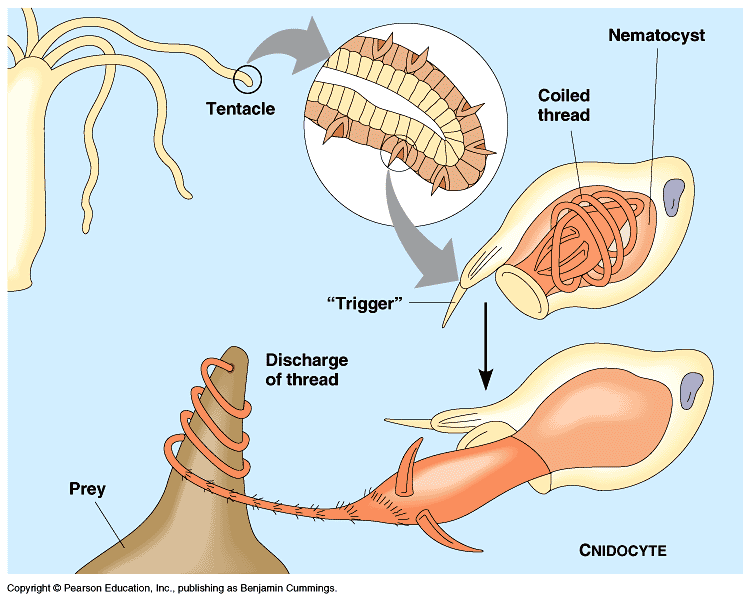
Hydras are also poisonous, albeit not to the degree of their mythological counterpart. Most cnidarians, including corals and jellyfish, have cnidocytes - hooked, venomous cells that paralyze whatever they are about to eat- in their tentacles. Hydras are harmless to humans; jellyfish are another story.
Some types of algae take advantage of the hydra's predatory nature and have formed symbiotic relationships; the hydra gets rid of stuff that would nibble them and the algae provide some supplementary energy.

Not sure if this is algae...but it is pretty.
Hydras never seem to age. Like the immortal jellyfish (another cnidarian), they are considered biologically immortal. All cells continually divide, making them hard to poison as well. If the situation with immortal jellyfish is any indicator, hydras may become capable of world domination.

This is how hydras reproduce. Perfect monster fodder.
They also have some interesting reproductive habits, but compared to
Subscribe to:
Posts (Atom)

