Showing posts with label selective breeding. Show all posts

Saturday, November 7, 2015

Jurassic World, Part 2: Is the Game Better Than the Movie? and I-Rex VS Mewtwo.

“…here we are, hunter-gatherers wandering among the wreckage of our own making, and evolved to play with evolution.” - George Gessert, “Why I Breed Plants.”

So, I mentioned last section that I’ve been playing Jurassic World: the Game. I love this game to death, and actually think it’s better than the movie. 

I know, I know: I speak madness, this is Sparta, GET REKT. Hear me out. 

One of the things I really hated about the movie was how forced a lot of the things felt. For a few examples: “FAMILY IS THE BEST THING EVER EVEN THOUGH I’M AT A DIVORCE HEARING,” “Remember that one time we made out? Yeah, we’re a couple, now,” “WE’RE KIDS LET’S BE REBELLIOUS AND STUPID!” (more on this later), “weaponize all the things” (more on this later, too), and, most importantly, “TAKE THAT, YOU GENETIC FREAK! Whaddya mean, ‘I’m just as spliced?!’” 

That last one is not only the main point of this article, but also one of the main points of Jurassic Park as a whole: how far can science go before its wax wings melt? 

This is where the game really stands out. Aside from more character development and more dinosaurs overall, I have to mention how the designs really made the whole point about wax wings better than the movie. It did that mostly by having more dinosaurs, allowing us to interact with said dinosaurs, and doing slightly different things with them. 

For example, in the movie, we see raptor training. Vic Hoskins, a person working with both InGen and the military, mentions weaponizing the raptors, suggesting them as mine-sniffing dogs with talons among other things. Hoskins also suggests selectively breeding raptors for loyal strains. In the end, the training/conditioning wins out, but here’s the kicker: there is nothing wrong with selective breeding, especially for loyalty/docility. What’s wrong, really, is the military’s intent for such a thing. 

You do realize he was selectively-bred, right? 


Get this: the domestication of the dog predates the invention of the wheel. Dogs have been confirmed man’s best friend since 15,000 BCE; the wheel was invented around 3,500 BCE. It has been proven, multiple times, that not only are dogs and wolves the same species, but that all you have to do to make a wolf into a dog is select the brood for tameness. In foxes, this took only four generations; in wolves, with how similar their social structure is to that of humans, it may have taken even fewer than that. For the record, feral dogs have reverted almost entirely into wolves, yes. They’re called dingoes

Imagine doing that with raptors. Wouldn’t that be AWESOME? Since this type of breeding also creates new patterns (specifically piebaldism - irregular white patches on a creature’s coat), we could have a variety of raptors tailored to the demands of anybody with the time and money for a pet raptor! Want one with a nifty stripe like Blue? You got it. An all-white one? Doable. Orange? Sure, why not! 

And y’know what? The game actually encourages this. 

Image from the JW Wikia, but I have one, too. 

JW the Game has an arena function. In order to get stronger dinos, you have to fuse two of them together. The results lead to cleaner patterns and brighter colors, similar to the selectively-bred Okeetee corn snakes (they are not a heritable morph - they are “cleaned” wild-colored corn snakes). The tradeoff is camouflage for a pattern that rakes in the dough. All you have to do is mate/evolve your dinosaurs. It’s no worse than trying to select for, say, deeper purple in albino reticulated pythons, along with a good temperament. Always go for temperament. 

“But that’s unnatural!” 

No, no it isn’t. Allow me to elaborate on why it is perfectly fine using “fuck” in every sentence with several different meanings. 

Nature does not fucking care what humans do to its creatures. As long as things are fucking and their offspring continue to fuck, the species survives. Mother Nature is a fucking bitch; as long as you fuck and your offspring can fuck, you win. It doesn’t matter if a fucking wolf does it with a fucking dog- humans are the ones who care. As far as the wolfdog is concerned, it is still Canis fucking lupus, and can still fuck either of its parents while producing offspring that can fuck. That is how animals fucking win. That is all that fucking matters to nature: fucking. 

What is unnatural is that male dinosaurs aren’t fucking acknowledged. We don’t even know if there’s a fucking stud, who, by the way, must be doing a lot of fucking if he exists. If anything, preventing the dinosaurs from fucking naturally like that is more unnatural than selectively breeding them. At least with selective breeding, there is fucking going on. 

I’m done with the F-bombs, now. Hopefully, they make the point. Your move, Catcher in the Rye. 

The problem: even selective breeding, an art as old as humankind, has very bad connotations, nowadays. PETA has made sure that selective breeding is linked with puppy mills, cross-eyed white tigers, and generally illegal activities. This is not to say that such things don’t happen at all with inbreeding, or that puppy mills are A-OK, but it is still an art almost as old as humanity itself, and will not go away. Generally speaking, humans move forward with their inventions, not backwards. This applies to breeding, too; for example, Siamese cats have had the exact same issues with crossed eyes as white tigers in the past (it’s the same type of albinism, even), but selective breeding, including outcrosses, overcame that hurdle. We’re generally pretty good at picking out traits we like and accentuating them without causing too much damage - i.e. making it so that the organisms can’t fuck. 

Refer back to the quote we opened with: we have evolved to play with evolution. Selective breeding is selecting for traits we like, rather than being stronger or faster. Considering that humans can be treated as their own extinction event, perhaps it’s about time we looked at selective breeding as its own, bizarre adaptation: a genetic response to a new environment. In this case, that new environment is us. 

So, again, let’s loop back to something I said in the beginning: part of the point of Jurassic Park is a sort of “wax wings of Icarus - don’t fly too close to the sun/play God” analogue. While we could argue that Indominus rex makes the point pretty clear by herself, might the game actually make it better? 

A liger, bred for its skills in AWESOME. 


Hybrids, in general, are a sort of breaking point for humans as far as science is concerned. You can mate a lion and a tiger, for example, making a liger, but the liger is going to have a few problems. For one, they suffer a lot of the same issues as large dog breeds; because the growth inhibition gene in lionesses is not at all present in ligers, they grow huge, to the point where their hearts literally cannot support them. Female ligers can indeed reproduce, but males are almost certainly sterile. Sterility happens rather frequently in hybrids, and remember our golden rule: Fuck. Once you can’t reproduce well, Nature herself flips you off as a species. This isn’t even touching sci-fi splicing; sometimes, crossing two things is enough to make Nature go “yeah, NO.” (Also, to preemptively cut off any anti-gay stuff? This has to happen to an entire species, and nature always has a few individuals that won't pass on their genes.) 

Before I go into how JW: the Game shows this better than the movie, I’d like to talk about Mewtwo. 

Scan from Bulbapedia. Should've just used mine. 


For those of you who do not know who or what Mewtwo is, you’re either really old or are not from this planet. I will nonetheless explain. 

Mewtwo is a Pokemon created from a single bit of DNA from Mew, said to be the progenitor of all Pokemon-kind, and Arceus knows what else. In its PokeDex entries, it is said to have been created by a scientist “after years of horrific gene splicing and DNA-engineering experiments.” Things like having the “most savage heart among Pokemon” and thinking only of combat also come up repeatedly. And yet…

…there are a few reasons that people are not piss-shit terrified of Mewtwo. No, if anything, Mewtwo is regarded as the only 100% badass Pokemon - even by people who are not fans of Pokemon. A lot of this has to do with how Mewtwo was softened as a character for the first Pokemon movie; watch the Japanese movie and/or the dubbed “Birth of Mewtwo,” and see exactly how anthropomorphized and softened the “most savage heart” became. 

Mewtwo was designed, from an artistic standpoint, to be a freak; like, seriously, that neck tube looks wrong. So was Indominus rex. Both are intelligent, cold-hearted, ruthless in battle, and meant to look like bastardizations of nature. They nonetheless are marketable badasses. 

Is it any wonder that this thing got the most merch? 


(Also, you aren’t marketing the hell out of something being a blend of T-Rex and raptor…why? “Part T-Rex. Part raptor. ALL AWESOME.” Also also, no, albinos are not scary; if anything, white and melanistic animals make things even more of an attraction! (See also: white tigers, black “panthers,” and NOLA’s white alligator.) Now fire your entire marketing department and anyone who kept THOSE TWO GENES a secret. The rest…people won’t care after that, trust me.) 

What the movie didn’t tell us was that there were more fused dinosaurs besides Indominus. Some of them, like the Stegoceratops, also got toys, despite not being in the movie. Others, though… 


This is Koolasaurus, the only fused amphibian in the game, but I'm pretty sure Pepe the frog has more reasons to live. 


I’m gonna throw it out there that the JW game doesn’t do enough with pterosaurs (or amphibians, for that matter). No long-tailed pterosaurs until the Dimorphodon update really stunted the potential for a giant, beaky wyvern-splicer. The fused monster (yes, only one fused pterosaur) for them simply looks like…nothing compared to the phoenixian Lv. 40’s until it fully evolves. All splicers start out with this pink-grey mush color to them, while the selectively-bred parent species look like something out of Avatar. It’s a kinda-dinosaur molded out of clay versus a living work of modern art. 

But oh, no. You look at the other two crosses of what should be badass dinosaurs, and things start looking so much worse. 

I'll give you the crack, okay? By the way, I don't own any of these caps because I'm not cool enough. 


I am, of course, talking about the Spinoraptor and Carnoraptor. One of these barely has feathers and has huge, pink, bulging eyes with tiny pupils, like some sort of dinosaur drug addict. The other has the cool horns of a Carnotaurus…stunted into little demonic nubs, along with wrinkly skin like on a shrunken head and black, beady eyes. If Indominus was not enough of an indication that insane splicing was not the answer, oh my gods, look at her creepy as hell siblings. 

Indominus kinda beat us over the head with “this is WRONG” while looking completely badass - just like Mewtwo. Her possessed siblings do so in a much more subtle and chilling manner. That is art. 
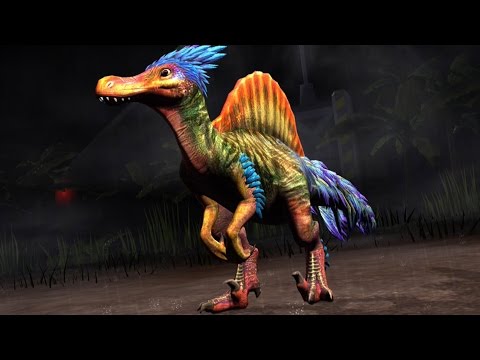

Now that's more like it! 

Granted, the evolved hybrids look a lot cooler. The gray mush of Tropeogopterus becomes just as bold as any other pterosaur, and even if Carnoraptor and Koolasaurus look just as freaky as before, it’s an improvement over the color gray. Evolve anything but Indominus, and it looks decent (red stripes and spikes...yawn). So, what else does the game do that the movie doesn’t? 

Pretty much just generic kids in the movie. Not so in the game. 


At this point, I’m going to bring up the two kids. Zach, the older brother, is a techie; he reminds me a lot of my (younger) nephew in that he’s concerned about things regarding technology, and is the type of kid who freaks when a place has no cell phone reception (which I think he got from his mom, but I digress). Gray, the younger kid, is into things like science and math, and is just giddy to see dinosaurs and be out in nature. Although these sides of these characters were probably in the movie on some level, I think one exchange really hammers in the key difference between the two: 

Zach: This is awful! There’s no cell phone reception! 

Gray: I know, isn’t it great? 

That bit, right there, cements these two as characters. (It also proves that the people who made Gray’s character really don’t know anything about how modern kids act, but more on that later.)  It’s not verbatim, but the exchange really stuck out. Zach’s character is consistently tech-oriented, while Gray is an absolute geek about the natural world. The movie focuses on the sibling relationship between these two, which, while realistic, feels cheap and forced in places (“Y U NO BOND WITH CLAIRE?!”). They could’ve had something more interesting and insightful if they had given the two more traits (or emphasized extant traits) beyond “they’re brothers; the younger kid likes dinosaurs, older brother is borderline stupid and generally a rebellious teenager.” 

I would like to note that the Wikia says absolutely nothing about Zach’s character and a lot about Gray’s character. I’ll get into why this matters in a bit. 

While it wasn’t necessarily crystalline in the movie, in the game, these kids are really, really symbolic in a way that doesn’t beat you over the head…as much as the movie did in spots with different characters. Look at that dialogue I pasted up there, and the purpose of these two siblings suddenly becomes clear: Zach is obsessed with technology and would probably die without his phone, while Gray is a junior paleontologist. These two are extreme representations of nature VS technology, with Gray being nature boy and Zach being glued to his phone. Even their names hint at this if you squint. 

Now, mind, they are still characters. They are also still older and younger siblings. For example, the Wikia describes Gray as a little bit hyper, and getting on Zach’s nerves from time to time. Zach nonetheless tries to keep a reign on his little brother, even if he has a rebellious side himself. 

Um, question: why not switch these two? I don’t really object to the younger sibling being aligned with nature and the elder being concerned with his iPhone, but symbolism aside, which is more realistic? Drawing from my own relatives, I know the opposite from experience: the older brother is more concerned with math and science and is a Boy Scout, and the younger one wants his tablet PC, his dad’s phone, or really, any screen to stare at and tap on. Kids these days are growing up with devices that their older siblings never encountered; it would make a lot of sense for a kid in that day and age to be tired of dinosaurs, which have been “normal” for much of his life, while the older sibling is more concerned with not only the names, but the processes that created them to begin with, as well as the older Jurassic Park. It would also make more sense for the younger sibling to be more hyperactive not just because he's a little kid, but because he’s grown up in a world that encourages technological ADD (which I have STRONGLY experienced with a friend’s little brother). 

Now, here’s why they didn’t do that: Gray is not only symbolic of nature, but also of the Jurassic Park fanbase. Really into dinosaurs? Check. Kinda knows when things are about to go wrong, sort of like an animal sense? Check. Knows stuff about the old park? Oho, checkaroonie. Again, though - wouldn’t this make more sense on the older brother? 

The world as most humans know it. 


Maybe, maybe not. It’s a sad fact of American culture that adults usually aren’t into nature. The mature world of man is not a world of wild animals  - it’s a world of metal and people on their phones on a constant basis. In the adult mind, humans have exceeded nature already, and don’t really see it as a threat. People who really like animals tend to be more in-tune with their inner child, so I can see why the writers did what they did with these characters. 

In short: while I don’t entirely agree with the positions of younger and elder siblings, I respect the creators’ choices. It just could have been more powerful if this had been fleshed out, and maybe switched. I do mean “fleshed out” and not “beaten into our skulls,” the latter of which ironically makes things less effective. 

In the end, the two siblings have to settle their differences and work things out in order to avoid being eaten by Mewtwosaurus. The humans eventually sic the natural (but still very spliced) dinosaurs on the freak they have created, and win out by playing off of both conditioning and natural behavior. In other words, a compromise between tech and nature was reached. We've evolved to play with evolution, but that doesn't mean we control it entirely, nor does it mean that we won't make icky-looking mistakes. 


While the movie does make the point of wax wings on its own, it feels like the game does it better. It doesn’t beat you over the head, lets you interact more with the dinosaurs than humans we are supposed to like (even then, Blue the raptor is the best character in the movie), and actually teaches you, the player, more things than the movie ever did without you realizing it. Nostalgia Critic was completely right in that the movie should maybe have been more about cool dinosaurs doing cool dinosaur things than about forced stereotypes, whether girls can ever have it all or not, and not-at-all subtle callbacks to the first movie (Jaws was very cleverly inserted, though). It’s still worth seeing, so go ahead and give it a watch - and then go play the game on your tablet or phone. If nothing else, it’s a fitting complement to a decent flick. 

Sunday, June 10, 2012

Creature Feature: Featherless Chickens.

Going green is a huge deal nowadays. Basically, we've realized that a whole lot of Earth's resources - fossil fuels, fresh water, wood - are finite, especially if we keep using them at the rate we have been. The meat industry happens to be one of the least green industries out there, responsible for as much greenhouse gases as public transportation (if not more). So, if we told you that some scientists had designed a greener, more energy-efficient chicken, you would assume that there was some horrible catch, right?


Umm...does a chicken with a big "fry me" sign written on it due to lack of feathers strike you as a  "horrible catch?"

The "featherless" or "naked" chickens were developed by scientists at the Rehovot Agronomy Institute located near Tel Aviv, Israel in the early 2000's. They are not genetically spliced with something that makes 'em lose their feathers. They have been selectively bred that way without the use of other organisms, so no complaining about Frankenfood. We would nonetheless like to add "zombiebird" to the list of potential names for the rooster above.

This chicken is not only easy to cook, but it is supposedly greener than your average chicken. Supposedly, it grows faster and is more energy efficient. Overheating is a real problem for chickens, especially in hotter climates. Too much heat might even lead to ugly, irregular molting, so the next best idea after turning up the A/C is to breed a chicken that doesn't have feathers to begin with.They are also supposedly low-fat.


Breeding a featherless chicken also saves considerable time and water on the part of farmers. If you have ever skinned, de-scaled, or de-feathered a fresh kill, you know that it is very time-consuming. On large-scale farms, the feathers are washed off, so breeding for no feathers curbs the fresh water issue, too. Sounds almost too good to be true, doesn't it?

There are some cons to having no feathers, obviously. These birds can live in exactly one climate: Hot and dry. Everywhere else, they have problems. No feathers means no protection from cold, parasites, or even the pecking of other chickens. Speaking of other chickens, plumage is also an important part of chicken mating rituals. I don't know what the human equivalent of this would be; it's just plain unattractive to be a featherless chicken.

Can selective breeding for exactly one trait really have that much impact on the farming potential of one animal? Sure. Anything with "Angora" in its name tends to do better in Ankara, Turkey, than anywhere else. Those animals are mainly bred for extremely long hair and are clearly meant for that climate. These chickens are also meant for a specific climate. If we see chicken meat coming in from Israel, we'll know that their zombiebird project was a success.

Saturday, March 17, 2012

Styx Writes a Blog Post (or, Tortoiseshell Cats).

As you may have noticed with Kimba the white lion, there are some things that didn't quite make it into Freak Week 3.5, but are still weird enough to cover in this blog. I decided to do something a little bit different for tortoiseshell cats; seeing as people on the internet seem to like talking cats, the remainder of this post will be Styx's translated writings about her own color morph. 


Little Guardian Beast. by ~KuroKarasu on deviantART

Hi! I'm Styx and Kuro is my human. She lives in my apartment making clicky noises on a weird silver thing a lot of the time. She says there are people who like what she does on the clicky thing. So, umm, hi, people. :3 


Anyways, Kuro wanted me to tell you about myself.  I don't know much about what kind of cat I am (except that it's the kind that reigns above humans- which is all of them), but mommy says that I'm a tortoiseshell. That means I have black and orange patches with a tiny bit of white. She acts like that is a very special thing. 

Tortoiseshell is just a color pattern, not a fancy-pants breed. It's kinda like calico with less white. Like calicos, boys either don't have tortie-ness or wind up not having babies. The chance of a male tortie is one in three thousand, meaning that, even if they're sterile, those cats are worth a lot. It has something to do with my two X chromosomes making my weird colors possible; since males only have one X, no cool paintjob for them!

Apparently, we tortoiseshell cats are considered lucky in some cultures. We are often referred to as 'money cats' in the U.S. Calicos get most of the love in that regard, though. :( We torties just bring good luck or something, especially to sailors wanting fair weather. I wonder if that means more fishies? :3 I want more fishies.
Not me. Still cute.


Mommy also says I have a "tortitude." That means I'm very active, fiery, independent, vocal, and protective of my human. I hate it when she leaves the room for more than a few hours! :< And I also have to wake her up every morning. She usually takes advantage of that by giving me cuddles under the covers. I am too dignified for that and squirm out after a minute! 
It's MY apartment. Let no one tell you otherwise!


Now mommy must give me meaty foodings. See you all! :3

Monday, March 5, 2012

Bio-Art: A Tribute to Selective Breeding.

But is it art?


Long story short: Kuro realized she had been bad and needed to make a Theme Week for March. Freak Weeks are always fun, and this week will be no exception.

That said...it's about time this column covered selective breeding  - the first form of biological art known to man. Charles Darwin bred pigeons to help propel his evidence for natural selection, but it is an art when you get right down to it. Even when breeding animals for things like taste, aesthetics always play a part in the breed's development. Prove me wrong.


Selective breeding is exactly what it sounds like: Breeding plants or animals for certain traits. This can be just one trait, like milk production, albinism, or docility. Eventually, many breeds become multi-traited creatures inbred to hell and back.  Most modern breeds consist of physical build, personality, color, and, of course, a solid name and line. It helps if these are registered in pedigree books.

Not all captive bred animals qualify as breeds. The validity of a breed depends, first, on whether the animal can be considered domesticated or not. That in itself is a very hard thing to prove; definitions of domestication vary between "can be bred in captivity" to "must have a social structure at which humans can be considered the alpha." One extreme allows lions; the other excludes white mice bar brainwashing.

Are they still domesticated if they try to take us over?
 

With the vagueness of a breed in mind, many true breeds are severely inbred. This leads to defects like crossed eyes (which have been bred out of Siamese cats), hip dysplasia (in small dogs), and usually an overall shortened lifespan in comparison to their wild/not inbred counterparts. Breeds are not necessarily superior to mutts. If, however, a certain trait is desirable enough, it may get bred in...

Bred for size and little else. Shame they were covered already.


Nature breeds creatures to survive. Humans breed them to be pretty (or edible). We shall see how these differences pan out in Freak Week 3.5 - in which we will cover things that may or may not be actual breeds. Look forward to it!

Monday, March 28, 2011

Freak Week II HO!

Today is Lady Gaga's birthday. No, we are not trying to deliberately synchronize every theme week with Lady Gaga - just this one. It just so happened that both of these recent themes fit with "Born This Way," too.

This dog is not anorexic. She may or may not have self-esteem issues.


For those of you who missed last Freak Week, it was devoted to things not made by nature, but by man. Specifically, we were looking at different breeds of animal. Chances are, if left to their own devices, Darwin would hit them all with his cane and we would never speak of them again.Breeds can be just as freaky as wild animals; just because it's domesticated doesn't mean it isn't cool!

Freak Week focuses on breeds. That means hybrids like mules do not count. Neither do white tigers; that is just one morph, although they are slowly becoming a breed in and of themselves. Gene-spliced organisms, such as those GFP rats we love so much, also do not qualify as breeds. So, recap: What makes a breed a breed, again?

1. The animal/plant in question has to be considered domesticated.
2. It has to look and behave differently from others of its species.
3. It has to breed true, i.e. pass those different traits on to its offspring. 

So, let the curtains rise on creatures (and plants) that we SWEAR were born that way...

Wednesday, March 9, 2011

Creature Feature: Domestic Silver Fox.

A lot of people do not keep an open mind towards new things. This goes double if the new thing in question just so happens to be an animal. Every single time I look at possibly keeping a strange mammal as a pet, I see some legitimate advice always followed by a recommendation to get a cat or dog."Why not get a cat or dog?" is not a valid answer to everything. Seriously, just asking whether one should have a raccoon or not proves that the inquirer is a more responsible pet owner than nine out of ten dog owners who bought a puppy on impulse.

People who ask about exotic pets have likely already looked into cats and dogs. If they wanted to get a cat or dog, they would get a cat or dog. They are not looking for something that everybody else already has. There are a fair amount of mammals that are perfectly well-domesticated and would make better recommendations than this cat and dog BS, such as ferrets, cows in a variety of sizes (that one comes with the added bonus of free milk!), horses, pigs, various rodents, and foxes.


Yes, foxes. You heard about them on the breed entry and the special on Eevee. The domesticated silver foxes (Vulpes vulpes) of Russia really do deserve an entry all their own.

Foxes had been "domesticated" for a long time in the fur trade to begin with. "Domesticated," in its loosest sense, means able to breed in captivity.  There are problems with that simple definition. Tigers can breed in captivity; are they domesticated? Most people would say not. Something else had to happen to make animals like dogs "domesticated" and wolves not, even though both breed well in captivity.


In 1959, Dmitri Belyaev began working with the silver morph of the red fox (which looks more black than silver, but that's beside the point) in an attempt to determine what steps needed to be taken to turn a wild canid like a fox or wolf into a domestic canid like a dog. He focused on exactly one trait: Tameness. Only the tamest of the foxes were allowed to breed.

The results? Nothing short of amazing.


In the second generation alone (1962), the foxes began to show a genetic lack of aggression towards humans. Two generations (years) later, the foxes began wagging their tails like dogs and approaching humans of their own free will. In that same generation, the fox kits whimpered like puppies and allowed themselves to be petted and carried. Two more years later, the foxes were following humans and licking them.

From the SibFox site. Google it; you know you want to.
There were also a number of physical changes that showed up a few years after the behaviors were cemented into the foxes' psyches. In 1969, they developed two traits common to dogs and domesticated animals in general: Floppy puppy ears and piebaldism. The ears stay floppy for up to three months in the tame foxes. Piebaldism is a whole different can of worms, especially if one is not familiar with the term.

Piebaldism is a type of leucism rare in the wild, but very, VERY common in domesticated animals. In a nutshell, piebaldism describes any irregular white patches on an animal's body. This is often bred for an opposite look in captivity (i.e. more white than black). Holstein cows, Pinto horses, and Jack Russell Terriers are all examples of piebald mammals. It is so common in captivity and so very rare in the wild that this one morph is considered a sign of domesticity.


Makes ya wonder, doesn't it?

The silver fox project went on from 1959 to 1975; recently, it has run into financial problems. It is nonetheless noteworthy for showing the changes that must have occurred between wolves and domestic dogs in a relatively short time frame. People arguing that domestication took ages are full of it; selecting for tameness is enough to turn the wily fox into a domestic dog in just a few generations.

Want one? It is possible to get a real, genuine tame fox of your own for a hefty price at www.sibfox.com; it is also a ton of fun just to click around and see the results of selectively breeding for tameness. These foxes are tame, tame, tame.

Still think that only cats and dogs can make good pets? Then someone isn't doing the breeding right.

Tomorrow: That's a lotta fish.

Thursday, September 23, 2010

Creature Feature: Mini Cows.

Take a deep breath after those last two entries. You deserve something cute if you read them. I do not mean cute in my own perverse sense of cute, I mean cute that leads to a general "d'awww!" from most people.

Ready? OK, good.


Yes, that is a really small cow. Miniature cattle only get 36-46 inches in height, making them ideal for aspiring mini-dairy farmers, mini-butchers and cow lovers who cannot afford a whole lot of farm space.

They are also darn adorable. Seriously, that's a cow the size of a dog, there. To put things in perspective, this is how big a regular Holstein gets:


(As I said in my aurochs entry, cows used to be even bigger. This cow was BRED DOWN to approximately 5 ft in height.)

There is not only one breed of miniature cattle. There are several. The Dexter and certain strains of Zebu (Bos primogenius indicus) were deemed 'naturally small' since they were developed before large size became desirable in cattle. Lately, crossing different breeds such as Holsteins or Angus into miniature strains has become common and, of course, profitable.


Also adorable.

Miniature cattle are steadily rising in popularity. One of the main reasons for this rise is that, the increased awareness of factory farming, more people would like to know where their food is coming from. The easiest way to know that for sure is to raise, milk and kill it yourself. These cows only take an acre or two of land per specimen, so they are a more manageable way to know where one's food has been.

Plus, they have been bred to look like pandas:

Thursday, August 12, 2010

Might As Well Face It...


Iron Hand in a Velvet Glove by =KuroKarasu on deviantART

...I'm addicted to lav. People who don't know me, meet Priscilla, a lavender corn snake (Pantherophis guttatus) who's a total spaz. Yes, she is named after Priscilla from Claymore; yes, she has a slight bump on her back that might be responsible for her occasional freakout.

Yes, she really is purple. She looked more purple as a baby, but she is still purple. Really.

Albinism is one thing. That mutation just turns off melanin- the pigment that makes animals black or brown. The idea of a purple animal is freaky on its own level, simply because mammals do not make purple. Everything with purple looks somehow unearthly.


It looked like a Purple People-Eater to me...

There are many variations on lavender/purple coloration in snakes. Strangely, instead of this coloration being limited to one species or subspecies, lavender-ism (phoenicism? I'm not sure there IS a proper scientific word for this, so I'm using the Greek word for purple) occurs throughout species and genera. There are lavender retic and ball pythons, kingsnakes, corn snakes, and although they REALLY do not look the part, cobras. The lavender trait has also been found in some lizards.

Now, I'm not a scientist. I do not know the molecular mechanics behind every color of the rainbow. My educated guess, judging primarily from the light purple found in caramel ball pythons, is that lavender coloration has something to do with the enzyme tyrosinase.


Tyrosinase is one factor that goes into an albino animal's coloration. In ball pythons, a T+ albino is called a caramel (above), and a T- albino is, well...a normal albino. White skin with yellow patches...y'know, as normal as albinos get.

The same enzyme also oxidizes dopamine, the chemical known for regulating pleasure, so there may be more merit to the 'drug trip' idea than one would think. (This effect will only be strengthened by my pending 'Molave' project...shhh.)

As one site so delicately put it, as they mature, lavender ball pythons look like they are 'glowing under blacklight.' That is the case with young lavender albino reticulated pythons as well. As young lavender 'tics grow, however, they become more yellow than orange...


...becoming one of the most beautiful snakes in the world. Wow. Beat that, Canis lupus familiaris!

Tuesday, August 10, 2010

A Museum of Natural Art?


Today, I went to the Museum of Contemporary Art in Chicago. They did not have some of the truly special stuff that made me 'wow' the first time around, like a gigantic light chamber and a hall of iridescent mirrors. They had some neat tricks with mirrors with an interesting thesis behind them, but most of the things made me tilt my head in WTF. Looking at the crap that people turn into art made me wonder:

Why the hell isn't there a museum for natural art?

To clarify: I am not only talking about all that is beautiful in nature, but also all that was created from life itself. That means morphs, hybrids, things with two heads, and so on. Collies, sphynxes, bubble-eye goldfish, scaleless rattlesnakes and Chinese Cresteds all deserve their own pedestals. Breeds can go extinct, too. Credit must be given where credit is due.

Don't think it would work? Check out how many zoos are pimping white tigers - as I have said before, white tigers are just about the least natural animals there are (after dogs and cats). Freaks mean big money, which is why Siegfried and Roy can get away with pimping their white cats in Vegas.


Remember them?

Despite everything I have said about white tigers, I do admit that they are on their way to becoming a solid breed. If people can breed crossed eyes out of Siamese cats, they can probably do the same with white tigers. Call this a double standard if you like, but I am cool with white tigers being part of an actual show. They should not be representatives of real, wild tigers any more than German Shepherds should speak for wolves.

Zoos should not make ligers, white tigers, black panthers, and so forth just to attract customers. As I said before, ligers do not happen in nature, and white tigers are about as inbred as European royalty - they are far from pristine natural specimens. Going to a zoo just because it has a white tiger is a scam; you are not helping the problems associated with the morph, and more and more regular tigers will suffer for the attention given to their inbred cousins.

That is not promoting conservation. That is conservation mixed with a veritable freakshow. It misrepresents and skews what people really want to save. Do you want to save an animal that could never survive in its natural habitat?


Speaking of black and white attention whores...

This does not mean that all white tigers should be eradicated - just keep them out of conservation arguments. They are the rough equivalent of using advertisements in a scholarly paper; that is, they are clutter that should not be used when trying to make a serious point. Ditto with ligers. Black wildcats can slide, but they too suffer from inbreeding (and several misconceptions). By the way, support Lady Gaga!


I swear she's a rare specimen from Pandora.

Let's give the freaks a place to stay. Zoos should not have them. Get a bunch of taxidermists and exotic pet owners together and make it happen. There are also plenty of glowing microbes and stones to pick from, so we could really go nuts.

Sunday, July 25, 2010

Breeds VS Species.

Hello, everyone! Welcome to Freak Week- a week devoted entirely to animals that makes NATURE spit her soda out in sheer WTF at. Although nature has made some pretty darn weird stuff herself, this week will be devoted to the most freakish breeds that mankind has mustered thus far.

Breeds. Not species.

"Wait, those are different?" you ask. Yes, they are. They are very different terms with different implications in modern society. They are different in terms of where they are found. Hell, they are even different on a linguistic level. Have a demonstration:

Imagine, for a second, that someone wanted to ban a certain breed of animal - say, pit bulls - from a certain area in the U.S. OK, no big deal - pit bulls are just one breed of dog, and they just so happen to be a breed specifically bred to fight in arenas. Dog fighting is illegal in most states. Since pit bulls are named and bred for that sport, a ban on pit bulls is a (horribly failed) attempt to curb illegal dog fighting. Normally, only pit bull owners and dog lovers will care about such a thing. After all, it's only one breed of dog, right?

Now for a contrasting scenario, imagine a ban on all species in the genus Python. That 2000-dollar piebald ball python (P. regius) that will never ever get more than 6 feet in length is suddenly put on the same level as the Burmese python (P. molurus bivittatus), which is only related at the generic level. The two do not share dietary habits, natural habitat, or sexual compatibility on a regular basis. They are not the same species. This came VERY close to happening, in part because of the confusion between "breed" and "species."

"Breed" denotes a certain type of domesticated animal. They are standardized, showed, and recorded. For example, Golden Retrievers and Labradors are both breeds of domesticated dog - Canis lupus familiaris. Holstein and Jersey are both different breeds of cattle. My tabby cats are a different breed from the hairless cats seen in Austin Powers and Lady GaGa's "Bad Romance" video. They are the same species of animal, but different breeds.


I still cannot tell whether this is a Canadian or Russian hairless. The ears don't look big enough to be a Russian, but part of me hopes that GaGa did her homework. No, I could not resist using a "Bad Romance" cap.

For a more technical definition: " A breed is a group of domestic animals or plants with a homogeneous appearance, behavior, and other characteristics that distinguish it from other animals of the same species. When bred together, animals of the same breed pass on these uniform traits to their offspring, and this ability—known as "breeding true"—is a definitive requirement for a breed."

Thanks, Wikipedia. So, what does that mean in real life?

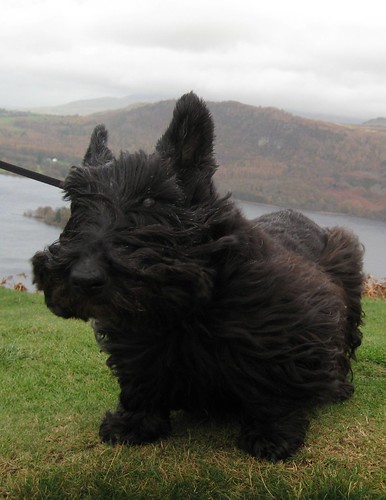
If you breed, say, two Scottie dogs together, you will get nothing but Scottie dogs. No retrievers. No dogs that look like wolves. No Labradors. Just little, yappy black dogs that look like they were pulled off of a flapper girl's skirt. They look like Scotties, walk like Scotties, and bark like Scotties. You're pretty damn sure that you have a family of Scottie dogs on your hands, with all the temperaments, quirks, and appearances of their parents.


Scotties can mate with any of those breeds mentioned above, as well as wolves. On a regular basis. With no decrease in fertility. In the 'wild,' i.e. the dog park. This compatibility is, in part, what makes Scotties their own breed rather than their own species. Even then, they would be a subspecies of the subspecies Canis lupus familiaris - yes, the domesticated dog is still a wolf, albeit a subspecies.

Here's why: Not only are dogs descended from wolves to begin with, but they can interbreed with ease, and the hybrid pups show no decrease in fertility. Any dog with any wolf in them within 5 generations is technically considered a wolfdog. The same is true with dingoes, another Canis lupus subspecies (which is technically a domestic dog turned feral). This is NOT true with coyotes, who not only have a premating barrier VS dogs, but whose bastard pups tend not to be very fertile. (I have heard conflicting info concerning coydogs in particular, but whatever the case, they don't do it very often.)


Yes, this is all about mating and survival of the fittest - just like Darwin's Origin of Species. There are, however, some differences between the selections that make a species and the selections that make a breed.

Let's look at the definition of 'breed' again, this time in PowerPoint form:

1. The animal in question has to be considered domesticated.
2. It has to look and behave differently from others of its species.
3. It has to breed true. I don't want a wolf in my litter of Scottie dogs.

Now, in greater detail:

1. Your mileage may vary on the term "domesticated." I have heard anything from 'has to be able to breed in captivity' to 'must be trainable and submissive (e.g. have some form of social hierarchy, allowing humans to be recognized as a 'leader')' to be considered domesticated.' In many cases, the domesticated form of a species differs greatly from, and sometimes replaces, the wild ancestor (as in the case of Bos taurus). For example, a Russian scientist bred silver fox (Vulpes vulpes) kits that were the least afraid of humans together; the results paralleled the changes that had occurred between C.lupus lupus and C. lupus familiaris.

2. This is really broad. For this, you need to find the 'wild-type'- i.e. the form and type most commonly found in the animal's natural habitat. Then, compare it with a captive specimen. Using out Scotties as an example again, let us put a Scottie alongside a gray wolf. The two look and act differently, but they would still be sexually compatible. There might be a size issue, but that would almost be like saying that a normal person can't make out with a dwarf.

3. When I breed Scottie dogs, I WILL get Scottie dogs. There was someone that I once met on my bike route who had lost a purebred Scottie in the past; she wanted nothing except another Scottie dog to fill the hole in her heart, even though it would cost a LOT more to purchase than a random shelter dog. The Scottie's personality, physical characteristics, and other differences from other dog breeds out there all had a hand in her decision. She knew how a Scottie dog would act, how big it would get, what it would look like, and how to take care of it. She could not have done this with any other dog, even though they are all Canis lupus familiaris. Even a Scottie cross would not do; breeding out cuts down the predictability of traits.

This is different from speciation on a number of levels. The definition of 'breed' is limited to domesticated animals - again, your mileage may vary on that term. Breeds are deliberately created for certain qualities, both physical and temperamental. They are substantially different from their wild counterparts, but not differentiated enough so as to prevent sexual compatibility.

I have been using Scotties thus far as an example of a 'breed.' It is a well-known breed with a decent amount of crosses, and has had good exposure in pop culture. I have had an experience in which someone wanted a Scottie and nothing else - a testament to its status as a true breed, not a mutt.

Let us look at a few things that are not breeds, and then at what makes a species a species and not a 'breed,' shall we?

Morphs are the traits most commonly mislabeled as 'breeds.' An albino animal is not that different from a wild-type member of the same species - it is a horse of a different color and nothing more or less.

As an example, Labradors can come in many colors (such as golden, chocolate and black, to name a few). These are all color morphs. In the wild, color morphs can vary with locality or be a simple recessive, dominant, or co-dominant trait. By definition, a morph must exist in the same wild population as at least one other morph.

In captive populations, when a morph deviates from a breed standard, as is the case with Holstein cattle, the morph may branch off into its own breed. It's pretty much a paint job most of the time.


Always putting the red folk down...

Although the Greek word 'morph' means 'form,' more often than not, the term is applied to some sort of color variation. In any case, the morph is usually one trait (although many traits are linked to some other trait, such as crossed eyes in white tigers). Breeds have many, many traits associated with them. That is why furred hairless dogs are still considered the same breed; there are other traits that make the breed. (Also, the heritability of hairlessness means that SOME furred puppies are inevitable.) Morphs can be one part of a breed, just like eggs are one ingredient in a cake.

Hybrids are also not, technically, breeds. I do not mean 'hybrids' like a Scottie-whatever mix; I mean mules, wolfdogs, coydogs, beefalo, zorses, ligers, jungle corn snakes (corn x king), Borneo Bateaters (retic x Burm), and other such crosses. Those are either species crosses or subspecies crosses. While they may have been induced in captivity (lions and tigers no longer share territory in the wild), they are still not breeds.


A Borneo Bateater, a fertile hybrid between Burmese and reticulated pythons. There is some debate over whether it is a natural intergrade or not...but DAMN if it isn't awesome!

Remember criterion 3: It has to breed true to be considered a breed. Some of those hybrids do not breed period, or have reduced fertility, mostly because of chromosomal differences. Even in hybrids that can breed, the abnormal ratio of parental DNA means that they will not necessarily look exactly like their parents, nor that their natures can be determined with consistency. Generally, hybrids are a one-time deal, and the results afterward are by no means steadfast. They are not themselves considered breeds, but can, like morphs, be grouped within breeds (e.g. German Shepherd x coyote).

Subspecies, although genetically compatible with other members of the species, are also not usually considered 'breeds.' Although they do breed true and differ sufficiently from other subspecies (there is never only one subspecies; the term is reserved for two or more), they are often not domesticated, and never seen as captive breeds. Unlike breeds, they are recognized as a scientific class due to their differences - for example, Morelia spilota cheynei VS Morelia spilota spilota.

A species refers to, again as per Wikipedia, "a group of organisms capable of interbreeding and producing fertile offspring." I would personally add "in their natural environment," or "frequently," but there is really not much to be said beyond that. Sure, there are DNA sequencing methods of determining species, but if you really want to debate whether Burmese and ball pythons are the same species or some such, just remember that they have different habits, live in COMPLETELY different environments, and only one is sold at Petco these days (with good reason).

AS OF RIGHT NOW, THERE ARE NO BREEDS OF SNAKE - JUST MORPHS, SPECIES, AND SUBSPECIES.

To be fair, the albino Burmese python (P. molurus bivitattus) is close to the 'breed' title. Not only are they sweet enough to cause diabetes, but they exhibit higher fertility than most other types of Burmese python, as well as having the 'calm white snake' demeanor that seems to be consistent throughout snake species (as seen in the video below).

Even unrelated snake species, such as corn snakes (Pantherophis guttatus/Elaphe guttata), have very docile albinos. The increased fecundity, however, is not consistent between different species. This is probably due to the albino Burm's nature as one of the first snake morphs on the market. (And why not? I'm not saying that EVERYBODY should have a giant pet snake, but Burmese pythons are impressive and docile. Even a wild-type Burmese python can be sweet as a kitten.)


In my reticulated python entry, I mentioned that retics were actually one of the better candidates for domestication (even by the strict definition - retics are the closest snakes have to ANYTHING with a social hierarchy). I also mentioned that Tiger retics seemed to be more docile than their wild-type counterparts. This is an excellent example of correlated traits - it does not seem like the retic has lost its intelligence or famous/notorious ability to recognize its owner, and has less of a temper than other morphs. People who own and handle retics well often get attached to them (and, to some degree, vice-versa).

Now, if only they didn't get 30 feet long as adults. Oh, wait, there are a few subspecies of dwarf retic from various little islands...that are hyper and aggressive. This correlation between small size and scrappy nature deters many a potential owner from getting a dwarf specimen. They're also more expensive than solid gold caviar, and that doesn't even exist. It will be a while before snakes develop genuine breeds, if ever.

Please, please, please do not get the terms 'breed' and 'species' mixed up! Although it may be comforting to think of all of nature as one big happy family, it is not. Burmese pythons are different from reticulated pythons, which are different from ball pythons. Not all squirrels are the same species. Cows do not only come in black and white; they come in a rainbow of shapes and a variety of sizes, and they are all the same species (be on the lookout for Bos taurus). Your macaw is not that closely related to your parakeet, even though they look like darn similar birds sometimes. If it is not 'domesticated,' it is not a breed.

With that said...On with the freak show.