Friday, July 23, 2010

Creature Feature: Butcherbirds.


Awww, isn't that the cutest little songbird that you've ever seen? It's a loggerhead shrike (Lanius ludovicianus). Instead of being flashy or having a pretty voice, the shrike attracts his mates with presents that he's hoarded.

These "presents" include dead animals that have been skewered on thorns, barbed wire, or anything else pointed. Their prey ranges from insects (including the lubber grasshopper, whose poison deteriorates after baking) to lizards, all skewered and waiting to be eaten. The genus of shrikes is, after all, called Lanius - Latin for "butcher." Check out how they hunt in Israel...and the end result!


They also like shiny things, but who cares?

Shrikes are not the only birds to utilize this technique. The real butcherbirds are the members of Cracticus, which resemble Australian magpies. Even its scientific name sounds, well..cracked. Look up any member of the genus and you find stuff like this:


These butcherbirds are native to Australia and Asia, which of course led to at least one pop culture reference:


From Devil Lady episode 15. Since the show is not only Japanese but also refers to crows, it is DEFINITELY talking about the Cracticus butcherbirds.

What? Nobody would ever do that for real because it is so darn twisted? Think again. Vlad the Impaler, a Romanian prince, was known for torturing people by leaving them to die on stakes. Most of you probably know about him via Bram Stoker's Dracula - the price's real last name.


He must have been a shrike in a past life, not a bat.

Thursday, July 22, 2010

Creature Feature: Sea Angel


(The video says it all.)


Many people do not immediately think "cute" whenever they see a slug. Sea angels (clade Gymnosomata), a type of shell-less marine snail, look adorable. They are found in frigid waters, also earning them the name "ice angel."

Instead of using a pseudopod to get around like most snails, their 'foot' has evolved into a pair of gelatinous wings. Aww.


Try and say no to those wings. That pudgy body. The reddish organs that resemble a heart. They look like something from a glass shop, only squishy.


If it's cute enough for Pokemon and Hello Kitty, it's cute enough for the rest of the world.


Then you see them eat. Yes, something this cute is a predator. It goes from a pixie to a Lovecraftian nightmare as soon as food (usually a sea snail) comes along. Check out Bogleech's page to see an animation! (Yeah, I admire Bogleech enough not to mooch from him.)

No wonder my friend's Manaphy kicked ass...

Wednesday, July 21, 2010

Creature Feature: Spotted Hyenas.

Well, that was the most vile "They Actually Eat That" I've ever done. It delayed my post about another scavenger with far more sanitary eating habits.

Hyenas (specifically the spotted hyena, Crocuta crocuta) are a fairly common animal to see in popular culture. They are most often set against lions as an 'evil dog' of sorts and/or used for comedic effect. There is some truth in this; lions and hyenas do indeed hate each other, with hyenas going so far as to kill lion cubs on a regular basis.

Besides their rivalry with lions, hyenas are known for their whooping calls resembling human laughter. These calls are just as multifaceted as bird songs, telling the age, mood, and social standing of any hyena in question. Unlike wolves, which howl in unison to show their strength as a pack, hyenas will call alone. It's almost language! (Thanks a lot, Noam Chomsky...stunting the field of animal language studies...)

Nearly all cartoons fail to tell you that hyenas are not related to dogs. They are more closely related to cats and mongooses, even if they do have some features that make them seem canine. They are also adept hunters, relying on keen vision as opposed to scent or hearing. (This is not as true for other hyena species - spotted hyenas have special teeth designed for both scavenging and hunting. Other hyenas do not.)


Not particular to EITHER common branch of carnivora is the hyena's unique social system, which largely derives its rules from the female's dick.

Wait. What?

Female hyenas have an enlarged clitoris, which looks an AWFUL lot like a penis. They urinate, screw, and give birth through this pseudo-penis. They are also one of the few mammals in which the female is larger than the male (and rightfully so, given that their babies are the biggest relative to the mother). This makes mating considerably more difficult, but also gives the female more choosing power in the process. (It also looks really awkward when they do it, but look that up on your own.)


Yes, that is a FEMALE hyena. Imagine giving birth through that!

Spotted hyena clans are matriarchal, and function a lot more like primate clans than wolf packs or lion prides. Hyenas among the most intelligent carnivorids, outperforming chimpanzees on problem-solving tests.


The real test: Can they outperform THIS chimpanzee?

"They Actually Eat That:" Roadkill.


America has really low food standards. We don't know half the crap that's in our Big Macs, hot dogs, cheese, or even vegetables. All we do is pick unwittingly pick up said crap at the grocery store, fast food joints, and so on. High class restaurants are not exempt; they cut corners, too.

Some Americans actually choose to eat crap. I am not talking about 2Girls1Cup. (Don't look that up if you do not already know what it is, by the way.)

America is covered by a network of highways, which in turn supports a huge car industry (that people sweat buckets about in this economy). These highways run along forests, fields, and farms. This proximity to nature does make for awesome road trips, but also leads to many, many animals getting killed by traffic.

They actually eat that?!

Yep. Once an animal is killed, its meat has to be scraped off the road and taken to some place where people know how to cook it. There are a number of roadkill cafes, and a fair amount of individuals cook roadkill in their own homes.


(If Britain took it over, it has roadkill cafes. Russia uses roadkill in stew as well.)

Some roadkill chefs even lure animals with treats just to turn them into roadkill; you may as well shoot them at that point. The main difference is that EVERYONE owns a car, but only some people own guns.

Of all the weird foods I have looked at so far, this is the one that makes me go "why?" the most. OK, so the meat is leaner if it comes from a wild animal...but that does not change that it was not only run over by a car carrying GODDESS KNOWS WHAT kind of dirt on its wheels, could be full of worms and nasty bacteria, and...need I say anything more? There are reasons why roadkill cuisine has such precise cooking directions.

The sad thing is, it's probably cleaner than anything at an American McDonald's. That is how low the food standards are in the U.S. Roadkill is better for you than almost anything you will find at a given fast food joint...but be careful how you cook it.

(Sorry about the lack of pictures in this week's entry, by the way. Roadkill is not visually interesting at all - more often than not, as in the video, roadkill gets chopped into some miscellaneous stew, deep-fried, or is otherwise made indistinguishable as roadkill.)

Tuesday, July 20, 2010

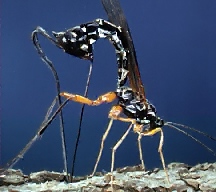
Creature Feature: Ichneumoninae.

Although many vertebrates may take on the pattern of "big, impressive male, small female," insects tend to see the world a bit differently. Many of you have probably heard of the praying mantis eating the male after mating (which, again, makes PERFECT sense to me), and of ant/bee queens. Sexual dimorphism in favor of the female is not a hard and fast rule for insects, but seems to be pretty solid in the order Hymenoptera - the order containing ants, bees, wasps, sawflies, and hornets.

This brings us to ichneumonoid wasps. If you thought the reproductive system from the Alien movies was weird, bear in mind that the Xenomorph's way of doin' it was based LARGELY on this particular sort of insect (with later nods to eusociality).

If the earlier entry on botflies did not tip you off, chest-bursters are very, very real in the cruel world of nature. There are a number of ways that they can theoretically happen, but, in the case of ichneumon wasps, they deposit the eggs via a whip.


"If I be waspish, best beware my sting..." Yeah, I'm sure I butchered that Shakespeare quote, but stingers ARE derived from ovipositors. Way to lace an extra innuendo in there, Bard.

The females of Megarhyssa and Rhyssa in particular are equipped with slender, narrow ovipositors (tubes for depositing eggs). Although many insects have ovipositors of some sort, ichneumon wasps have ovipositors that curl over like scorpion tails. This has given them the nickname of "scorpion wasps."


Why does the female need such a long ovipositor? Ichneumonoid wasps lay their eggs inside other insect larvae. The infected larvae are, slowly but surely, eaten alive.


Despite their creepy appearance and alien reproductive habits, these wasps are quite efficient at pest reduction (like the giant hornets are). They also use polydnaviruses to suppress the host's immune response, which is more than can be said for the Xenomorphs.


Just pest control. Nothing personal.

Sunday, July 18, 2010

Creature Feature: Indian Muntjac.

Some of you are probably wondering why I have never done any deer on this blog. Their mating displays are at least as impressive as those of the pretty male birds I keep showcasing, right? Hell, the Irish Elk supposedly went extinct because of its huge, elaborate antlers!


THAT is a nice rack!

"Females are sad, males are AWESOME" is not restricted to birds. It is a lame, repetitive formula that one can easily get bored of, but common in nature that it is almost impossible to avoid. Many lizards, mammals, and insects also use this formula. Birds just so happen to be my forte, and, unlike deer, are spread across many genera.

In mammals, the difference between sexes tends to be greater than that in other classes. Not only are the females less elaborate, but, due to CRAZY mammalian sexual dimorphism, are usually smaller (even though they have to bear live young and provide them with nutrients...why?). I will have to look up exactly why the size difference exists sometime. All I know is that it bites worse for mammalian females than avian ones.

This deer is no exception to that rule...but, evidently, female deer have the same taste as female humans do in vampires.


(It burned my eyes just to Google this.)

The Indian muntjac (Muntiacus muntjak), also known as the barking deer, is native to pretty much all areas of South Asia. It is one of the oldest known species of deer, and among the first to evolve antlers.


Child of Baphomet, or reminder of a time long past? You decide.

The male of the species has unusual headgear to show for this change. His are stacked on top of bony nubs, making him look...well...demonic.


Of course, any mammal looks demonic when it is not covered in fur.

They also have fangs. Tusks my ass; they may not have venom, but they certainly do NOT look like the tusks of swine, elephants, or anything else besides other primitive deer. Those teeth are not just for show; male muntjacs fight with them. They are not used to suck blood, even if they really, really look the part.


I vant to kick your ass!

That's not all. Muntjacs are also called "barking deer." Yes, in order to warn other deer, a muntjac barks. As in, "woof woof." Why choose between vampire and werewolf? This little deer can play both!


Screw Edward and Jacob. I'm on Team Muntjac.

Creature Feature: Last Lizard - Jesus Christ.

Yes, you read that title right. There is nothing in the Bible that says Jesus Christ was not a lizard. Lizards can regenerate faster than people can, walk on walls, give virgin birth, and have awesome color-changing skin. That list alone grants lizards divine being potential.


David Icke would have a field day.

They can also walk on water.


There are a number of species in the genus Basiliscus, a group called "Jesus Christ lizards" because of their ability to run on water. To be perfectly fair, they are also called "Mystic Lizards" and "Devil's Lizards," but those did not go over as well.

Although the generic name denotes a highly toxic 'king of reptiles' that can turn people to stone with its gaze and poisons flowers with its breath, the real lizards are harmless (unless you are an insect). They are fairly big at a meter from head to tail, and range from Mexico down to Panama.


(This is actually my favorite lizard of all! I love its colors, its eyes, its ability to walk on water...AND its spinal ridge!

The basilisk walks on water using slight webs on its feet to create air pockets. Its long tail helps it balance on its hind legs as it makes a mad dash across the surface of the water. A basilisk can walk on water for up to 14.8 feet before needing to swim.


Water-walking aside, basilisks look like little dinosaurs (especially the plumed basilisk, B. plumifrons)! What a way to end Lizard Week; there will be a really weird mammal tomorrow. Praise Raptor Jesus!


Eh, close enough. :D Someone needs to make a Jesus Lizard joke like this...